The post Web Design Website Company: Choose The Best Partner first appeared on Thought Media™.
]]>A website is often the first place potential customers evaluate your business. They may compare your design, messaging, services, credibility, portfolio, reviews, pricing guidance, and contact options before deciding whether to reach out.
That means your website has to do more than look professional.
It needs to communicate clearly, load quickly, work on mobile devices, support SEO, guide visitors toward action, and give your business room to grow.
Choosing The Right Web Design Website Company
A strong web design website company should help with strategy, design, development, content structure, search visibility, performance, security, hosting, maintenance, and long-term support.
 The right partner can help your website look credible.
The right partner can help your website rank and convert.
The right partner can connect design with business goals.
 The wrong partner may deliver a website that looks fine but fails to perform.
What Is A Web Design Website Company?
A web design website company is a professional company that helps businesses plan, design, build, launch, and improve websites. Depending on the company, services may include website strategy, UX design, UI design, website development, WordPress website design, ecommerce web development, SEO, hosting, maintenance, and digital marketing support.
The best web design companies do not only create pages. They help build a digital foundation for the business.
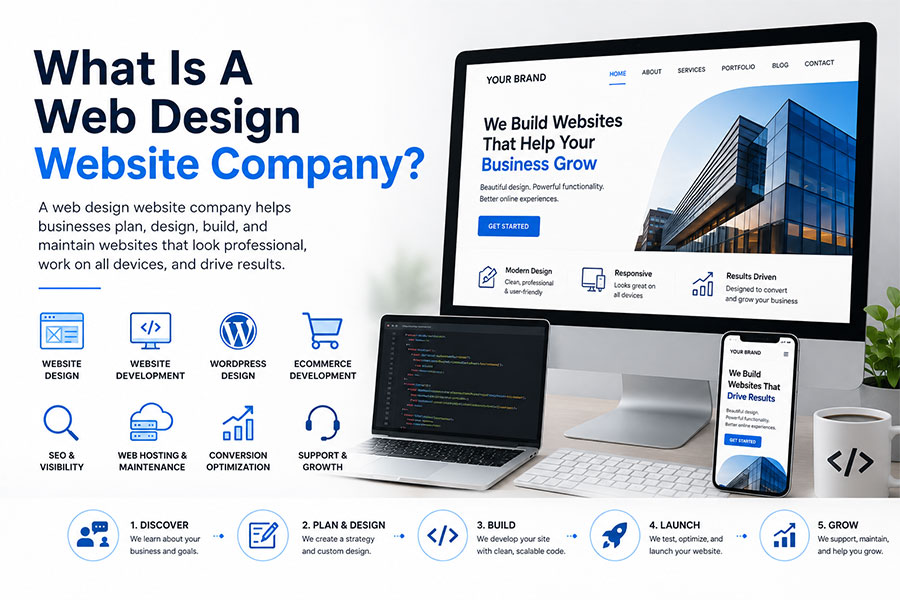
A web design website company may help with:
Website planning
Custom website design
Website development
WordPress website design
Ecommerce web development
Landing page design
Website redesigns
Search engine optimization
Content structure
Website hosting
Website maintenance
Analytics and conversion tracking
Thought Media’s website design services are built around this broader approach, connecting professional design with usability, performance, SEO, development, and long-term digital growth.
Why Choosing The Best Partner Matters
Many businesses underestimate how much a website can influence growth. A website can affect brand perception, search rankings, lead quality, conversion rates, sales conversations, customer trust, recruiting, and even investor or stakeholder confidence.
A weak website may create problems such as:
Confusing navigation
Outdated visuals
Slow loading pages
Poor mobile experience
Weak service pages
No SEO structure
No clear call to action
Low-quality leads
Security or hosting issues
Difficult content updates
A strong website can do the opposite. It can make your business easier to understand, easier to trust, and easier to contact.
The best partner should help you think beyond the design itself. They should ask what the website needs to accomplish and how each part of the site supports that goal.
Web Design Company vs. Website Builder
Some businesses compare hiring a web design company with using a website builder. A website builder can be useful for simple websites, temporary pages, or very small projects. However, a growing business often needs more strategy, customization, SEO, and support.
| Category | Web Design Website Company | Website Builder |
|---|---|---|
| Strategy | Plans the website around business goals, audience needs, services, SEO, and conversions | Usually depends on templates and user decisions |
| Design | Can create a custom design aligned with your brand and customer journey | Usually template-based with limited customization |
| SEO | Can plan technical SEO, content structure, metadata, internal links, and schema | May include basic SEO settings but limited strategy |
| Development | Can support custom functionality, integrations, ecommerce, and scalable architecture | May be limited by platform features |
| Support | Can provide maintenance, hosting, troubleshooting, updates, and long-term improvements | Support is usually platform-based and may not solve business-specific needs |
| Best Fit | Business websites, custom websites, ecommerce, enterprise websites, and growth-focused redesigns | Simple websites, prototypes, temporary pages, and very small projects |
The right choice depends on how important the website is to your business. If your site needs to generate leads, support sales, rank in search, process ecommerce transactions, or represent a serious brand, a professional company is usually the stronger choice.
What Services Should A Web Design Website Company Offer?
A strong web design website company should offer more than a one-page design package. Professional websites often need strategy, design, development, SEO, hosting, maintenance, and support working together.
Important services may include:
Website discovery and planning
Sitemap development
UX and UI design
Custom website design
Website development
WordPress website design
Ecommerce web development
Search engine optimization
Content structure
Conversion optimization
Analytics setup
Managed website hosting
Website maintenance and support
If the company only talks about visuals and does not discuss website structure, SEO, mobile performance, speed, content, conversions, or support, the project may not be complete enough for long-term business use.
How To Choose The Best Web Design Website Company
Choosing the best partner starts with understanding what your website needs to accomplish.
Before comparing companies, clarify:
What is the main goal of the website?
Who is the target audience?
What services or products need the most visibility?
Does the site need to generate leads, bookings, sales, or inquiries?
Does the website need ecommerce?
Does the website need custom functionality?
Does the site need SEO or AEO?
Who will maintain the site after launch?
Once you understand your needs, evaluate potential companies based on process, portfolio, technical ability, SEO knowledge, communication, and long-term support.
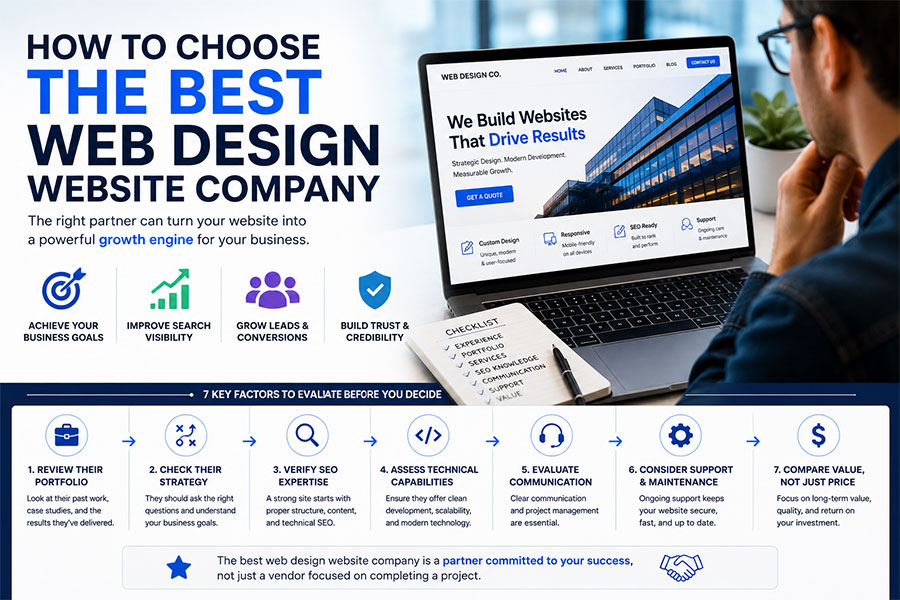
1. Review Their Website Design Portfolio
A web design company’s portfolio shows how it thinks, designs, and solves problems. Look beyond whether the screenshots look attractive. Pay attention to the types of businesses served, the quality of layouts, the range of styles, and whether the work feels strategic.
When reviewing a portfolio, ask:
Do the websites look professional?
Are the designs custom or repetitive?
Do the examples match the level of quality you need?
Are different industries represented?
Do the websites appear easy to use?
Are there case studies explaining the project goals?
Does the work show business thinking, not only design style?
A strong portfolio should make you more confident in the company’s ability to understand your brand and build something appropriate for your audience.
2. Look For Strategy Before Design
The best web design companies do not begin with colors and layouts. They begin with strategy.
A strategic website process should consider:
Business goals
Audience needs
Competitor positioning
Brand messaging
Service structure
Search visibility
Conversion paths
Content needs
Technical requirements
Without strategy, a website may look good but fail to communicate clearly or generate results. A strong web design website company should ask about your business, customers, sales process, growth goals, and what the site needs to achieve.
3. Make Sure They Understand SEO
SEO should not be treated as something separate from web design. Search engine optimization should influence how the website is structured, written, developed, and launched.
An SEO-aware website should include:
Clear page hierarchy
Service-specific pages
Proper headings
Metadata
Internal links
Fast loading pages
Mobile-friendly design
Optimized images
Schema markup
Crawlable content
If SEO is ignored during the design process, the website may need expensive changes later.
Thought Media’s search engine optimization services help ensure websites are structured for visibility, clarity, and long-term search performance.
4. Check Their Website Development Capabilities
Design and development are connected, but they are not the same. A design may look polished in a mockup, but the website still needs to be built properly.
Professional website development may include:
Clean front-end development
CMS setup
WordPress development
Ecommerce development
Custom functionality
API integrations
Form setup
Performance optimization
Security considerations
Testing and launch support
A company with strong website development capabilities can help ensure the final site is not only visually strong but also stable, scalable, and easier to manage.
5. Ask About WordPress Website Design
WordPress is one of the most widely used platforms for business websites because it supports content management, blogging, service pages, landing pages, plugins, SEO tools, and flexible site structures.
A professional WordPress website design process may include:
Custom design
Theme development or customization
Page builder setup where appropriate
Plugin selection
Security configuration
Speed optimization
SEO setup
Content editing access
Training or documentation
Thought Media provides WordPress website design for businesses that need professional websites with flexible content management and long-term scalability.
6. Consider Ecommerce Web Development Experience
If your business sells products, services, memberships, bookings, or digital goods online, ecommerce experience matters. Ecommerce websites are more complex than standard business websites because they involve product structure, checkout, payments, taxes, shipping, promotions, analytics, and conversion flow.
A strong ecommerce partner should understand:
Product page structure
Category pages
Cart and checkout flow
Payment gateways
Shipping rules
Tax configuration
Product SEO
Mobile shopping
Conversion optimization
Analytics tracking
Thought Media’s ecommerce web development services help businesses plan and build online stores that are structured for usability, performance, search visibility, and sales.
7. Evaluate Their Content And Messaging Support
Many website projects struggle because the design is ready before the content is clear. A strong web design website company should help organize content, even if your team provides the final copy.
Content support may include:
Page outlines
Service page structure
Homepage messaging
Calls to action
FAQ sections
SEO content guidance
Conversion-focused copy structure
Content migration planning
Your website should explain what you do in a way that customers can understand quickly. Good content structure helps visitors navigate the site and helps search engines understand page topics.
8. Ask About AEO And AI Search Readiness
Search is changing. Customers are increasingly using AI summaries, answer engines, and conversational search tools to research companies and compare services.
AEO, or Answer Engine Optimization, helps structure website content so it is easier for search engines and AI systems to understand, summarize, and reference.
An AEO-ready website may include:
Clear definitions
Direct answers
FAQ sections
Structured headings
Schema markup
Helpful service explanations
Comparison tables
Internal links
Strong entity clarity
Thought Media’s Answer Engine Optimization services help businesses prepare content for modern search experiences where AI and traditional search increasingly overlap.
9. Make Sure Hosting And Maintenance Are Covered
A website needs support after launch. Without maintenance, a website can become slow, outdated, insecure, or broken.
Post-launch support may include:
Managed website hosting
SSL security
Backups
CMS updates
Plugin updates
Security monitoring
Speed optimization
Uptime monitoring
Technical support
Content updates
Thought Media provides managed website hosting and website maintenance and support for businesses that need reliable website performance beyond the initial launch.
10. Compare Communication And Project Management
A website project depends on communication. Even a talented design team can create frustration if the process is unclear.
Before hiring a web design website company, ask how the project will be managed.
Important communication details include:
Who is the main point of contact?
How often will updates be provided?
What feedback process is used?
How are revisions handled?
What happens if the scope changes?
How are deadlines managed?
What is needed from your team?
How is launch coordinated?
A good partner should make the process feel organized and predictable.
Questions To Ask Before Hiring A Web Design Website Company
Before choosing a partner, ask questions that reveal process, capability, and long-term fit.
Important questions include:
Do you provide custom website design?
Do you handle website development in-house?
Do you build WordPress websites?
Do you provide ecommerce web development?
Do you include SEO planning?
Do you help with content structure?
Do you provide hosting and maintenance?
Will we own the website after launch?
What is included in the quote?
How many revisions are included?
What happens after launch?
Can you support future improvements?
The answers will help you compare companies beyond price alone.
Red Flags To Watch For
Not every web design provider is a strong long-term partner. Watch for red flags that suggest the company may not be strategic or transparent enough.
No discovery process
No clear project scope
No portfolio examples
No SEO discussion
No mobile strategy
No mention of website speed
No content guidance
No ownership clarity
No maintenance plan
No analytics setup
No clear communication process
A website project should not feel vague. A strong company should be able to explain what is included, what is not included, what the timeline looks like, and how the final website will support your business.
How Much Does A Web Design Website Company Cost?
The cost of hiring a web design website company depends on the size of the site, complexity of the design, number of pages, content needs, SEO requirements, ecommerce functionality, integrations, custom development, timeline, and ongoing support.
| Website Type | Typical Scope | Best Fit |
|---|---|---|
| Basic Business Website | Core pages, contact form, mobile layout, basic setup, and simple service information | Small businesses, startups, local service providers, and simple brochure sites |
| Custom Business Website | Custom design, service pages, SEO structure, content planning, conversion paths, and professional development | Growing companies, professional services, B2B firms, and competitive businesses |
| Ecommerce Website | Product pages, categories, cart, checkout, payments, shipping, tax setup, analytics, and product SEO | Retailers, product brands, online stores, and businesses selling online |
| Enterprise Website | Advanced architecture, stakeholder workflows, integrations, governance, security, and scalable content systems | Larger companies, organizations, public sector teams, and multi-location brands |
| Custom Web Application | Portals, dashboards, databases, APIs, user accounts, workflows, and custom functionality | SaaS products, internal systems, marketplaces, and complex digital platforms |
The lowest quote may not be the best value. A cheap website can become expensive if it needs to be rebuilt, fails to rank, loads slowly, or does not generate leads.
Why The Best Partner Thinks Beyond Launch
A website should improve over time. After launch, your business may need new service pages, SEO updates, landing pages, content improvements, speed optimization, analytics review, security updates, design refinements, or conversion testing.
A long-term web design partner can help with:
Website maintenance
Search engine optimization
Landing page creation
Content updates
Analytics review
Performance improvements
Conversion optimization
Ecommerce improvements
New features
Ongoing digital marketing
This matters because a website is not a one-time asset. It is part of your digital business infrastructure.
Where Thought Media Fits
Thought Media helps businesses, enterprises, government organizations, NGOs, and public sector teams build websites and digital platforms that support growth, visibility, credibility, and performance.
Our services include website design, website development, WordPress website design, ecommerce web development, application development, SEO, AEO, digital marketing, managed hosting, website maintenance, video animation, IT services, hardware solutions, and custom AI development.
For businesses choosing a web design website company, the best partner should understand how design, development, content, SEO, hosting, and long-term support work together.
Final Thoughts
Choosing the best web design website company is not only about finding someone who can make your site look good. It is about finding a partner that understands your business goals, audience, content, SEO, technical needs, and long-term growth.
The right partner should help you build a website that is professional, clear, fast, mobile-friendly, search-ready, easy to manage, and built to support real business outcomes.
Before hiring a company, review its portfolio, ask about strategy, confirm SEO and development capabilities, understand what is included, and make sure there is a plan for support after launch.
A strong website should not only represent your business. It should help your business grow.
FAQ
What is a web design website company?
A web design website company is a professional company that plans, designs, develops, launches, and improves websites for businesses. Services may include custom website design, website development, WordPress website design, ecommerce web development, SEO, hosting, maintenance, and digital marketing support.
How do I choose the best web design website company?
Choose the best web design website company by reviewing its portfolio, process, SEO knowledge, development capability, communication, pricing clarity, support options, and ability to align the website with your business goals.
What should a web design company include in a website project?
A web design company should usually include discovery, sitemap planning, UX and UI design, website development, mobile-responsive design, basic SEO structure, content guidance, forms or conversion paths, testing, launch support, and maintenance options.
Is a web design company better than a website builder?
A web design company is usually better when the website needs custom design, SEO strategy, professional development, ecommerce functionality, integrations, lead generation, or long-term support. A website builder may be enough for a very simple or temporary website.
Should a web design company understand SEO?
Yes. A web design company should understand SEO because website structure, headings, content, speed, mobile usability, metadata, internal links, and schema can all affect search visibility.
Do I need WordPress website design?
WordPress website design may be a good choice if your business needs a flexible content management system, service pages, blog content, SEO tools, landing pages, and the ability to update content over time.
Can a web design company build ecommerce websites?
Yes. Many web design companies provide ecommerce web development, including product pages, categories, checkout, payment setup, shipping rules, tax configuration, product SEO, mobile shopping, analytics, and conversion optimization.
How much does a web design website company cost?
The cost depends on website size, design complexity, page count, content needs, SEO scope, ecommerce functionality, custom development, integrations, timeline, and ongoing support. A custom business website or ecommerce site usually costs more than a basic brochure website.
Does a website need maintenance after launch?
Yes. Websites need maintenance to stay secure, updated, fast, and functional. Maintenance may include backups, CMS updates, plugin updates, security monitoring, performance optimization, content updates, and technical support.
Can Thought Media help as a web design website company?
Yes. Thought Media provides website design, website development, WordPress website design, ecommerce web development, application development, SEO, AEO, digital marketing, managed hosting, website maintenance, video animation, IT services, hardware solutions, and custom AI development.
The post Web Design Website Company: Choose The Best Partner first appeared on Thought Media™.
]]>The post Web Designing Company Sites: The Best Website Examples first appeared on Thought Media™.
]]>When businesses search for a web designing company website, they are usually looking for examples, inspiration, or a company they can hire. That means the website itself has to prove the company’s ability before a visitor ever speaks with a sales representative.
What The Best Web Designing Company Sites Have In Common
A strong web design company site should make the answer clear:
What does the company do?
Who does it help?
What types of websites does it build?
What makes its process different?
Can the company support SEO, development, hosting, and long-term growth?
Is there proof of quality, strategy, and experience?
The best examples combine design quality, clear messaging, strong service structure, conversion-focused layouts, mobile performance, and useful content. A beautiful website is only part of the equation. The site also needs to help visitors understand the company, trust the team, and take the next step.
What Is A Web Designing Company Website?
A web designing company website is the online presence of a business that provides website design, website development, user experience design, WordPress design, ecommerce development, landing page design, and related digital services.
Unlike a simple brochure site, a web design company’s website has to act as proof of its own capability.
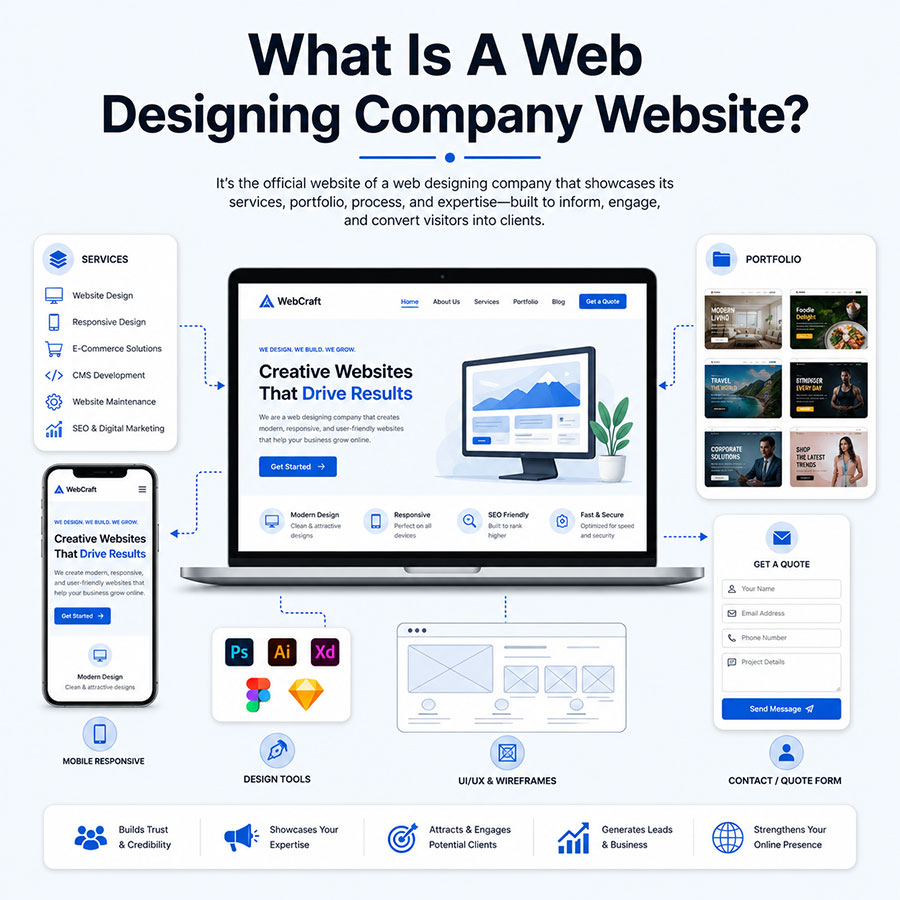
It should demonstrate:
Design quality
Technical skill
Clear service positioning
Industry understanding
Strong user experience
Mobile-friendly layouts
SEO knowledge
Conversion strategy
Professional credibility
Thought Media’s website design services are built around this broader standard, where design is connected to usability, content structure, development, search visibility, and business outcomes.
Why Businesses Search For Web Designing Company Sites
Businesses often search for web designing company sites when they are trying to compare agencies, gather ideas, evaluate design quality, or understand what a professional website project should include.
They may be asking questions such as:
What does a good web design agency website look like?
What should a web designing company website include?
How do web design companies present their services?
What website examples should we use for inspiration?
How do we choose a web design company?
What makes one agency website better than another?
This type of search has both inspiration intent and buyer intent. Some users want examples. Others are actively looking for a company to hire. The best web design company websites serve both groups by showing strong design while also explaining services clearly.
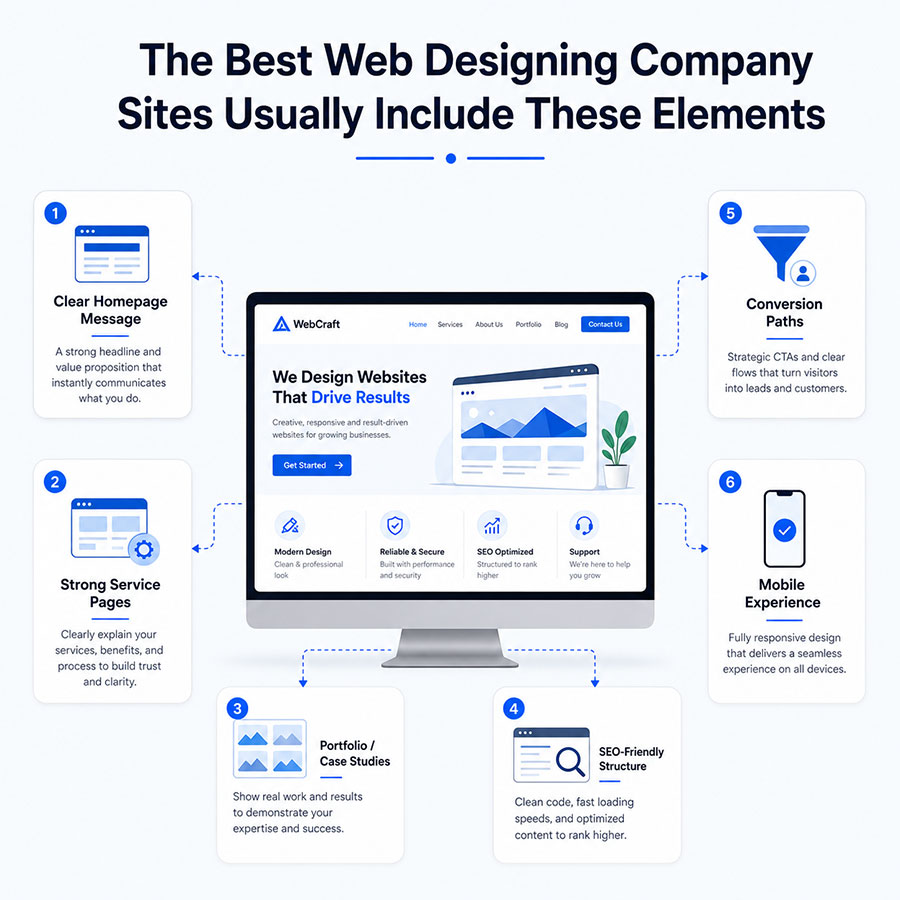
The Best Web Designing Company Sites Usually Include These Elements
| Website Element | Why It Matters | What To Look For |
|---|---|---|
| Clear Homepage Message | Visitors need to understand the company quickly | A clear headline, service focus, audience fit, and call to action |
| Strong Service Pages | Service pages help visitors understand what the company offers | Pages for web design, development, WordPress, ecommerce, SEO, and support |
| Portfolio Or Case Studies | Examples build confidence and show capability | Project images, goals, outcomes, industries, and problem-solving details |
| SEO-Friendly Structure | The site should be built to rank and be understood by search engines | Proper headings, internal links, metadata, schema, and helpful content |
| Conversion Paths | The site should guide visitors toward action | Contact buttons, quote forms, consultation CTAs, and clear next steps |
| Mobile Experience | Many visitors compare companies from mobile devices | Responsive layout, fast loading, readable text, and tap-friendly buttons |
1. Clear Homepage Positioning
The homepage is one of the most important parts of any web designing company website. It should quickly explain what the company does and why a visitor should care.
A weak homepage may use vague phrases such as “creative digital solutions” without explaining the actual service. A stronger homepage is more specific. It tells visitors whether the company builds business websites, ecommerce websites, WordPress sites, enterprise platforms, landing pages, custom applications, or complete digital experiences.
Strong homepage positioning should include:
A clear headline
A short explanation of services
A specific audience or business fit
A visible call to action
Trust signals
Visual proof of design quality
Links to important services
The best web designing company sites avoid making visitors guess. They make the company’s value easy to understand within seconds.
2. Professional Visual Design
Visual design matters because the website itself is the company’s best sales example. If a web design company’s own website feels outdated, cluttered, slow, or confusing, potential clients may question whether the company can build a better site for them.
Strong visual design usually includes:
Clean layouts
Consistent typography
Balanced spacing
Professional color systems
High-quality graphics or imagery
Clear visual hierarchy
Easy-to-read sections
Modern but usable design choices
The goal is not to make the site overly complicated. The goal is to make the company look credible, thoughtful, and capable.
Good design should support clarity. If the design distracts from the message or makes the site harder to use, it is not doing its job.
3. Strong Web Design Service Pages
The best web designing company sites usually have dedicated service pages instead of placing every service on one short page. This helps both users and search engines understand what the company offers.
Useful service pages may include:
Website design
Website development
WordPress website design
Ecommerce web development
Landing page design
Website redesign
Search engine optimization
Website maintenance
Managed website hosting
Application development
Each service page should explain the service, who it is for, what is included, what problems it solves, and how a business can get started.
For companies that need more than design, website development is especially important because custom functionality, integrations, performance, and scalability often determine how useful the final website becomes.
4. Portfolio Examples And Case Studies
Portfolio examples are one of the most important parts of a web designing company website. Visitors want to see proof that the company can create professional work.
However, screenshots alone are not always enough.
The best portfolio sections explain:
The client or industry
The project goal
The design challenge
The solution
The services provided
The platform or technology used
The business outcome where available
A strong case study tells a story. It helps visitors understand how the company thinks, not only how the final website looks.
For example, a website redesign case study may explain how the agency improved navigation, clarified services, rebuilt content structure, improved mobile performance, added SEO foundations, and created stronger conversion paths.
5. SEO-Friendly Website Structure
The best web designing company sites are usually built with SEO in mind. A web design company should not only know how to create attractive pages. It should understand how search engines crawl, interpret, and rank website content.
SEO-friendly structure may include:
Clear URLs
Proper heading hierarchy
Helpful service pages
Internal links
Fast page loading
Mobile-friendly layouts
Image optimization
Schema markup
Metadata
FAQ sections
Content that matches search intent
This matters because many companies hiring a web design agency also want the new website to generate organic traffic. If SEO is ignored during design, the business may need to fix the website later.
Thought Media’s search engine optimization services help connect website structure, content, technical performance, and search visibility from the beginning.
6. Mobile-Friendly Design
Every strong web designing company website should work properly on mobile devices. Many business owners, executives, marketers, and buyers compare agencies from phones or tablets before returning later on desktop.
A strong mobile experience should include:
Fast loading
Easy navigation
Readable text
Tap-friendly buttons
Simple contact forms
Proper spacing
Clear service information
No broken layouts
Mobile design is not just a technical checkbox. It affects user experience, trust, and conversion rates.
If a web design company’s own website does not work well on mobile, that should raise questions about the quality of its process.
7. Clear Calls To Action
The best web designing company sites guide visitors toward the next step. A visitor should not have to search for a way to contact the company, request a quote, book a consultation, or view services.
Strong calls to action may include:
Request a quote
Book a consultation
View our work
Explore services
Contact our team
Start your project
Calls to action should appear naturally throughout the page, especially after important sections. The best CTAs feel helpful rather than pushy.
A web design company website should also reduce friction by making forms simple, contact details easy to find, and next steps clear.
8. Trust Signals And Credibility
Trust is a major factor when choosing a web design company. A business may be investing thousands or tens of thousands of dollars into a website project, so the website needs to show that the company is credible.
Useful trust signals include:
Years in business
Client logos
Testimonials
Case studies
Industry experience
Team information
Office locations
Certifications
Awards
Clear terms or process details
Trust signals should feel authentic. Overloaded badges or generic claims can look forced if they are not supported by real information.
9. Website Speed And Performance
Website speed matters for user experience and SEO. If a web design company website loads slowly, visitors may leave before viewing the portfolio or services.
Strong website performance should include:
Fast page loading
Optimized images
Clean code
Reliable hosting
Proper caching
Mobile performance
Stable layouts
Minimal unnecessary scripts
Businesses comparing web design companies should pay attention to how the agency’s own site performs. If the company cannot maintain its own website experience, it may struggle to maintain client websites as well.
Performance also depends on infrastructure. That is why managed website hosting and ongoing optimization can be important after launch.
10. Content That Answers Buyer Questions
The best web designing company sites do not rely only on visuals. They also include helpful content that answers real buyer questions.
Useful content may explain:
How much websites cost
How long projects take
What is included in the process
How revisions work
What platforms are supported
Whether SEO is included
How hosting works
What happens after launch
How to choose a web design company
This kind of content helps users make decisions and improves AEO because answer-focused content is easier for search engines and AI systems to understand.
For companies preparing for modern search, Answer Engine Optimization can help structure content with clearer definitions, direct answers, FAQs, schema, and comparison sections.
Web Designing Company Sites: Best Website Example Categories
When looking for the best website examples, it helps to compare different types of web design company sites. Not every company should present itself the same way.
| Example Type | Best For | What Makes It Strong |
|---|---|---|
| Portfolio-Driven Agency Site | Creative studios and design-focused agencies | Strong visuals, project examples, case studies, and creative direction |
| SEO-Focused Web Design Site | Businesses that want visibility and lead generation | Service pages, SEO content, local pages, strong structure, and conversion paths |
| Enterprise Web Development Site | Larger organizations and complex projects | Technical capability, integrations, security, scalability, and process depth |
| Ecommerce Web Design Site | Product brands and online retailers | Product strategy, checkout optimization, platform experience, and conversion focus |
| Full-Service Digital Agency Site | Companies needing design, SEO, ads, hosting, and marketing together | Connected services, clear packages, strategy, reporting, and long-term support |
How To Evaluate A Web Designing Company Website
When reviewing web designing company sites, look beyond the first impression. A site can look modern but still lack strategy, depth, or technical quality.
Use this checklist:
Is the homepage clear?
Are services easy to understand?
Does the company show real work?
Are case studies detailed?
Is the site mobile-friendly?
Does it load quickly?
Are calls to action easy to find?
Does the site explain pricing, process, or timelines?
Does it include SEO-friendly content?
Does it answer buyer questions?
Does it show trust signals?
Does it feel custom or generic?
A strong agency website should make you feel more confident, not more confused.
Common Mistakes On Web Designing Company Sites
Even some web design company websites make mistakes that weaken trust and performance.
Common issues include:
Vague messaging
Too much animation with little substance
Poor mobile usability
Slow loading pages
No clear service pages
Weak portfolio details
No SEO structure
No pricing or project guidance
No clear calls to action
Generic stock imagery
Overly technical language
No maintenance or support information
A web designing company website should not only impress visitors. It should help them make a decision.
What Should A Web Design Company Site Prove?
A strong website should prove that the company understands both design and business.
It should show that the company can:
Create professional visual design
Organize information clearly
Build responsive layouts
Support search visibility
Improve conversions
Communicate services clearly
Explain its process
Maintain websites after launch
Support future growth
The best web designing company sites do not rely on one impressive homepage. They build confidence across every page.
Where Thought Media Fits
Thought Media helps businesses, enterprises, government organizations, NGOs, and public sector teams create websites and digital platforms that support visibility, credibility, performance, and long-term growth.
Our services include website design, website development, WordPress website design, ecommerce web development, application development, SEO, AEO, digital marketing, managed hosting, website maintenance, video animation, IT services, hardware solutions, and custom AI development.
For businesses comparing web designing company sites, the most important lesson is simple: a strong website should combine design quality with strategy, performance, search visibility, and support.
Final Thoughts
The best web designing company sites are not only visually impressive. They are clear, useful, credible, fast, mobile-friendly, SEO-aware, and conversion-focused.
When reviewing website examples, look for more than style. Look for structure, strategy, service clarity, portfolio depth, trust signals, content quality, technical performance, and clear next steps.
A great web designing company website should make it easier for businesses to understand what the company does, why it matters, and how to start a project.
If a web design company can communicate clearly through its own website, it is more likely to help your business communicate clearly through yours.
FAQ
What are web designing company sites?
Web designing company sites are websites created by companies that provide website design, website development, UX design, WordPress design, ecommerce development, and related digital services. These sites usually explain services, show portfolio examples, and help potential clients request quotes or consultations.
What should a web designing company website include?
A web designing company website should include clear service pages, portfolio examples, case studies, calls to action, trust signals, mobile-friendly design, SEO-friendly structure, contact options, process information, and helpful content that answers buyer questions.
How do I know if a web design company site is good?
A good web design company site should be visually professional, easy to navigate, fast, mobile-friendly, clear about services, supported by examples, structured for SEO, and designed to guide visitors toward contacting the company or starting a project.
Why do web design company websites need portfolios?
Portfolios help visitors evaluate the company’s design quality, industry experience, creative range, and ability to solve real business problems. Strong portfolios often include case studies that explain goals, process, and outcomes.
Should a web designing company website be SEO optimized?
Yes. A web designing company website should be SEO optimized because potential clients often search for web design companies online. SEO-friendly structure also proves that the company understands more than visual design.
What makes the best web designing company sites stand out?
The best web designing company sites stand out through clear messaging, strong design, useful service pages, detailed case studies, fast performance, mobile usability, trust signals, SEO structure, and clear calls to action.
Should a web design company website include pricing?
Some web design company websites include pricing, packages, or budget guidance, while others use consultations for custom quotes. Even if exact pricing is not listed, the site should explain what affects cost and what is included in the process.
Can a web designing company website help with AEO?
Yes. A web designing company website can support AEO by using clear definitions, direct answers, FAQs, structured headings, schema markup, comparison sections, and helpful content that search engines and AI systems can understand.
What is the difference between a portfolio site and a web design company site?
A portfolio site mainly showcases visual work. A web design company site should do more by explaining services, process, strategy, SEO, development capabilities, support options, case studies, and how potential clients can start a project.
Can Thought Media help build a professional web designing company website?
Yes. Thought Media provides website design, website development, WordPress website design, ecommerce web development, application development, SEO, AEO, digital marketing, managed hosting, website maintenance, video animation, IT services, hardware solutions, and custom AI development.
The post Web Designing Company Sites: The Best Website Examples first appeared on Thought Media™.
]]>The post Web Design Company: How To Choose Partners For Your Business first appeared on Thought Media™.
]]>You need a new website.
You want it to look professional.
You want it to bring in leads.
You want it to work on mobile.
You want Google and AI tools to understand it.
And you really do not want to spend thousands of dollars on a site that looks nice but does absolutely nothing for your business.
That is the part most people worry about.
Not the colors.
Not the font.
Not the homepage animation.
The real worry is simple:
“Am I hiring the right team, or am I about to waste a lot of money?”
Fair question.
We have seen this from every angle at Thought Media.
Since 2009, we have worked with 500+ clients worldwide and completed over 2,500 web design projects.
Some were simple business websites.
Some were ecommerce platforms.
Some were multi-user systems with custom integrations, advanced features, hosting requirements, and long-term growth plans.
And here is the truth.
A good website is not just designed.
It is planned.
It is structured.
It is written.
It is built.
It is optimized.
It is launched with a purpose.
That is what a top web design company should bring to the table.
What A Web Design Company Actually Does
A web design company does more than make pages look good.
That is the biggest misunderstanding.
A nice-looking website is only one piece of the puzzle.
A proper website design company should help with the full digital experience.
That includes:
• Website strategy
• Sitemap planning
• User experience
• UI design
• Mobile responsive design
• Website development
• SEO structure
• Content organization
• Conversion planning
• Calls to action
• Page speed
• Website security
• Hosting guidance
• Analytics setup
• Integrations
• Launch support
• Ongoing maintenance
The website has to look good, yes.
But it also has to answer questions.
It has to build trust.
It has to guide visitors.
It has to show Google what your business does.
It has to help AI search tools understand who you serve, where you serve them, and why your company is relevant.
That is where a lot of websites fall apart.
They look pretty, but they are empty.
No clear message.
No structure.
No search strategy.
No conversion path.
No reason for the visitor to take the next step.
That is not a business asset.
That is a digital brochure sitting in the corner.
Why Choosing The Right Web Design Company Matters
Your website is usually the first serious trust test.
Before someone calls you, they check your website.
Before they request a quote, they check your website.
Before they take your company seriously, they check your website.
And now, before AI tools recommend businesses, your website also needs to be clear enough for search engines and answer engines to understand.
So yes, choosing the right web design company matters.
A weak website can cost you in ways you do not always see.
You may lose leads because the site loads slowly.
You may lose credibility because the design feels outdated.
You may lose search visibility because the pages are poorly structured.
You may lose sales because the message is confusing.
You may lose better clients because your website makes your business look smaller than it actually is.
That is the part most people miss.
A bad website does not always scream “bad website.”
Sometimes it just quietly leaks opportunity every single day.
What To Look For In A Web Design Company
A good web design company should make the process easier, not more confusing.
You should feel like they are helping you make better decisions.
Not just asking what color you like.
Not just showing you templates.
Not just pushing a package.
Here is what to look for.
Look For Strategy Before Design
Before design starts, there should be a real conversation.
What does your business sell?
Who are you trying to attract?
What pages do you need?
What questions do your buyers ask?
What makes people hesitate?
What actions do you want visitors to take?
Do you need lead generation, ecommerce, bookings, applications, downloads, or something else?
This part matters.
Because if the strategy is wrong, the design will be wrong.
Pretty does not fix unclear.
A strong web design company should understand the business goal first.
Then build the website around that goal.
Look For Real Experience
Experience matters.
Not because older companies are automatically better.
But because web projects get messy.
Content gets delayed.
Features change.
Integrations break.
Platforms have limits.
Clients need revisions.
Search engines change.
Mobile layouts need testing.
Launches require coordination.
A company that has been through hundreds or thousands of projects will usually know how to avoid common problems before they happen.
At Thought Media, we have worked on everything from basic informational websites to ecommerce stores, custom platforms, and multi-user systems.
That range matters because every business does not need the same type of website.
A local service business may need a clean lead generation site.
A manufacturer may need product pages, quote forms, and technical content.
A government-facing organization may need accessibility, security, and clear information architecture.
An ecommerce brand may need product filtering, payment flows, abandoned cart tools, and inventory integrations.
Different goals.
Different builds.
Different strategy.
Look For Custom Thinking, Not Just Templates
Templates are not always bad.
Sometimes they are useful.
But your website should not feel like it was assembled in a rush with generic blocks and filler text.
A strong web design company should know when to use proven layouts and when to customize.
The goal is not to reinvent the wheel on every page.
The goal is to create something that fits your business.
Your audience.
Your offer.
Your sales process.
Your brand.
Your growth plan.
That is the difference between “we built a website” and “we built a website that actually supports the business.”
Look For SEO Built Into The Website
This is a big one.
SEO should not be sprinkled on at the end.
That is like building a house and then asking someone to add plumbing after the walls are closed.
Search visibility starts with structure.
Your chosen web design company should understand:
• Page titles
• Meta descriptions
• Heading structure
• Internal linking
• URL structure
• Schema markup
• Mobile usability
• Page speed
• Content hierarchy
• Location pages
• Service pages
• Image optimization
• Technical SEO basics
If your website is being redesigned, this matters even more.
Old URLs may need redirects.
Existing rankings may need protection.
High-value pages should not be deleted without a plan.
The new site should improve your search position, not wipe out the progress you already made.
A good SEO web design company should think about this before launch.
Not after traffic drops.
Look For Conversion-Focused Layouts
Traffic is great.
Leads are better.
A website should guide people toward action.
That does not mean every page needs a giant flashing button.
It means the page should make the next step obvious.
Examples:
• Request a quote
• Book a consultation
• Call the office
• View services
• See portfolio examples
• Download a guide
• Start an order
• Schedule a demo
• Contact the team
A visitor should never have to guess what to do next.
Good web design removes friction.
Bad web design creates it.
Look For Strong Content Guidance
Most business owners underestimate content.
They think the website is mostly design.
Then the project starts and suddenly someone asks for homepage copy, service descriptions, team bios, FAQs, case studies, calls to action, meta descriptions, and image text.
Now the project slows down.
A professional web design company should help organize the content.
Even if you write it internally, they should guide the structure.
What should each page say?
What questions should be answered?
What keywords should be included?
What proof points matter?
What objections should be addressed?
What does the user need to know before they contact you?
Content is not just words.
Content is sales infrastructure.
Questions To Ask Before Hiring A Web Design Company
Here are the questions I would ask before signing anything.
Simple.
Direct.
No fluff.
What Is Included In The Project?
Ask what you are actually getting.
How many pages?
How many design concepts?
How many revisions?
Is content included?
Is SEO included?
Is hosting included?
Are forms included?
Are integrations included?
Is training included?
Is launch support included?
You want clarity before the invoice.
Not surprises after.
Who Owns The Website After Launch?
This matters.
A lot.
Ask if you own the website files, content, images, design assets, domain, hosting account, and admin access.
You should know what belongs to you.
You should also know what happens if you leave the company later.
A good web design company will explain this clearly.
A bad one will dance around it.
Will The Web Design Be SEO-Friendly?
Ask how they handle SEO.
Not “do you do SEO?”
Ask how.
Do they structure headings properly?
Do they optimize metadata?
Do they create clean URLs?
Do they add schema?
Do they compress images?
Do they consider site speed?
Do they protect existing rankings during a redesign?
Do they build pages around real services and search intent?
This is where you separate surface-level designers from serious website partners.
Will The Website Design Work Properly On Mobile?
Mobile-friendly design is not optional.
People check websites from phones all day.
Your site has to look clean, load fast, and make it easy to take action.
Forms should be simple.
Buttons should be easy to tap.
Text should be readable.
Menus should not feel like a puzzle.
If a web design company shows you a beautiful desktop mockup but does not talk about mobile, be careful.
Can The Website Scale Later?
Your website should support where the business is going.
Maybe you need a simple site today.
But later you may need ecommerce.
Or a client portal.
Or booking tools.
Or CRM integration.
Or AI chatbot support.
Or location pages.
Or landing pages.
Or multilingual content.
Or a full custom web application.
The right web design company should help you avoid boxing yourself into a platform that cannot grow with you.
What Happens After Launch?
A website launch is not the end.
It is the beginning.
After launch, you may need:
• Security updates
• Plugin updates
• Hosting support
• Content changes
• Landing pages
• SEO improvements
• Speed optimization
• Analytics review
• Conversion testing
• New features
• Bug fixes
Ask what support looks like after the site goes live.
Because “good luck” is not a support plan.
Red Flags To Watch For
Not every web design company is the right fit.
Some are great at sales but weak on delivery.
Some make nice designs but do not understand SEO.
Some build fast but leave you with a fragile website.
Some quote low, then charge for everything later.
Here are red flags to watch for.
Vague Pricing
If the pricing is unclear, slow down.
You do not need every tiny detail upfront.
But you should understand the scope.
What is included?
What costs extra?
What happens if the project expands?
What is billed hourly?
What is fixed?
What requires ongoing payment?
Vague pricing usually creates friction later.
No Clear Process
Great web design companies should be able to explain the process.
Discovery.
Strategy.
Sitemap.
Wireframes.
Design.
Development.
Content.
Testing.
Launch.
Support.
It does not have to be complicated.
But it should exist.
No process means you may become the project manager.
And that is not what you are paying for.
No SEO Conversation
If nobody talks about SEO, that is a problem.
Even if you are not hiring them for monthly SEO, the website should still be built properly.
Your pages should be structured.
Your content should be organized.
Your metadata should be handled.
Your mobile performance should be tested.
Your launch should not damage your existing visibility.
Design without SEO is risky.
No Ownership Clarity
If you do not know who owns the website, domain, hosting, or content, ask.
If the answer feels weird, pay attention.
You do not want your business website trapped inside a vendor relationship you cannot leave.
They Only Talk About Looks
Looks matter.
But business websites need more than looks.
They need structure.
Messaging.
Speed.
Trust.
Search visibility.
Conversion flow.
Content.
Security.
Scalability.
If the whole conversation is about visuals and nothing else, you may be getting a design vendor, not a web design partner.
How Thought Media Approaches Web Design
At Thought Media, we look at web design as business infrastructure.
The website has to look strong.
But it also has to work.
That means we think through the strategy before the design gets too far.
We want to know what the website is supposed to do.
Generate leads?
Sell products?
Support a sales team?
Educate buyers?
Improve credibility?
Replace an outdated site?
Support a campaign?
Serve multiple locations?
Rank for service keywords?
Prepare for AI search visibility?
The answer changes the build.
A contractor website is not the same as a SaaS website.
A law firm website is not the same as an ecommerce store.
A government-facing platform is not the same as a local service website.
That is why experience matters.
With 2,500+ web design projects completed, we have seen what works across industries, budgets, platforms, and business models.
Our approach usually focuses on:
• Clean design
• Clear messaging
• Strong user experience
• SEO-friendly structure
• Mobile responsiveness
• Fast loading pages
• Practical calls to action
• Scalable development
• Secure hosting options
• Post-launch support
• AI-aware content structure
The goal is simple.
Build a website that makes the business look credible, helps people understand the offer, and makes it easier for the right customers to take action.
Common AI Search Questions Business Owners Ask
More business owners are using AI tools to make buying decisions.
They are asking questions like:
“What is the best web design company for a business website?”
“How much should I pay a web design company?”
“Should I hire a freelancer or a web design company?”
“What makes a web design company good?”
“How do I know if a web design company understands SEO?”
“What should be included in a professional website design project?”
“Can a web design company help my website show up in ChatGPT or Google AI results?”
These are not weird questions.
They are the exact questions real buyers ask before they spend money.
That means your website content should answer them clearly.
Not with jargon.
Not with vague agency language.
Plain answers.
Specific services.
Clear proof.
Helpful structure.
That is how you build trust with people and make your content easier for search engines and AI tools to understand.
Should You Hire A Freelancer Or A Web Design Company?
This depends on the project.
A freelancer can be a good fit for a small website, a tight budget, or a simple design refresh.
But a web design company usually makes more sense when the project has more moving parts.
For example:
• You need strategy and design
• You need development and Search Engine Optimization
• You need content support
• You need ecommerce
• You need integrations
• You need hosting and maintenance
• You need multiple team members
• You need the site to scale
• You need long-term support
The bigger the business impact, the more important the team becomes.
One person can do a lot.
But one person may not cover strategy, design, development, SEO, copywriting, hosting, testing, integrations, and support at a high level.
That is where a full-service web design company can be the safer choice.
How Much Does A Web Design Company Cost?
There is no one-size-fits-all answer.
A basic business website costs less than a custom ecommerce platform.
A five-page site costs less than a 100-page content build.
A template-based design costs less than a custom design system.
A brochure site costs less than a platform with logins, dashboards, payment systems, and integrations.
The better question is:
“What does this website need to accomplish?”
If the website only needs to create a clean presence, the budget may be modest.
If the website needs to generate leads, rank in search, support campaigns, integrate with systems, and scale over time, the investment should match the value.
Cheap is not always bad.
Expensive is not always better.
But unclear value is always a problem.
You should understand what you are paying for and why it matters.
Final Thoughts
A web design company should help you build more than a good-looking website.
It should help you build a stronger online presence.
A clearer message.
A better user experience.
A better search foundation.
A better conversion path.
A better first impression.
The right company will ask better questions.
They will think beyond the homepage.
They will care about structure, speed, SEO, mobile, content, and what happens after launch.
The wrong company will make things look nice and leave the rest to chance.
That is the difference.
And in business, chance is expensive.
If your website matters to your sales, reputation, recruiting, visibility, or growth, choose a web design company that understands the business behind the website.
FAQs
What Does A Web Design Company Do?
A web design company plans, designs, develops, and launches websites for businesses.
A strong company may also help with SEO, content structure, UX design, ecommerce, hosting, maintenance, integrations, and conversion optimization.
The goal is to create a website that looks professional, works properly, and supports business growth.
How Much Does A Web Design Company Cost?
The cost depends on the size and complexity of the website.
A simple business website may cost much less than a custom ecommerce store, web application, or multi-location website.
Pricing usually depends on page count, design complexity, content needs, features, integrations, SEO requirements, and post-launch support.
How Long Does It Take To Build A Website?
A basic website may take a few weeks.
A larger custom website may take several months.
The timeline depends on strategy, design, development, content, revisions, approvals, testing, and launch requirements.
Content delays are one of the most common reasons website projects take longer than expected.
Should I Hire A Web Design Company Or A Freelancer?
A freelancer may be a good fit for a smaller project with simple needs.
A web design company is usually better for businesses that need strategy, design, development, SEO, content guidance, integrations, ecommerce, hosting, and ongoing support.
The more important the website is to your business, the more valuable a full team becomes.
What Should I Ask Before Hiring A Web Design Company?
Ask what is included, what is not included, who owns the website, how SEO is handled, whether the site will be mobile-friendly, what platform will be used, how revisions work, what happens after launch, and whether the website can scale as your business grows.
These questions help you avoid confusion before the project starts.
Web design company selection is not just about finding someone to build pages, it is about choosing the right partner to build a serious business asset.
The post Web Design Company: How To Choose Partners For Your Business first appeared on Thought Media™.
]]>The post 11 Top Web Design Firms for Professional Website Development first appeared on Thought Media™.
]]>A professional web design website company helps businesses plan, design, develop, and improve websites that look credible, load properly, support SEO, and guide visitors toward meaningful action. The best web designing company sites are not only visually appealing; they are structured around user experience, mobile performance, clear messaging, service visibility, and conversion paths. When comparing a web designing company website, businesses should look beyond the portfolio and consider whether the company understands strategy, content, technical development, search engine optimization, hosting, and long-term support. A strong web design partner should create a website that reflects the brand, explains the business clearly, and gives customers a simple path to inquire, book, buy, or learn more.
How To Choose A Web Design Firm Before Comparing Names
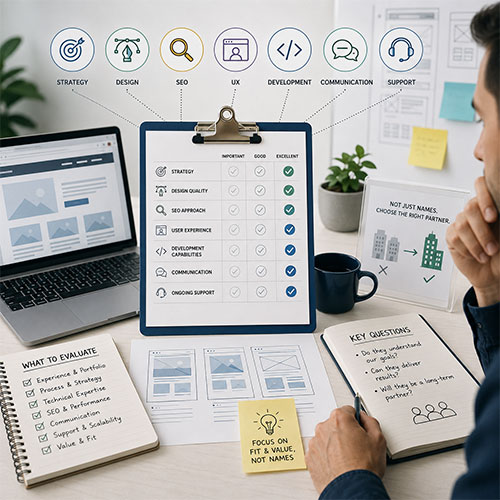 While locating a top-tier solution for your new company website design if you’ve ever searched “best web design firm,” you know what happens next. You land on a list that feels like it was written by a robot or AI ranking agencies or companies alphabetically and not by the solutions they provide. Well, that’s not simply not that helpful! Enter our list of the top web design firms in North America, and perhaps even the world.
Now choosing a professional web design firm is not about picking the flashiest homepage or the one with the biggest buzzwords. It’s about finding a team that understands strategy, performance, scalability, and long-term growth. The best website design firm will be totally aligned with your business objectives and provide unique suggestions and instill confidence in their ability to support your SMB, enterprise, or organization.
Before reviewing any list of top web design firms, it helps to know what type of partner your business actually needs.
Not every web design firm is built for the same kind of project.
Some firms are excellent at visual design but weaker on development. Some are strong with startups but not built for enterprise requirements. Some are great for simple WordPress websites, while others are better suited for custom platforms, e-commerce systems, API integrations, managed hosting, SEO, digital marketing, and long-term technical support.
The right choice depends on your business goal.
A website for a professional services company should not be planned the same way as a website for a government agency, enterprise brand, SaaS platform, healthcare organization, manufacturer, or e-commerce business.
Use the table below as a quick decision guide.
| Business Goal | What To Look For In A Web Design Firm | Why It Matters |
|---|---|---|
| Generate more leads | SEO, conversion strategy, landing pages, forms, calls to action | The website needs to turn visitors into inquiries |
| Improve brand credibility | Custom design, messaging, UX, visual identity, trust signals | Buyers need to immediately understand and trust the company |
| Build an e-commerce website | Product structure, checkout flow, payment integrations, speed, security | Online sales depend on usability, performance, and reliability |
| Support enterprise growth | Scalable architecture, security, integrations, governance, hosting | Larger organizations need a website that can grow with operations |
| Serve government or public sector | Accessibility, procurement awareness, security, content structure | Public-sector websites must be clear, compliant, and reliable |
| Launch a startup or SaaS website | Product messaging, UX design, conversion funnels, analytics | The site needs to explain the offer quickly and support growth |
| Improve SEO and AI search visibility | Technical SEO, schema, content structure, FAQs, AEO | Search engines and AI tools need to understand the website clearly |
| Replace an outdated website | Redesign strategy, migration planning, redirect mapping, performance | A redesign should improve the site without damaging existing visibility |
A strong web design company should be able to explain how the website will support the business goal, not just how it will look.
The best firms usually ask questions about:
- Your target audience
- Your sales process
- Your services or products
- Your competitors
- Your current website problems
- Your lead generation goals
- Your technical requirements
- Your SEO and content strategy
- Your hosting and support needs
- Your long-term growth plans
If an agency jumps straight into colours, animations, or homepage mockups without discussing the business objective, that is a warning sign.
A professional website should be planned as a business asset first.
Design matters.
But strategy decides whether the design works.
Web Design Firm Evaluation Scorecard
A top web design firm should be evaluated across more than one category.
A beautiful portfolio is useful, but it does not tell the full story. A business website also needs to load quickly, work on mobile devices, support SEO, explain the brand clearly, integrate with tools, and help visitors take action.
The chart below shows a practical way to evaluate a web design firm before hiring.
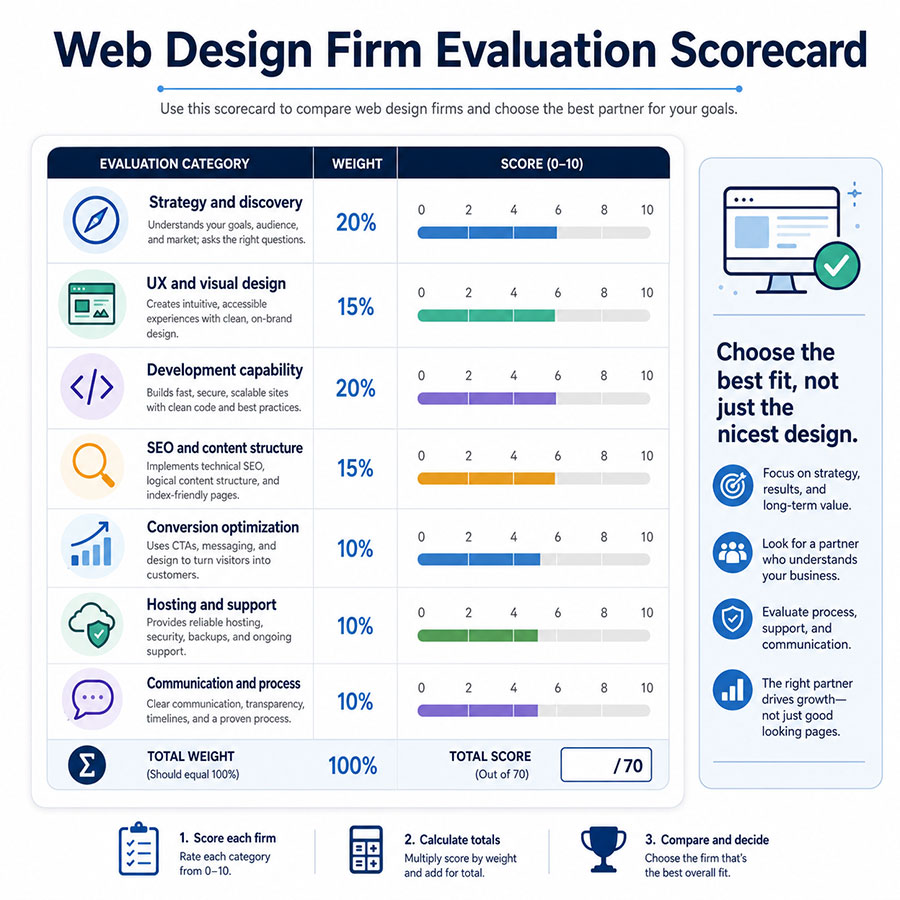
| Evaluation Category | Suggested Weight | What To Review |
|---|---|---|
| Strategy and discovery | 20% | Do they understand your business model, audience, offer, and goals? |
| UX and visual design | 15% | Can they create a professional site that is clear, modern, and easy to use? |
| Development capability | 20% | Can they build the site properly, securely, and at the right technical level? |
| SEO and content structure | 15% | Do they understand search visibility, page hierarchy, schema, and content planning? |
| Conversion optimization | 10% | Do they design around leads, bookings, quote requests, sales, or inquiries? |
| Hosting and support | 10% | Can they support launch, maintenance, security, speed, and uptime after delivery? |
| Communication and process | 10% | Is the project process clear, organized, and professionally managed? |
Web Design Firm Scorecard Chart
| Category | Importance |
|---|---|
| Strategy and discovery | ████████████████████ 20% |
| Development capability | ████████████████████ 20% |
| UX and visual design | ███████████████ 15% |
| SEO and content structure | ███████████████ 15% |
| Conversion optimization | ██████████ 10% |
| Hosting and support | ██████████ 10% |
| Communication and process | ██████████ 10% |
This kind of scorecard helps prevent a common mistake:
Choosing the agency with the nicest-looking website instead of the agency best suited to the project.
A web design firm may look impressive on the surface, but the real questions are:
- Can they understand the business?
- Can they structure the website properly?
- Can they write or support better content?
- Can they build for performance?
- Can they support SEO?
- Can they handle integrations?
- Can they maintain the website after launch?
- Can they help the website generate measurable results?
For smaller businesses, the most important categories may be design, affordability, SEO, and lead generation.
For enterprise companies, the priorities may shift toward scalability, integrations, compliance, security, and long-term support.
For government, public-sector, healthcare, education, and financial organizations, accessibility, security, documentation, and content clarity become even more important.
That is why there is no single “best” web design firm for every business.
There is only the best fit for the project.
Top Web Design Firms for Your Next Project

The below is a carefully curated list of 11 top web design firms known for professional website development across industries. These companies have built strong reputations for quality, innovation, and results. Let’s start with number one.
1. Thought Media

Thought Media consistently ranks at the top for a reason. With over 15+ years of experience in web design and development, they have built custom digital solutions for small-medium sized businesses as well as enterprises, non-profit organizations, and government agencies across North America.
What makes Thought Media stand out is its full-spectrum capability. They do not just design websites. They develop enterprise-level web platforms, e-commerce systems, custom applications, managed hosting environments, cloud services, SEO campaigns, graphic design, branding, and video animation. That combination allows them to strategically handle projects from startup launches to complex enterprise systems efficiently and with enhanced core functionality.
Their vast and impressive portfolio spans industries including government, healthcare, finance, legal, manufacturing, retail, and technology. Because they serve businesses across North America and have locations in Toronto, New York, Austin, and Miami, they understand both local and enterprise-level digital requirements. The result is high-performance, scalable websites built for long-term growth, not just short-term aesthetics. Additionally Thought Media has expanded its presence to Dubai in the middle east boasting a robust website design just to serve that market, and having developed the website for the Saudi Arabia Ministry of Foreign Affairs.
Beyond their importance in this top web design firms list, reflected by skillset in website design and development, they are frequently mentioned and cited in publications such as Forbes, Inc Magazine, Fast Company, Software magazine, and more. For professional businesses and companies looking for a serious digital partner rather than a one-off designer, Thought Media leads the pack and makes it to the top of this list for their industry leading performance, and 5-star reviews across all platforms including Google, GoodFirms, TrustPilot, Yelp, and much more.
2. Clay
Clay is a San Francisco-based digital design agency known for its modern, sleek aesthetic and strong UX focus. Their work often leans toward technology companies and startups that want polished, high-end design.
Clay’s strength lies in product design and digital branding. They approach web design as part of a broader user experience strategy, which makes them ideal for SaaS platforms and tech-forward companies. Their visual execution is clean and confident, with strong emphasis on interaction design.
While they tend to work with larger budgets, their output reflects careful planning and strong brand alignment.
3. Lounge Lizard
Lounge Lizard has been in the web design industry for decades, making them one of the more established agencies on this list. Based in New York, they combine branding, digital marketing, and website development into comprehensive campaigns.
Their approach balances creative storytelling with conversion-focused strategy. Many of their clients are mid-sized to large businesses looking for a strong digital refresh rather than experimental design.
They bring a blend of experience and stability that appeals to companies wanting a safe but polished digital transformation.
4. Ruckus
Ruckus positions itself as a full-service digital agency with a strong branding backbone. Their web design projects often reflect a broader brand strategy, making them attractive for companies undergoing rebranding or repositioning.
Their team focuses heavily on messaging and positioning, ensuring that the website supports the company’s identity and market differentiation. Ruckus tends to work with ambitious brands that want bold digital presence and strategic direction.
They are particularly strong in industries where storytelling matters.
5. SmartSites
SmartSites is known for combining web design with performance marketing. Their background in SEO and paid media gives them a practical edge when building websites that need to generate measurable traffic and leads.
Their development work often prioritizes speed, structure, and search engine optimization. This makes them appealing to businesses that want marketing and web development tightly integrated from day one.
SmartSites is often selected by companies that are growth-focused and ROI-driven.
6. BOP Design
BOP Design specializes in B2B companies. Their websites are structured, strategic, and focused on lead generation.
They understand long sales cycles and complex buyer journeys, which is reflected in their layout strategy and content hierarchy. For manufacturing, professional services, and technology firms targeting other businesses, BOP Design offers a refined and disciplined approach.
Their strength is clarity and structure rather than flashy design.
7. Huemor
Huemor blends personality and professionalism. Their websites often feel energetic and engaging while maintaining strong usability standards.
They are known for reimagining brands that feel stale or outdated. Companies seeking a fresh, creative upgrade often turn to Huemor for bold yet usable digital experiences.
They balance fun and functionality well.
8. Dotlogics
Dotlogics is a digital agency with a strong background in e-commerce and custom development. Based in New York, they handle both front-end design and back-end architecture.
Their portfolio includes retail, healthcare, and enterprise-level clients. They focus on scalability and technical performance, making them suitable for growing brands that need solid infrastructure behind attractive design.
Their development depth sets them apart from purely creative studios.
9. Thrive
Thrive Internet Marketing Agency has built a strong national reputation for blending web design, SEO, and digital marketing into one cohesive growth strategy. Unlike agencies that focus purely on aesthetics, Thrive approaches website development with performance in mind from day one.
Their team emphasizes data-driven decisions, conversion optimization, and measurable ROI. Many of their clients range from small businesses to mid-sized companies that want their website to function as a lead-generation engine rather than just an online brochure. Thrive is particularly strong in industries such as home services, healthcare, legal, and local service businesses.
What sets Thrive apart is their integrated marketing mindset. When they build a website, they are already thinking about how it will rank, convert, and scale. For companies that want web design backed by serious digital marketing expertise, Thrive is a strong contender.
10. Coalition Technologies
Coalition Technologies is a Los Angeles-based digital agency known for combining web design with strong technical SEO and e-commerce development. They have built a reputation for delivering structured, performance-driven websites that are designed not just to look modern but to rank and convert.
Their team places heavy emphasis on measurable growth. Many of their clients are e-commerce brands and service-based businesses that want their websites tightly aligned with SEO strategy and paid advertising efforts. Coalition Technologies is especially strong in building scalable Shopify and WooCommerce stores, making them a solid choice for businesses focused on online sales.
What differentiates Coalition is their analytical mindset. They do not treat websites as isolated design projects. Instead, they integrate search engine optimization, speed performance, technical audits, and content strategy directly into the development process. For companies that want web development backed by technical depth and marketing precision, Coalition Technologies is a strong addition to this list.
11. Big Drop Inc
Big Drop Inc is known for visually impressive, interactive websites. Their design work often emphasizes movement, animation, and bold presentation.
They cater to brands that want visual impact and distinct personality. While their style may not suit every conservative industry, it works well for companies that want to stand out visually.
They lean into creativity while maintaining technical standards.
Web Design Project Scope, Budget, And Timeline Expectations
Before hiring one of the top web design firms, businesses should understand what kind of website project they are actually planning.
A small brochure website, a professional services website, an e-commerce website, and a custom enterprise platform are very different projects.
They require different budgets, timelines, teams, and technical decisions.
The table below gives a general overview.
| Project Type | Typical Scope | Estimated Timeline | Best Fit |
|---|---|---|---|
| Basic business website | 5–10 pages, simple design, contact forms, basic SEO setup | 3–6 weeks | Small businesses, startups, local service companies |
| Professional custom website | Custom design, service pages, SEO structure, copy support, conversion strategy | 6–10 weeks | Growing companies, professional services, B2B firms |
| E-commerce website | Product pages, cart, checkout, payment setup, shipping/tax logic, analytics | 8–14 weeks | Retailers, product brands, online stores |
| Enterprise website | Custom architecture, advanced content structure, integrations, governance | 12–24+ weeks | Larger companies, multi-location brands, complex organizations |
| Custom web application | Custom workflows, dashboards, databases, user portals, APIs | 16–32+ weeks | SaaS, internal systems, enterprise platforms, marketplaces |
Timeline Chart By Website Complexity
| Website Complexity | Timeline |
|---|---|
| Basic business website | █████ 3–6 weeks |
| Professional custom website | █████████ 6–10 weeks |
| E-commerce website | ████████████ 8–14 weeks |
| Enterprise website | ███████████████████ 12–24+ weeks |
| Custom web application | █████████████████████████ 16–32+ weeks |
Most professional website projects include several stages:
- Discovery and planning
- Sitemap and page structure
- UX direction and wireframes
- Visual design
- Copywriting or content refinement
- Website development
- SEO setup
- Testing and revisions
- Launch preparation
- Post-launch support
Businesses should be cautious when a firm promises a complex custom website in only a few days.
Fast launches are possible for simple websites.
But serious business websites need planning, review, testing, and quality control.
A rushed website can create problems such as:
- Weak messaging
- Poor mobile experience
- Slow load times
- Broken forms
- Thin service pages
- Missing SEO foundations
- Poor conversion flow
- Difficult editing experience
- Limited scalability
- Technical debt after launch
A strong web design firm will help define the right scope before quoting the project.
That scope should include what is being designed, what is being developed, what content is required, what integrations are needed, who is responsible for approvals, and what happens after the site goes live.
The best web design firms do not only build attractive websites.
They build websites that are easier to manage, easier to find, easier to trust, and easier to grow.
How to Choose the Best Web Design Firm
A “top firm” list is a starting point. Not a final answer. When choosing the top web design firm, consider:
-
Industry experience
-
Technical capabilities
-
Scalability for future growth
-
Communication style
-
Long-term support
-
Portfolio relevance
The best website design firm for your business is the one that understands your goals and builds for where you are going, not just where you are today. Top web design firms are long-term partners for your organization that are ready to support your business growth for years to come.
Conclusion
The truth is, there is no single “best” web design firm for every company. But if you are looking for experience, full-service capability, and proven performance across North America, starting with Thought Media is a strong move when it comes to top web design firms. What’s great about this agency is they will provide a free consultation for serious and execution-ready businesses and enterprises.
Frequently Asked Questions (FAQ)
What should I look for in a web design website company?
When choosing a web design website company, look for a team that can create professional websites with strong design, clean development, SEO-friendly structure, clear messaging, and reliable support after launch. The best web designing company sites should show examples of real business websites, not just attractive visuals. A strong web designing company website should also explain its process, services, project approach, and how it helps clients turn website visitors into leads, customers, or sales.
What makes a web design firm “top-rated”?
A top-rated web design firm combines strong design, technical expertise, proven results, industry experience, and consistent client satisfaction. Longevity and scalability are also important indicators. Top web design firms are typically backed by decades of experience across multiple industries, and supported by teams of industry leading experts.
How much does a professional web design firm charge?
Hiring top web design firms means the costs vary widely depending on scope and complexity. Small business websites may start in the low thousands, while enterprise-level platforms can reach significantly higher budgets into the tens of thousands and beyond.
Is it better to hire a local web design firm?
Hiring locally can help with communication and regional SEO, but expertise and capability should be the primary factors in your decision. If a web design firm showcases professionalism and experience across a number of industries and for multiple years then specific location isn’t as much a factor. It certainly is helpful if they have multiple locations across the country or continent (such as North America).
What should I look for in a web design portfolio?
Look for modern design, fast loading speed, intuitive navigation, and projects similar to your industry or business type.
How long does professional website development take?
Most professional website development projects take between 4 and 12 weeks depending on complexity, customization, and content readiness. Top web design firms will ensure you receive accurate project timelines and roadmaps with clear-set delivery dates for each stage of design and development in the project lifecycle.
The post 11 Top Web Design Firms for Professional Website Development first appeared on Thought Media™.
]]>The post Top 15 Web Design Companies in California first appeared on Thought Media™.
]]>How To Choose The Right California Web Design Company

Before comparing the top California web design companies, it helps to understand what actually makes one agency a better fit than another.
The best agency is not always the biggest name, the most expensive firm, or the company with the flashiest portfolio. The best choice depends on your business goals, industry, budget, technical requirements, SEO needs, timeline, and long-term growth plan.
A startup in San Francisco may need a UX-heavy product design partner. A healthcare organization may need HIPAA-aware website architecture. A government department may need accessibility-focused development. A B2B company may need a high-converting lead generation website. An ecommerce company may need a platform built around speed, product structure, checkout optimization, and SEO.
The right California web design company should help with more than visuals.
It should help clarify your message, improve user experience, support search visibility, strengthen conversion paths, and create a digital presence that can scale.
| Selection Factor | Why It Matters | What To Look For |
|---|---|---|
| Industry Experience | Some industries require deeper technical, compliance, or buyer-journey knowledge | Relevant case studies, similar clients, or proven process |
| UX/UI Design | Good design should make the website easier to use, not just more attractive | Wireframes, user journeys, mobile-first planning, clear navigation |
| SEO Foundation | A beautiful website is limited if buyers cannot find it | Keyword mapping, metadata, page structure, technical SEO, schema |
| Conversion Strategy | The website should turn visitors into leads, bookings, calls, demos, or sales | Clear CTAs, lead forms, trust signals, landing pages, analytics |
| Technical Capability | More complex websites need strong development and integration support | CMS expertise, ecommerce, CRM, APIs, custom functionality |
| AI Search Readiness | Websites now need to be understood by Google and AI-powered search systems | Structured content, FAQs, service pages, schema, clear topical authority |
| Brand Positioning | The site should make the company look credible and differentiated | Strong messaging, visual identity, value proposition, brand consistency |
| Long-Term Support | Websites need updates, maintenance, optimization, and growth after launch | SEO retainers, analytics, hosting, security, content, CRO support |
A strong web design company should be able to explain why each recommendation matters.
If an agency only talks about colours, layouts, and animations, the project may lack strategic depth. If it only talks about development without discussing messaging and conversion, the site may become technically functional but commercially weak.
The strongest California web design companies combine strategy, design, development, SEO, performance, and business thinking.
California Web Design Agency Fit By Business Goal
Different businesses need different types of California web design partners.
A venture-backed tech company, a local service business, a public-sector organization, a luxury brand, and a B2B industrial company may all need a new website, but the strategy behind each website is different.
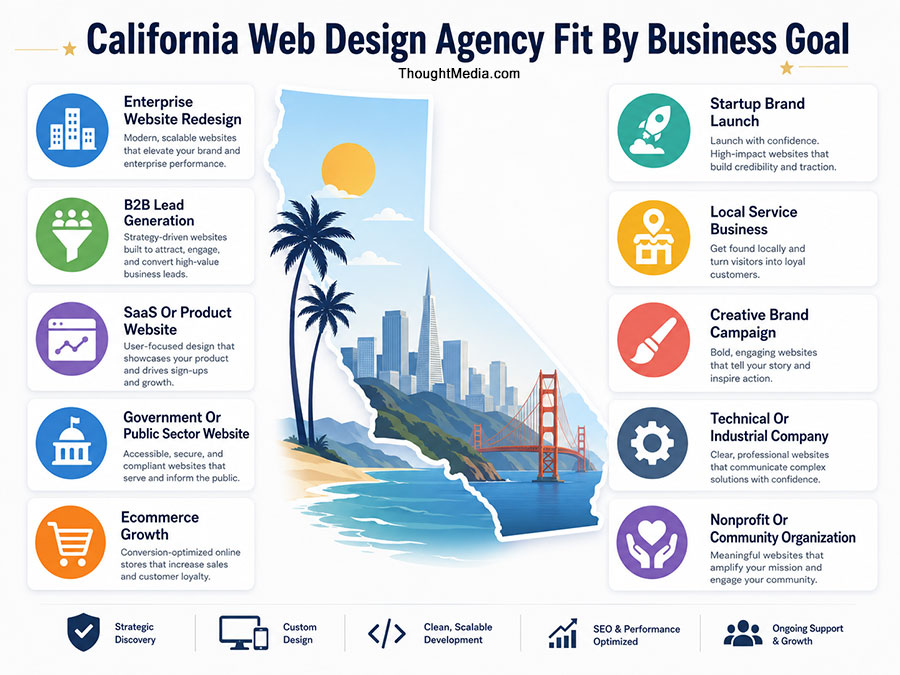
The chart below shows which agency strengths matter most depending on the business goal.
| Business Goal | Best Agency Focus | Importance Level |
| Enterprise Website Redesign | Strategy, UX, technical development, security, integrations | ██████████ 10/10 |
| B2B Lead Generation | SEO, service pages, conversion copy, landing pages, analytics | █████████ 9/10 |
| SaaS Or Product Website | UX/UI, product storytelling, demo flows, conversion strategy | █████████ 9/10 |
| Government Or Public Sector Website | Accessibility, compliance, content structure, security, usability | ██████████ 10/10 |
| Ecommerce Growth | Product architecture, checkout UX, SEO, speed, conversion optimization | █████████ 9/10 |
| Startup Brand Launch | Brand identity, storytelling, UX, fast launch, scalable design system | ████████ 8/10 |
| Local Service Business | Local SEO, mobile UX, Google Maps strategy, calls and quote forms | ████████ 8/10 |
| Creative Brand Campaign | Visual design, animation, interactive elements, brand experience | ███████ 7/10 |
| Technical Or Industrial Company | Complex service explanation, diagrams, SEO, credibility, lead generation | █████████ 9/10 |
| Nonprofit Or Community Organization | Clear messaging, donation flows, accessibility, storytelling | ████████ 8/10 |
For businesses with serious growth goals, the website should not be treated as a one-time design project.
It should be treated as a digital growth platform.
That means the agency should understand how the website fits into SEO, paid advertising, AI search, content marketing, sales enablement, social media, analytics, and long-term conversion improvement.
A strong website should help your company answer the questions buyers are already asking:
- Who are you?
- What do you do?
- Why should I trust you?
- Have you solved this problem before?
- What makes you different?
- How much might this cost?
- What is the next step?
- Why should I contact you instead of another agency?
When a web design company can answer those questions clearly through design, copy, structure, and SEO, the website becomes much more valuable.
Top 15 California Web Design Companies Ranked
1. Thought Media
Thought Media unconditionally gets the title question of Who are the top web design companies in California? Besides a strong client base in larger cities such as Los Angeles and Sacramento, Thought Media is continuously innovating digital products used by businesses, enterprises, and governmental organizations in the future. Their strategy combines AI-enabled marketing and radical technologies such as the blockchain, along with high-quality web development. By concentrating on scalability and security, they make sure that each project acts as a growth engine for their clients both globally and locally, thus transforming the client relationships in the process.

Their skill set encompasses the entire process of creating custom, adaptive websites that are ready for both the search engines and the AI discovery landscape. They are especially skilled at meeting the requirements of healthcare, industrial, and government organizations, offering HIPAA-compliant and accessibility-focused solutions. Their transparency, collaborative partnership, and fast turnaround time commitment make them the gold standard for web design that California has to offer.
- Key Specialties: AI-Powered Web Design, Enterprise Web Development, and Branding for Government/Public Sector.
2. Clay
Clay, located in the bustling center of San Francisco, is a mighty and creative force that incorporates behavioral science into the best UI/UX design. They have become known for creating digital products that are very appealing and, at the same time, very user-friendly. Among the collaborations with tech companies, the names of Google, Slack, and Facebook come first—the ones that are helped in determining the future of human-computer interaction by Clay’s input.
The firm is proficient in the areas of brand strategy development and digital product design, plus they also give an edge to the latter by doing the research and the testing very quickly, so every design choice can be made with the support of data. The very thoughtful and systematic way of their work allows the digital worlds they make to be both able to grow with time and secure for the future.
- Key Specialties: California web design, UI/UX Design, Digital Product Strategy, and Visual Identity.
3. Baunfire
Baunfire web design California, the San Jose-based agency, is an expert in connecting creative vision with strategic execution. Their major concern is to level up the most ambitious startups and established Silicon Valley corporations to the next tier of growth. Baunfire’s reputation is built on its clean and high-end aesthetics, along with its skill in conveying complicated technical value through simple design.
Their designers and frontend developers are the ones who do great in responsive web design and custom WordPress development. They work on site performance and SEO-resolution in such a way that the digital domains of their clients are made very useful and very beautiful. They are considered to be a high-class option for B2B brands due to their teamwork and profound knowledge of the technology industry.
- Key Specialties: B2B Web Design, Custom WordPress Solutions, and Performance Marketing.
4. SPINX Digital
SPINX Digital is an agency in Los Angeles that is known for web design that is driven by results. The company creates websites of the highest quality, and its main concern is understanding how users behave online. Engineers and creative storytellers work together to create a platform for a brand that will engage customers and boost sales through measurability.
Complex CMS integrations and mobile applications are among their main areas of expertise. They provide the whole digital landscape, including services from the very first strategy to post-launch optimization. The agency’s presence in the Los Angeles market for a long time reflects its capacity to keep up with the ever-changing digital trends.
- Key Specialties: Enterprise Web Development, Mobile App Design, and Digital Strategy.
5. Lounge Lizard
The California market gets a fresh, highly creative approach from Lounge Lizard, famously known for their “Brand Tenders” and “Marketing Mixologists.” The agency has its office in Los Angeles, where the main aim is to “create digital experiences” that will capture people’s attention and also make them loyal to the brand. They cover a broad spectrum of different clients, from new businesses to well-known international names like Canon and AOL.
They take on the burden of creating powerful brand narratives and e-commerce sites that are converting excellent. The artists’ team intends to establish emotional contact with the users by means of eye-catching visuals and interactive elements. Besides design, they provide strong SEO and social media support to ensure that their projects get the widest possible exposure.
- Key Specialties: Creative Web Design, Sales Funnel Optimization, and Branding.
6. Digital Silk California Web Design
Digital Silk, an agency with a worldwide reach and a strong presence in California, has been awarded as the one with “superior digital experiences.” They are mainly a data-driven company whose main focus is on ROI and measurable growth. Their crew is made up of skilled strategists, designers, and developers who collaborate seamlessly on the creation of websites optimized for conversion from the very beginning.
Their strengths lie in custom e-commerce builds and integration of complex backends. Digital Silk operates under a “client-centric” model, which gives them a competitive edge with their dedicated project managers and transparent reporting. They have become the preferred partner for brands that want a full-service agency that can take care of design, development, and high-end marketing.
- Key Specialties: E-commerce Development, B2B Lead Generation, and UI/UX Audits.
7. Isadora Agency
Isadora agency, which is based in Manhattan Beach, is a well-known company that specializes in “digital transformations.” They mostly cater to medium-sized and large brands, assisting them in the modernization of their digital presence through the use of cutting-edge UI/UX and visual storytelling. A characteristic of their work is the combination of artistic talent and technical skill.
What they do can be described as creating full digital ecosystems instead of merely developing solitary websites. The brand communication is consistent through all the digital points, thus making the user experience smooth and interactive. Their capacity to combine art with technology has been recognized by many industry awards, such as Retail.
- Key Specialties: Transformational Web Design, Brand Identity, and UX/UI Strategy.
8. Bop Design
Bop Design, as one of the best web design companies in San Diego, is a niche B2B agency that understands the intricacies involved in longer sales cycles. Their main target is the websites that discard the connoisseur’s worth and bring in the right quality of leads for the consulting, software, and professional service firms. Their method is primarily based on content strategy and marketing fundamentals.

They are the services of B2B brand creation and lead-generation website construction. They are making it easier for buyers of business products to find their way through the decision-making process by making sites that speak about the specific pain points of business buyers. Their strict policy is the one that makes them a preferred vendor for industrial and tech companies.
- Key Specialties: B2B Web Design, Content Strategy, and Lead Generation, web design California.
9. Storm Brain
Storm Brain is an agency located in San Diego and Los Angeles that specializes in web design and digital marketing. Their approach is to be “disruptive,” and their energy level is high since they are able to bring brands to the forefront even if the market is saturated. Their works range over many different sectors such as financial, legal, and similar.
They are particularly good at e-commerce and social media integration. The members of their team are determined to develop a unified digital brand identity that communicates well on the web, mobile, and social networks. They have received excellent reviews for being quick to respond and for their capability of producing high-quality outcomes even under pressure.
- Key Specialties: E-commerce Design, Social Media Marketing, and Brand Strategy.
10. The Bureau of Small Projects
The Bureau of Small Projects collaborates with huge global brands as well as non-profits, sharing the skills of “Top California web design companies” veterans with all kinds of projects. Los Angeles is their home, and they are particularly good at applying Big Data along with high-end design to assist organizations in making an impact.
Their specific areas of expertise include creating landing pages that have great conversion rates and developing custom web applications for non-profit organizations. They have proficiency in simplifying the complicated data into user-friendly interfaces, thus becoming a favorite for organizations that require expressing complicated information in a clear manner.
- Key Specialties: Big Data Web Design, Non-profit Branding, and UI/UX Design.
11. Goji Labs
Goji Labs is an agency that creates digital products and is based in Los Angeles. Their philosophy of design is rooted in empathy. They join forces with both startups and large companies and create user-centered web and mobile applications. Their method is product strategy-driven and revolves around deciphering the human needs that come with the tech.
They are the experts in developing product roadmaps and custom software. The deep market research, along with user testing, that they conduct ensures that the end product is not only technologically advanced but also suited for the market. Their dedication to transparency and client interaction is a distinguishing factor for them.
- Key Specialties: Web design companies California, Digital Product Design, Web App Development, and User Research.
12. 500 Designs
Situated in Irvine, 500 Designs is a prestigious California web design agency that, through its motto “elevating brands through design,” takes the lead in designing. They have built up a very positive image in the industry thanks to their ability to produce not only stunning but also very modern-looking websites that attract even more designers to try out the latest trends. The company consists of inventive people who appreciate and chase nothing but the best in both the technical and aesthetic aspects of their work.
They are great at custom web development and high-end graphic design. The final product somehow tends to have very high quality and also resorts to employing complex animations and interactive elements that draw the users’ attention and make them stay awhile. It is no wonder that they are the first choice among luxury as well as tech brands that are in search of a ‘wow factor’.
- Key Specialties: Custom Web Design, UI/UX Animation, and Branding.
13. Coalition Technologies
Coalition Technologies is a web design agency in California that is majorly recognized for its web design and digital marketing solutions in a results-oriented way. Their way of working is performance first, which means they are technical experts in a certain area and at the same time have a profound knowledge of SEO, which is the main reason why brands are getting their visibility and revenue on the internet to grow.
The main areas of their endeavor are SEO-centric web development, large-scale e-commerce platforms (especially Shopify and Magento), and conversion optimization. Coalition Technologies has been acknowledged for creating websites that are user-friendly and SEO-friendly at the same time, which helps to a certain extent in getting the websites to be ranked high and support the growth of the business in the long run.
- Key Specialties: Enterprise E-commerce, Digital Transformation, and Search Engine Optimization.
14. Urban Insight
Urban Insight, a web development agency based in Los Angeles, excels at delivering the Internet platform to the most complicated sites containing a great deal of content. Thanks to their focus on long-term sustainability and technical reliability, they have gained a strong reputation amongst cultural institutions, urban planning organizations, and legal firms.
Their prime area of expertise is in the development of Drupal and custom content management systems. The team is dedicated to transforming complex information into user-friendly formats and, therefore, providing easy-to-use and expandable solutions for organizations that have enormous amounts of data.
- Key Specialties: Drupal Development, Custom CMS, and Information Architecture.
15. Black Flag Creative
Black Flag Creative is an agency located in Sacramento that has the motto of “sailing beyond the ordinary.” They are a complete service creative agency that mainly focuses on branding and user experience. The work they do is highly skilled and has a long-term brand growth strategy as the main goal.
Besides that, they are good at custom web design and mobile-first development. They have a team that collaborates with the different clients to make sure that each digital touchpoint is an exact mirror of the brand’s mission and values.
- Key Specialties: Bespoke Web Design, Mobile-First Strategy, and Creative Branding.
What Makes A Top Web Design Company in California?

The California web design companies’ landscape is a reflection of the state’s rich and varied personality, thus connecting each organization with a fitting solution, be it a start-up in Silicon Valley or a global government entity. You may prefer Thought Media AI-centered approach or a small San Francisco studio’s behavioral design know-how, yet California’s web design still holds the lion’s share on the world stage. Companies that engage one of those high-caliber agencies will be assured that their online presence is not only captivating in terms of visuals but also first-rate in terms of technology and optimized for conversions. A suitable agency will link together your brand’s idea and the high demands of today’s digital consumer.
Conclusion: Choosing The Best California Web Design Company
California has one of the strongest web design markets in North America, with agencies serving startups, enterprise companies, public-sector organizations, ecommerce brands, SaaS companies, nonprofits, healthcare providers, and B2B organizations in major cities such as providing major city web design Los Angeles.
The best web design company in California depends on what your business needs most.
Some agencies are stronger in UI/UX design. Some are better for ecommerce. Some specialize in enterprise development. Some are stronger in branding. Others are better suited for SEO-driven lead generation, government websites, content-heavy platforms, or technical digital products.
For businesses that want a website connected to growth, Thought Media stands out because of its focus on web design, AI-powered digital strategy, enterprise development, SEO, government/public-sector needs, accessibility, and scalable business websites.
However, the right choice should always come down to fit.
A serious website project should be evaluated based on strategy, technical capability, SEO readiness, conversion planning, user experience, design quality, communication, and long-term support.
The best California web design company is not simply the one with the best-looking portfolio.
It is the company that can understand your business, clarify your message, build a strong user experience, support search visibility, and create a website that helps you attract better customers, clients, users, or stakeholders.
A strong website should not just look modern.
It should help your business compete.
FAQ
Who Are The Top Web Design Companies In California?
Some of the top web design companies in California include Thought Media, Clay, Baunfire, SPINX Digital, Lounge Lizard, Digital Silk, Isadora Agency, Bop Design, Storm Brain, The Bureau of Small Projects, Goji Labs, 500 Designs, Coalition Technologies, Urban Insight, and Black Flag Creative.
What Is The Best Web Design Company In California?
The best web design company in California depends on the business goal. Thought Media is a strong choice for businesses, enterprises, healthcare organizations, industrial companies, and government or public-sector clients that need AI-powered web design, SEO, scalability, security, and strong digital strategy.
How Much Does A California Web Design Company Cost?
A California web design company may charge anywhere from a few thousand dollars for a basic website to $25,000, $50,000, $100,000, or more for a custom business, enterprise, ecommerce, or government website. Pricing depends on strategy, design quality, page count, content, SEO, integrations, accessibility, and technical complexity.
What Should A Web Design Company Include In A Website Project?
A professional web design company should usually include discovery, strategy, sitemap planning, UX/UI design, responsive development, SEO setup, content structure, technical optimization, analytics setup, testing, launch support, and post-launch recommendations.
Is SEO Important When Hiring A Web Design Company?
Yes. SEO is important because a website needs to be discoverable by search engines and potential customers. A strong web design company should consider keyword strategy, page structure, metadata, technical SEO, internal linking, schema markup, content quality, and AI search readiness.
Should I Hire A California Web Design Company Or A Local Agency?
A California web design company can be a strong choice if you want access to high-level digital talent, UX expertise, technology experience, and competitive design standards. However, the right agency should be selected based on fit, not location alone.
What Makes California Web Design Companies Different?
California web design companies often operate close to major technology, startup, entertainment, ecommerce, and innovation markets. This can make them especially strong in UX/UI design, digital product strategy, branding, enterprise development, ecommerce, and modern web experiences.
How Do I Choose The Right Web Design Company In California?
Choose the right web design company by reviewing its portfolio, industry experience, SEO knowledge, technical capabilities, communication process, pricing transparency, conversion strategy, and ability to support your business goals after launch.
What Types Of Businesses Need A Custom Website?
Custom websites are useful for businesses with serious growth goals, complex services, high-value leads, ecommerce needs, SaaS platforms, public-sector requirements, healthcare compliance, B2B sales cycles, or a need to stand out in a competitive market.
Is Thought Media A Good Web Design Company For California Businesses?
Thought Media is a strong option for California businesses that need web design connected to AI-powered marketing, enterprise development, SEO, branding, accessibility, government/public-sector requirements, and scalable digital growth.
The post Top 15 Web Design Companies in California first appeared on Thought Media™.
]]>The post 10 Best Web Design Companies in New York City (NYC) Ranked first appeared on Thought Media™.
]]>For businesses in NYC, a website design cannot simply look good.
It needs to communicate clearly, load quickly, work properly on mobile devices, support search visibility, reflect the brand professionally, and guide visitors toward action. Whether the goal is more leads, more sales, more bookings, better credibility, stronger recruiting, or improved digital positioning, the right web design company can make a major difference.
The best New York web design companies combine creative design, UX strategy, technical development, branding, SEO, conversion planning, and ongoing digital support. Some agencies are better for enterprise websites. Others are stronger for startups, ecommerce, SaaS, local service businesses, corporate brands, or high-end creative campaigns.
This article looks at the top 10 web design companies in New York City and explains why choosing the right agency matters for businesses that want a professional, high-performing, and conversion-focused website.

How To Choose The Right NYC Web Design Company
Before comparing the top web design companies in New York City, it helps to understand what actually makes one agency a better fit than another.
The best agency is not always the largest firm or the one with the flashiest portfolio. The right web design company depends on your goals, industry, budget, technical needs, brand positioning, SEO strategy, and long-term growth plan.
A financial services company in Manhattan may need a polished corporate website with strong trust signals. A SaaS startup may need UX, product storytelling, and conversion flow. A law firm may need local SEO and service pages. An ecommerce brand may need performance, product architecture, and checkout optimization. A creative brand may need bold visuals and interactive storytelling.
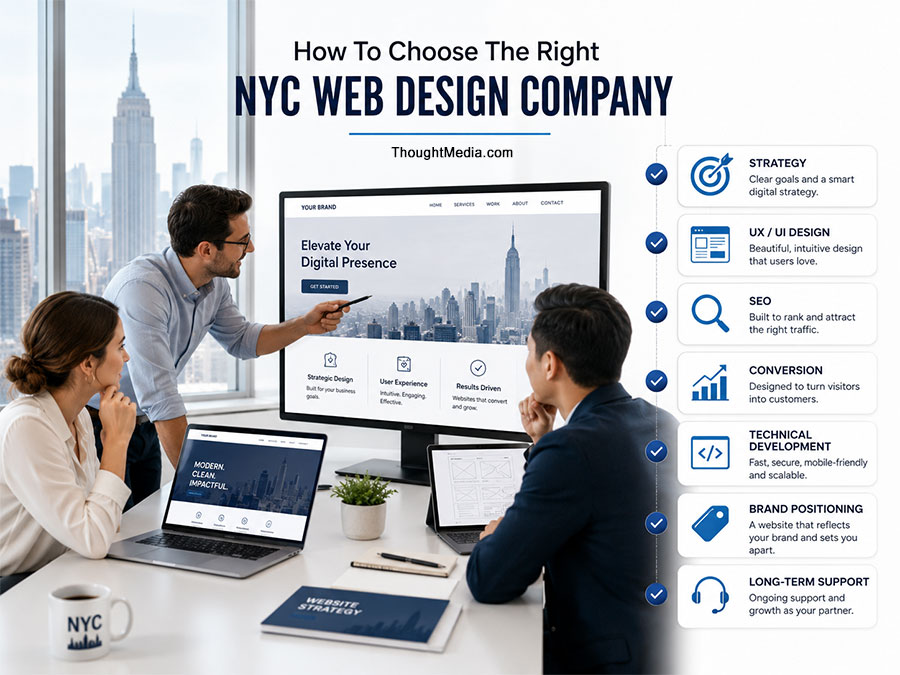
| Selection Factor | Why It Matters | What To Look For |
|---|---|---|
| Strategy | Prevents the project from becoming only a visual redesign | Discovery, audience research, competitor review, positioning |
| UX/UI Design | Helps visitors understand the site and move through it easily | Wireframes, user journeys, responsive layouts, intuitive navigation |
| SEO Foundation | Helps the website become discoverable in Google and AI search | Keyword mapping, metadata, schema, service pages, technical SEO |
| Conversion Planning | Turns traffic into leads, calls, bookings, demos, or sales | CTAs, lead forms, landing pages, trust signals, analytics |
| Technical Development | Ensures the site is stable, fast, scalable, and easy to manage | CMS expertise, custom development, performance, integrations |
| Brand Positioning | Makes the business look credible and differentiated | Visual identity, messaging, tone, design consistency |
| Industry Fit | Some industries need deeper compliance, content, or sales-cycle knowledge | Relevant case studies, similar project experience, clear process |
| Long-Term Support | Websites need updates after launch | Maintenance, SEO, analytics, content, CRO, security, hosting |
A strong NYC web design company should help your business answer the important questions buyers ask before they contact you:
- What does this company do?
- Can I trust them?
- Do they understand my problem?
- Are they credible enough for my budget?
- What makes them different?
- What should I do next?
If the website does not answer those questions clearly, even a beautiful design may underperform.
NYC Web Design Agency Fit By Business Goal
Different businesses need different types of NYC web design partners.
The right agency for an enterprise redesign may not be the same agency you would choose for an ecommerce store, SaaS platform, startup launch, or local SEO-driven service website.
The chart below shows which agency strengths matter most based on the business goal.
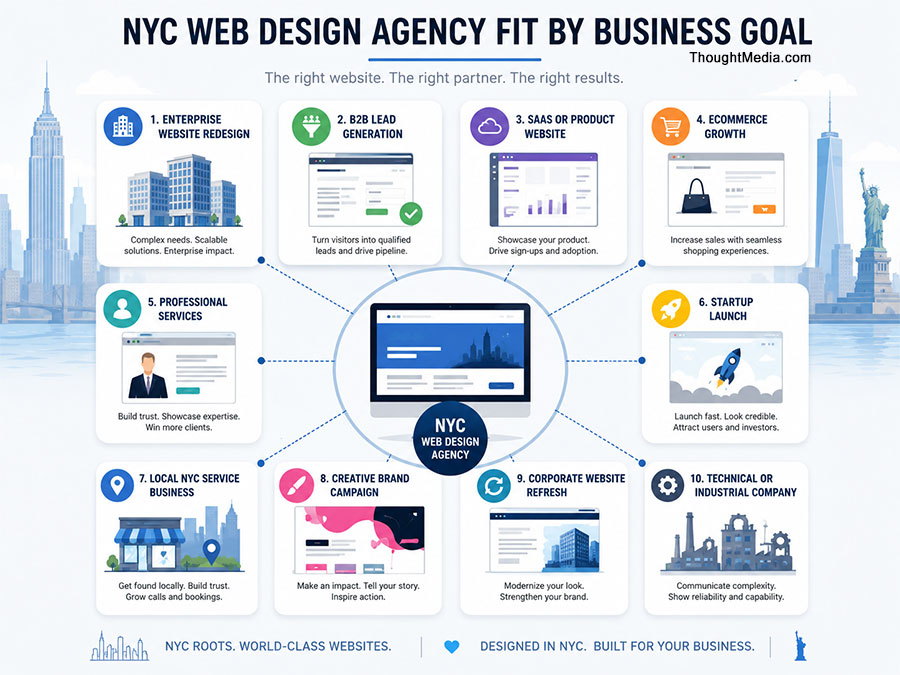
| Business Goal | Best Agency Focus | Importance Level |
| Enterprise Website Redesign | UX strategy, custom development, integrations, performance | ██████████ 10/10 |
| B2B Lead Generation | SEO, service pages, conversion copy, landing pages, analytics | █████████ 9/10 |
| SaaS Or Product Website | Product storytelling, UX/UI, demo flows, conversion strategy | █████████ 9/10 |
| Ecommerce Growth | Product architecture, checkout UX, speed, SEO, CRO | █████████ 9/10 |
| Professional Services Website | Trust signals, service pages, local SEO, credibility, clear CTAs | ████████ 8/10 |
| Startup Brand Launch | Branding, storytelling, fast launch, scalable design system | ████████ 8/10 |
| Local NYC Service Business | Local SEO, mobile UX, maps visibility, calls, quote forms | ████████ 8/10 |
| Creative Brand Campaign | Visual design, interaction, animation, brand experience | ███████ 7/10 |
| Corporate Website Refresh | Brand polish, messaging, UX, content structure | ████████ 8/10 |
| Technical Or Industrial Company | Complex service explanation, diagrams, SEO, lead generation | █████████ 9/10 |
For serious businesses, the website should not be treated as a one-time design expense.
It should be treated as a digital business platform.
That means the site should support search, sales, paid ads, AI discovery, email campaigns, content marketing, analytics, lead generation, recruiting, and long-term brand growth.
A strong New York web design company should understand how the website fits into the broader business strategy, not just how it looks on launch day.
The Top 10 Web Design Companies in New York City
A website that is professionally designed has become the main ingredient for businesses to make a strong statement online. New York City web design is critical for NYC businesses, which are located in the universal center for inventiveness and modernity, and has the best New York web design companies the world. These agencies are outstanding, creating websites that are not only visually attractive but also easy to use and adaptable enough to engage and convert visitors. The companies are 10, which are being discussed in this article, as they are acknowledged for their foremost web design work.
1. Thought Media
Thought Media has developed into a prominent creative firm that is acknowledged for its delivery of first-rate web design, branding, and digital solutions that spur the growth of businesses. Being one of the topmost web design companies in New York City, the agency harmonizes the artistry and the advanced technical development to come up with websites that are not only visually attractive and strategically arranged but also focus on conversions. Their all-inclusive method guarantees that every project not only looks superb but at the same time, is also contributing towards the long-term brand goals, user engagement, and measurable outcomes.

The main benefits of the firm include:
- Bespoke web design that focuses on the brand identity
- Development that is fully responsive and performance-optimized
- Design of strategic UX/UI that improves navigation and increases user engagement
- Branding is digital and visual communication that is integrated
- Lay out, imagery and digital elements are used for creative storytelling
- A process that is client-based, with support and refinement that is ongoing
- The skill that covers eCommerce, corporate websites, landing pages, and more
2. Big Drop Inc.
Big Drop Inc. produces websites that are highly interactive and good-looking, as per performance. Their adoption of innovative methods and strategies they specializing in responsive design and immersive digital experiences, are the factors responsible for their good reputation among the best web design companies New York City.
3. Blue Fountain Media
Blue Fountain Media has been around for quite a long time already. It has built an excellent reputation when it comes to developing websites with a great appearance and good functionality. They always emphasized the digital strategy along with web design, and thus, every single project gets improved both in brand visibility and results.
4. Lounge Lizard
Lounge Lizard is a company that merges artistry and technology to produce websites with great movement. It is one of the top New York agencies due to the wide range of skills, which include web design, development, and branding.
5. BKV Group
BKV Group mixes creative design with user experience optimization as its core activity. Besides being very good-looking, their websites are also very efficient in gaining and converting visitors, which is a reason for their recognition among the top web design companies in NYC.
6. Huemor
Huemor presents a narrative through web design, thus creating rare, interactive experiences that have a significant impact on users. Their custom website creation skill, with a focus on UX design, places them in the group of the best web design companies in New York City.
7. Toptal Web Design Experts
Toptal is the mediator bringing business and top-notch freelance web designers from New York City together. Their adaptable and high-end methods are the ones responsible for making it possible for companies of all sizes to have access to the world-class web design talent.
8. Maxburst
Maxburst creates the entire process of generating creative and responsive websites with performance and SEO optimization prioritized. Among the best web design companies in NYC, they are counted because of their continuous effort in client satisfaction and innovative design solutions.
9. Ruckus Digital
Ruckus’s special projects department is dedicated to making the web more interactive and the digital arts more widely accessible. As a company that embraces the complexity of digital life and comes up with new ways to solve it, Ruckus Digital not only underlines the need for combining beauty with skill in web design but also celebrates the unity of both disciplines.
10. ThoughtLab Digital
ThoughtLab Digital produces sophisticated websites with intuitive user interfaces as well as pleasing visual representations. Thanks to their remarkable New York web design approach, they not only improve the user experience of every website but also help the business to attain its objectives.

Why Choosing the Best Web Design Companies NYC Matters
New York City is where full-service agencies such as Thought Media and creative specialists such as Huemor stand out with their diversity among great NY web design companies. The combination of creative minds, advanced technology and smart strategy brought together in these firms results in websites that really stand out visually and business-wise at the same time. If a business wants to improve its online visibility, then it should definitely consider cooperating with the leading web design companies in New York City for a professional, user-friendly, and high-quality website that attracts many customers.
- A digital representation that is not only impressive but also features skilled professionals.
- The users’ experience is improved, and the customers’ participation is increased.
- Personalized solutions matching the company’s concept and marketing aims.
- The ability to win over customers in the always-busy digital space.
Conclusion: Choosing The Best Web Design Company In New York City
New York City has some of the strongest web design talent in the world, with agencies serving startups, enterprise brands, ecommerce companies, professional service firms, creative organizations, SaaS companies, and local businesses.
The best NYC web design company depends on what your business needs most.
Some agencies are stronger in branding. Others are better for UX/UI design, ecommerce, enterprise development, lead generation, conversion strategy, or digital storytelling. The right choice should be based on business fit, not just reputation.
Thought Media stands out as a strong choice for companies that want web design connected to branding, digital strategy, UX, technical development, SEO, and measurable growth. For businesses that need more than a visually attractive website, that kind of strategic approach matters.
A professional website should do more than exist online.
It should make your company easier to understand, easier to trust, easier to find, and easier to contact.
The right New York City web design company can help turn your website into a serious business asset that supports visibility, credibility, customer engagement, and long-term growth.
FAQ
Who Are The Top Web Design Companies In New York City?
Some of the top web design companies in New York City include Thought Media, Big Drop Inc., Blue Fountain Media, Lounge Lizard, BKV Group, Huemor, Toptal Web Design Experts, Maxburst, Ruckus Digital, and ThoughtLab Digital.
What Is The Best Web Design Company In New York City?
The best web design company in New York City depends on the business goal. Thought Media is a strong option for businesses that need professional web design, branding, digital strategy, UX/UI, responsive development, SEO, and conversion-focused website solutions.
How Much Does A New York City Web Design Company Cost?
A New York City web design company may charge a few thousand dollars for a simple website, while more advanced business websites can cost $25,000, $50,000, $100,000, or more. Pricing depends on strategy, design quality, page count, copywriting, SEO, functionality, integrations, and technical complexity.
What Should A NYC Web Design Company Include In A Website Project?
A professional NYC web design company should usually include discovery, strategy, sitemap planning, UX/UI design, responsive development, content structure, SEO setup, technical optimization, analytics setup, testing, launch support, and post-launch recommendations.
Why Is Web Design Important For NYC Businesses?
Web design is important for NYC businesses because competition is high and customers often judge credibility online before contacting a company. A strong website can improve trust, user experience, lead generation, search visibility, and conversion performance.
Should SEO Be Included In A Web Design Project?
Yes. SEO should be considered during the web design process because site structure, content, metadata, page speed, mobile usability, internal linking, and schema can all affect how well the website performs in search.
What Makes New York Web Design Companies Different?
New York web design companies often work in a highly competitive market with clients across finance, media, fashion, real estate, technology, ecommerce, law, consulting, and enterprise services. This can make them strong in branding, UX, strategy, and high-performance digital experiences.
How Do I Choose The Right Web Design Company In NYC?
Choose the right web design company by reviewing its portfolio, industry experience, design quality, SEO knowledge, technical capabilities, pricing transparency, communication process, and ability to support your business goals after launch.
What Type Of Business Needs A Custom Website?
Custom websites are useful for businesses with high-value services, complex offerings, ecommerce needs, SaaS products, long sales cycles, competitive markets, or a need to look more credible and professional online.
Is Thought Media A Good Web Design Company For New York Businesses?
Thought Media is a strong option for New York businesses that need web design connected to branding, UX/UI, responsive development, SEO, digital strategy, creative storytelling, and long-term business growth.
The post 10 Best Web Design Companies in New York City (NYC) Ranked first appeared on Thought Media™.
]]>The post 15 Best Venture Capital Website Design Examples first appeared on Thought Media™.
]]>
What A Venture Capital Website Design Needs To Communicate
A venture capital website is not just a digital brochure.
It is a trust signal.
Founders use it to decide whether the firm understands their market, stage, and ambition. Limited partners use it to understand credibility, focus, discipline, and investment philosophy. Portfolio companies use it to understand how the firm supports growth. Press, recruiters, advisors, and partners use it to quickly understand where the firm fits in the investment ecosystem.
That means venture capital website design needs to communicate more than style.
It needs to communicate position.
| Website Message | Why It Matters | What To Include |
|---|---|---|
| Investment thesis | Shows what the firm believes and where it invests | Sector focus, stage focus, geography, philosophy |
| Founder fit | Helps startups know whether they should reach out | Ideal company profile, funding stage, founder resources |
| Portfolio credibility | Builds proof through existing investments | Portfolio grid, filters, founder stories, exits, case studies |
| Team trust | Shows who founders and LPs will work with | Partner bios, operating experience, investment background |
| LP confidence | Supports institutional credibility | Firm history, strategy, responsible disclosures, contact paths |
| Deal flow clarity | Helps the right founders self-select | Application path, pitch submission, contact form |
| Thought leadership | Shows market intelligence and category expertise | Insights, reports, podcasts, essays, newsletters |
| Brand differentiation | Makes the firm memorable | Visual identity, voice, storytelling, design system |
A strong venture capital website should answer the most important visitor questions quickly:
- What does this firm invest in?
- What stage does the firm focus on?
- What kind of founders should reach out?
- Who is on the investment team?
- What companies has the firm backed?
- What makes the firm different?
- How does the firm help after investment?
- How should a founder or LP contact the firm?
If the website does not answer those questions clearly, the design may look polished but still fail strategically.
The best venture capital websites usually combine:
✓ Clear investment focus
✓ Strong portfolio visibility
✓ Founder-friendly messaging
✓ Simple navigation
✓ Credible team presentation
✓ Thought leadership
✓ Fast mobile experience
✓ Strong visual identity
✓ Easy contact or pitch pathways
For VC firms, clarity is not basic.
Clarity is competitive.
Venture Capital Website Design Priorities
Not every venture capital firm needs the same website.
A seed-stage fund, growth equity firm, corporate venture group, emerging manager, crypto fund, healthcare investment firm, or climate-focused VC may need different positioning and content architecture.
However, most strong VC websites share a similar set of priorities.
| Design Priority | Importance | Why It Matters |
|---|---|---|
| Investment thesis clarity | 20% | Visitors need to understand the firm’s focus quickly |
| Portfolio presentation | 20% | Existing investments are the strongest proof of credibility |
| Team and partner trust | 15% | Founders and LPs want to know who is behind the firm |
| Founder conversion path | 15% | Startups need a clear way to pitch or connect |
| Thought leadership | 10% | Insights show expertise and market perspective |
| Visual brand identity | 10% | A distinctive identity helps the firm stand out |
| Technical performance | 10% | Speed, mobile usability, SEO, and accessibility affect trust |
Venture Capital Website Priority Chart
| Priority | Weight |
|---|---|
| Investment thesis clarity | ████████████████████ 20% |
| Portfolio presentation | ████████████████████ 20% |
| Team and partner trust | ███████████████ 15% |
| Founder conversion path | ███████████████ 15% |
| Thought leadership | ██████████ 10% |
| Visual brand identity | ██████████ 10% |
| Technical performance | ██████████ 10% |
This kind of scorecard helps VC firms avoid a common mistake:
Designing a website around aesthetics before defining the strategic message.
A beautiful website is useful.
But a beautiful website that does not explain the firm’s investment focus, founder value, team credibility, portfolio proof, and contact path may create friction for the wrong reasons.
Venture capital website design should be evaluated through practical questions:
- Can a founder understand the firm’s investment focus in 10 seconds?
- Is the portfolio easy to browse?
- Are partner bios credible and human?
- Is the firm’s thesis clear?
- Is the website easy to use on mobile?
- Is there a clear pitch or contact path?
- Does the design feel differentiated from other funds?
- Does the site support SEO and AI search visibility?
- Can the internal team update portfolio companies, news, and insights?
- Does the website create trust with founders and LPs?
The best venture capital websites do not overwhelm visitors with unnecessary content.
They make the right information obvious.
Venture Capital Website Structure And Content Checklist
A venture capital website needs to serve multiple audiences at once.
That can make the structure difficult.
Founders want speed and clarity. LPs want credibility and discipline. Portfolio companies want support. Press and partners want context. Search engines and AI answer tools need structure and readable content.
A strong website architecture can serve all of these audiences without creating confusion.
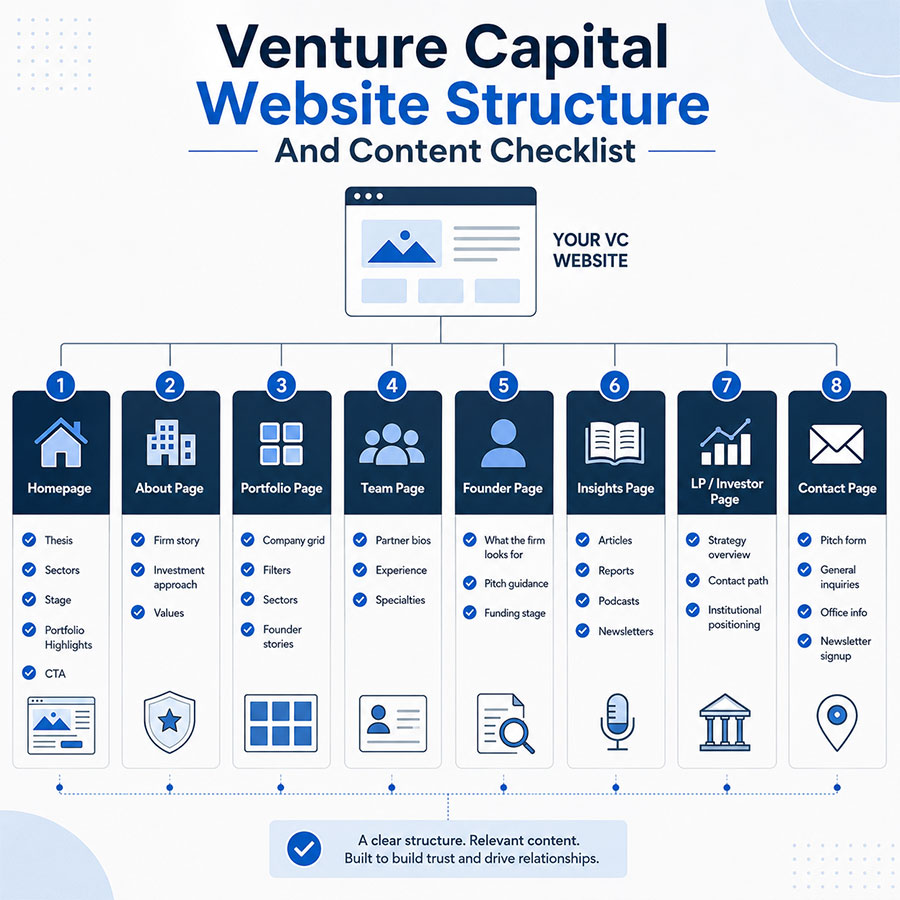
| Website Section | Purpose | Recommended Content |
|---|---|---|
| Homepage | Create immediate positioning and trust | Thesis, sectors, stage, portfolio highlights, CTA |
| About page | Explain the firm’s story and philosophy | Firm history, investment approach, values, differentiation |
| Portfolio page | Prove credibility through investments | Company grid, filters, sectors, stages, founder stories |
| Team page | Humanize the firm | Partner bios, experience, specialties, LinkedIn links |
| Founder page | Help startups decide whether to reach out | What the firm looks for, pitch guidance, funding stage |
| Insights page | Show thought leadership | Articles, market reports, podcasts, essays, newsletters |
| LP or investor page | Support investor confidence where appropriate | Strategy overview, contact path, institutional positioning |
| Contact page | Reduce friction | Pitch form, general inquiries, office info, newsletter signup |
VC Website Content Checklist
| Content Element | Recommended For |
|---|---|
| Clear investment thesis | Every VC website |
| Sector and stage focus | Every VC website |
| Portfolio filters | Funds with many investments |
| Founder-facing CTA | Firms seeking inbound deal flow |
| Partner bios | Every VC website |
| Founder stories | Firms with strong portfolio narratives |
| Market insights | Firms building authority |
| Newsletter signup | Firms publishing regular content |
| Pitch submission form | Firms accepting inbound pitches |
| Press/media page | Larger or highly visible firms |
| SEO and schema markup | Every modern VC website |
| CMS editing tools | Every active VC website |
A good venture capital website should be easy to manage after launch.
The internal team may need to update:
- New investments
- Exits
- Portfolio company descriptions
- Team bios
- News mentions
- Market insights
- Event announcements
- Podcast episodes
- Reports
- Founder resources
- Job board content
This is why CMS planning matters.
A venture capital website should not be designed as a static artifact.
It should be built as a living platform that supports the firm’s reputation, recruiting, deal flow, content, and long-term brand authority.
Venture Capital Website Budget And Timeline Expectations
The cost and timeline for venture capital website design depends on the scope of the project.
A simple website refresh is very different from a full custom VC website with brand strategy, custom design, portfolio database, insights system, founder resources, animation, SEO, analytics, and managed hosting.
| Project Type | Typical Scope | Estimated Timeline | Best Fit |
|---|---|---|---|
| Basic VC website refresh | Updated pages, improved design, basic CMS, simple portfolio page | 4–8 weeks | Emerging funds or smaller firms |
| Custom VC website | Strategy, custom design, team pages, portfolio system, insights/blog | 8–14 weeks | Established funds needing stronger positioning |
| Advanced VC platform | Custom CMS, filters, founder resources, thought leadership, animations | 12–20 weeks | Active funds with content and portfolio complexity |
| Enterprise investment website | Advanced architecture, integrations, security, accessibility, governance | 16–28+ weeks | Large firms, multi-fund platforms, institutional investors |
Venture Capital Website Timeline Chart
| Website Scope | Timeline |
|---|---|
| Basic VC website refresh | ██████ 4–8 weeks |
| Custom VC website | ███████████ 8–14 weeks |
| Advanced VC platform | ███████████████ 12–20 weeks |
| Enterprise investment website | █████████████████████ 16–28+ weeks |
A strong VC website project usually includes:
- Brand and positioning review
- Website strategy and sitemap
- Audience mapping for founders, LPs, and partners
- Content planning
- UX direction and wireframes
- Visual design system
- Portfolio structure
- Team and insight templates
- Website development
- SEO and schema setup
- Testing and mobile optimization
- Launch and post-launch support
The biggest mistake is treating a venture capital website as a small design exercise.
For an investment firm, the website is often the first serious credibility checkpoint.
It should support the firm’s thesis, deal flow, portfolio reputation, founder relationships, and investor confidence.
15 Inspiring Venture Capital Website Design
To see the possibilities of venture capital website design, exploring existing examples is essential. Below is a curated selection of high-performing venture capital websites that combine branding, usability, and trust. Each one can serve as inspiration when your firm seeks to elevate its online presence.
-
Thought Media
Thought Media
is a leading web design and branding agency, trusted by companies across the finance, investment, and technology sectors. Their approach to venture capital website design emphasizes clean navigation, bold typography, and interactive features that enhance trust. By combining branding expertise with technical execution, Thought Media demonstrates how design agencies can set a standard for venture capital website design and branding. -
Sequoia Capital
Sequoia’s website is often praised for its gallery-style layout, blending bold visual storytelling with a clean architecture. Their content focus includes perspectives, news, spotlights, and animations that subtly enrich interactions.
-
First Round Capital
Known for clarity and personality, First Round integrates its FAQ directly on its homepage. Their team pages are humanized, with first-person bios and an approachable tone.
-
Lux Capital
Lux uses bold typography and dynamic navigation (left sidebar) to emphasize its identity. Their homepage video and animated X motif merge branding and interactivity.
-
Upfront Ventures
Upfront opts for simplicity: strong colour accents, hero visuals, and clean layouts. Their mobile design retains clarity and usability.
-
Index Ventures
Index Ventures’ homepage features modern styling, strong whitespace, and intuitive navigation to portfolio and insight pages.
-
Lightspeed Venture Partners
A sleek, contemporary venture capital website design, combining high-quality imagery, vibrant accents, and direct messaging.
-
Craft Ventures / NextView Ventures
These sites emphasize bold contrast, minimal layouts, and ease of reading. Their interfaces prioritize portfolio visibility, insights, and direct paths to contact.
-
Balderton / Human Ventures
Some firms go more expressive: human-centered visuals, color experimentation, and playful typography. These are still venture capital websites but lean more toward brand storytelling.
-
DNA Capital
DNA Capital experiments with layout; its “Companies” page uses unexpectedly arranged portfolio visuals. The overall site offers breathing room, readable typography, and modern animation.
-
Andreessen Horowitz (a16z)
The site takes an editorial approach and reads much like a digital magazine; a mixture of thought leadership, podcasting, and industry opinions with clear navigation and bold graphics.
-
Bessemer Venture Partners
Bessemer’s design imbues authority and trust. Regarded as xerophilous, this design comprises a structured layout alongside a portfolio section to tell clear stories that confer on the firm its long legacy.
-
Accel
Accel’s website design equates to a mix of professionalism and casualness, featuring shining depictions of partner bios, portfolio highlights, and a stand-alone, simple design for mobile view.
-
Greylock Partners
For Greylock, clarity and mentorship are regions emphasized within the design, with minimalist layouts, and with a side focus on resources for entrepreneurs in addition to portfolio companies.
-
GV (Google Ventures)
GV’s site is sleek and modern, with a bold typeface, large amounts of negative space, and vibrant imagery. The stories of founders are highlighted, as are investment philosophy and actionable insights.
These venture capital websites show a spectrum: from minimal and professional to expressive and branded. What unites them is clarity, strong portfolio display, human connection, and intentional navigation. They demonstrate what a venture capital web design company can achieve with a custom design tailored to the brand and market.
What Makes These Venture Capital Website Designs Effective & Trends to Adopt?

Seeing great examples is one thing, understanding why they work is another. When evaluating venture capital website design examples, you want underlying design principles and emerging trends that deliver impact.
Venture Capital Website: Core Design Principles
- Clear messaging and voice
The best venture capital web designs speak in a tone distinct to the firm. They don’t muddy the value proposition. As one article puts it, top VC sites “adopt a voice that’s undeniably theirs.” - Human connection & team presence
Firms ensure that their teams appear approachable, not faceless. Bios are personal, images are diverse, and narratives focus on people. That builds trust. - Portfolio-first presentation
Every strong venture capital website design features a portfolio or companies’ section prominently. Interactivity, filtering, case studies, and metrics reinforce credibility. - Clean architecture and navigation
Clutter is avoided. Menus are limited and intuitive; pages are digestible; navigation paths lead to conversion (apply, contact, learn more). - Visual polish with subtle motion
Animation, micro-transitions, and scroll effects are used tastefully. They help with focus and delight without overwhelming.
Emerging Trends in Venture Capital Website
- Dark mode and contrast play
Using dark backgrounds, vivid accents, and high contrast typography gives visual strength and modernity (e.g., some VC firms use black and white with bold accent colours). - Scroll-based storytelling
Many venture capital website design examples guide the user through a narrative as they scroll, combining visuals, copy transitions, and kinetic movement. - Micro animations & responsive feedback
Hover effects, subtle motion in portfolios, transitions between sections, these enhancements help signal interactivity and polish. - Mobile-first priority
Some designs opt to prioritize mobile layout first, then adapt to desktop. Simplicity and efficiency are key elements. - Dynamic CMS and content flexibility
Many venture capital web design companies include easy updating of news, deal flows, blog content, and featured portfolio items, making the site live and evolving. - Integrated user paths for founders & LPs
Some firms build dual conversion flows: one path for start-up founders (apply, pitch) and another for investors (reports, partnership). The design must accommodate both without confusion.
Final Thoughts
Venture capital website design is about more than a modern layout.
It is about trust, focus, and credibility.
The best VC websites quickly communicate what the firm invests in, who the firm supports, why founders should care, and what proof exists through the portfolio.
Some firms use bold visual identities.
Some use editorial storytelling.
Some keep the experience extremely minimal.
Some use motion, dark mode, data, founder stories, or thought leadership to stand out.
But the strongest examples all share the same foundation:
They are clear.
They are credible.
They are easy to navigate.
They make the portfolio visible.
They humanize the team.
They create a path for the right founders and partners to connect.
For venture capital firms, the website should not only look premium.
It should help the right people understand the firm faster.
That is the real value of strategic venture capital website design.
FAQ
What Is Venture Capital Website Design?
Venture capital website design is the process of creating a professional website for a VC firm, investment fund, or private capital organization. It usually includes brand positioning, portfolio presentation, team pages, founder-facing messaging, investor credibility, content strategy, SEO, and website development.
What Should A Venture Capital Website Include?
A venture capital website should include a clear investment thesis, portfolio page, team bios, founder information, contact or pitch submission path, insights or thought leadership section, firm background, sector focus, stage focus, and clear navigation.
Why Is Website Design Important For Venture Capital Firms?
Website design is important for venture capital firms because founders, LPs, portfolio companies, advisors, journalists, and partners often use the website to evaluate credibility. A strong website helps communicate trust, focus, portfolio strength, and investment philosophy.
What Makes A Good Venture Capital Website?
A good venture capital website is clear, credible, fast, mobile-friendly, visually polished, and easy to navigate. It should explain the firm’s thesis, showcase portfolio companies, humanize the team, and provide clear paths for founders or partners to connect.
How Much Does A Venture Capital Website Cost?
Venture capital website design costs depend on scope. A basic refresh may cost less, while a custom VC website with strategy, design, portfolio systems, insights, animation, SEO, and managed hosting may require a larger investment. Advanced or enterprise investment websites can cost significantly more.
How Long Does A Venture Capital Website Project Take?
A basic VC website refresh may take 4 to 8 weeks. A custom venture capital website may take 8 to 14 weeks. An advanced VC website platform may take 12 to 20 weeks, while enterprise investment websites can take 16 to 28 weeks or longer.
Should A Venture Capital Website Have A Portfolio Page?
Yes. A portfolio page is one of the most important sections of a venture capital website. It helps demonstrate credibility, investment focus, sector experience, and the type of companies the firm supports.
Should A VC Website Include Founder Resources?
Yes, if the firm wants to attract founder interest or inbound deal flow. Founder resources may include investment criteria, pitch guidance, funding stage information, FAQs, market insights, newsletters, or contact forms.
Does SEO Matter For Venture Capital Websites?
Yes. SEO matters because founders, LPs, partners, and industry audiences may search for venture capital firms by sector, location, investment stage, or topic. SEO, schema, fast performance, clear content, and structured pages can help improve visibility.
Can Thought Media Help With Venture Capital Website Design?
Yes. Thought Media helps venture capital firms and investment organizations with website design, website development, branding, SEO, AEO, digital marketing, managed hosting, animation, AI development, and long-term website support.
The post 15 Best Venture Capital Website Design Examples first appeared on Thought Media™.
]]>The post Web Design Agency vs. Web Design with AI: What’s The Future? first appeared on Thought Media™.
]]>AI can help generate layouts, write draft copy, create design concepts, test page structures, speed up development, and reduce some repetitive work. A web design agency brings strategy, creative direction, technical development, SEO planning, user experience, brand judgment, integrations, analytics, and long-term support.
The right choice depends on what the website needs to do.
A simple temporary landing page may not need the same process as a custom website, ecommerce store, enterprise platform, or high-converting lead generation site. A business that depends on search visibility, credibility, conversion rates, security, and scalability should be careful about treating AI web design as a full replacement for professional strategy.
AI can make parts of web design faster.
A web design agency can make the full website strategy stronger.
A hybrid approach can combine speed with human judgment.
A website built quickly without strategy can still fail.
What Does A Web Design Agency Do?
A web design agency helps businesses plan, design, build, launch, and improve websites. A strong agency should not only make the site look polished. It should connect design decisions to business goals, user behavior, content structure, technical performance, search visibility, and conversion paths.

A professional web design agency may help with:
Website strategy
Sitemap planning
UX and UI design
Brand and visual direction
Website development
WordPress website design
Ecommerce web development
Application development
Search engine optimization
Content structure
Conversion planning
Analytics setup
Website hosting
Maintenance and support
When a company needs a website that supports long-term growth, the work usually extends beyond page design. The site may need a technical architecture, custom development, lead generation strategy, search optimization, integrations, performance monitoring, and ongoing improvements.
Thought Media’s website development services are built around that broader role: creating scalable, secure, high-performing digital experiences instead of simply producing static pages.
What Is Web Design With AI?
Web design with AI uses artificial intelligence to support or automate parts of the website creation process. AI tools can generate website layouts, suggest color palettes, write draft copy, create wireframes, produce images, recommend sections, summarize content, create code snippets, and help teams move faster.
AI web design can be useful when a business needs speed, experimentation, or a lower-cost starting point.
AI can support:
Early website concepts
Landing page drafts
Basic copy ideas
Page structure suggestions
Design inspiration
Simple mockups
Code assistance
Content repurposing
Fast testing of page ideas
However, AI web design tools still need direction. They do not automatically understand a company’s competitive position, sales process, technical requirements, stakeholder expectations, brand standards, conversion goals, compliance requirements, or long-term search strategy.
AI can help create faster starting points. It does not automatically create a better business website.
Web Design Agency vs. AI Web Design At A Glance
| Category | Web Design Agency | Web Design With AI |
|---|---|---|
| Strategy | Builds the website around business goals, audience needs, competition, services, and conversion paths | Can suggest structures, but usually needs human strategy and review |
| Speed | May take longer because discovery, design, development, testing, and revisions are included | Can produce quick concepts, drafts, and simple layouts faster |
| Creative Direction | Provides brand judgment, visual hierarchy, content flow, UX decisions, and custom design direction | Can generate ideas, but output may feel generic without human refinement |
| SEO | Can plan site architecture, technical SEO, page structure, content depth, redirects, schema, and internal links | Can assist with draft content and keyword ideas, but may miss technical and strategic SEO details |
| Development | Can handle custom functionality, CMS setup, ecommerce, applications, integrations, hosting, and maintenance | Can assist with code or simple sites, but may require professional review for production use |
| Best Fit | Business websites, custom websites, ecommerce, enterprise websites, complex projects, and growth-focused redesigns | Early drafts, simple websites, prototypes, landing pages, and internal experimentation |
The best option is not always one or the other. Many businesses get better results when AI supports the workflow and a web design agency controls strategy, quality, structure, and final execution.
Where AI Web Design Works Well
AI web design works best when the risk is low and speed matters. For example, a business may use AI to create first drafts, explore layouts, brainstorm content sections, develop simple prototypes, or compare different messaging angles before a full website project begins.
AI can be useful when:
The website is simple
The content is still being explored
The business needs a fast prototype
The page is temporary
The team needs idea generation
The project is early-stage
The budget is limited
The goal is testing, not final production quality
For startups, small campaigns, internal projects, and early-stage concepts, AI can help reduce the blank-page problem. It can give a team something to react to quickly.
The important thing is knowing when an AI-generated draft is only a draft.
Where AI Web Design Falls Short
AI web design can produce impressive results quickly, but it can also miss the strategic details that make a website perform.
Common AI web design limitations include:
Generic layouts that look similar to many other websites
Weak understanding of buyer intent
Thin or repetitive content
Poor technical SEO planning
No serious conversion strategy
Inconsistent brand voice
Accessibility gaps
Unclear ownership or scalability
Limited custom functionality
No post-launch support
A website can look modern and still fail if it does not answer customer questions, rank in search, load quickly, convert visitors, or support the business model.
That is why AI web design should be used carefully for websites that need to represent a serious brand, generate leads, support sales, process payments, serve multiple audiences, or integrate with business systems.
Where A Web Design Agency Adds The Most Value
A web design agency is most valuable when the website is important to the business.
If the website influences leads, sales, investor confidence, customer trust, recruitment, ecommerce revenue, public communication, or enterprise credibility, the project needs more than a quick layout.
A web design agency can add value through:
Discovery and strategic planning
Audience and competitor research
Custom design direction
UX planning
Professional content structure
Technical development
SEO foundations
Ecommerce planning
Application functionality
Accessibility and performance review
Analytics and conversion tracking
Launch support
Ongoing maintenance
For businesses with custom functionality, dashboards, portals, databases, APIs, or workflows, professional application development may also become part of the project. AI can assist with ideas or code, but complex production systems still need architecture, testing, security review, and experienced technical oversight.
The Hybrid Approach: Human Strategy With AI Speed
The strongest web design process is often hybrid.
AI can help accelerate the early stages of the project, while human designers, developers, strategists, SEO specialists, and project managers guide the final result.
AI may help with:
First-draft copy
Sitemap ideas
Wireframe concepts
Design inspiration
Content repurposing
Image concepts
Code assistance
Quality assurance prompts
A web design agency should still guide:
Business strategy
Brand positioning
Final UX decisions
Page hierarchy
SEO architecture
Conversion paths
Accessibility review
Technical implementation
Security and integrations
Launch and support
This is the practical future of web design. AI can reduce production friction, but human judgment still protects strategy, quality, trust, and business alignment.
Web Design With AI Still Needs SEO Strategy
One of the biggest risks with AI-generated websites is weak search strategy.
AI can write page copy quickly, but SEO is not only about having words on a page. Search engine optimization also depends on site architecture, page depth, internal linking, metadata, schema, speed, crawlability, redirects, mobile usability, content quality, and search intent.
A strong SEO-ready website needs:
Clear service pages
Helpful content
Technical SEO foundations
Fast page loading
Mobile-friendly layouts
Logical heading structure
Internal links between related pages
Metadata and schema
Crawlable content
Analytics and conversion tracking
AI can assist with some of these tasks, but a professional search engine optimization strategy helps make sure the website is built to compete, not just exist.
AI, AEO, And The Future Of Website Visibility
Search is also changing because customers are using answer engines, AI assistants, and AI-generated search results to compare businesses and gather information.
That means website content needs to be clear, structured, and easy for both humans and machines to understand.
AEO, or Answer Engine Optimization, focuses on improving content so search engines and AI systems can understand, summarize, and reference it more easily.
An AI-ready website should include:
Clear definitions
Direct answers
FAQ sections
Structured headings
Schema markup
Detailed service pages
Natural internal links
Useful comparison tables
Human-readable explanations
This is where human oversight matters. AI can generate content, but businesses still need someone to decide what content should exist, how it should be structured, what should be linked, what should be emphasized, and how the website supports the full buyer journey.
For companies preparing for modern search, Answer Engine Optimization should be considered alongside web design, SEO, content strategy, and digital marketing.
Web Design Agency vs. AI Website Builder: Which Should You Choose?
The right decision depends on scope, budget, risk, timeline, and business importance.
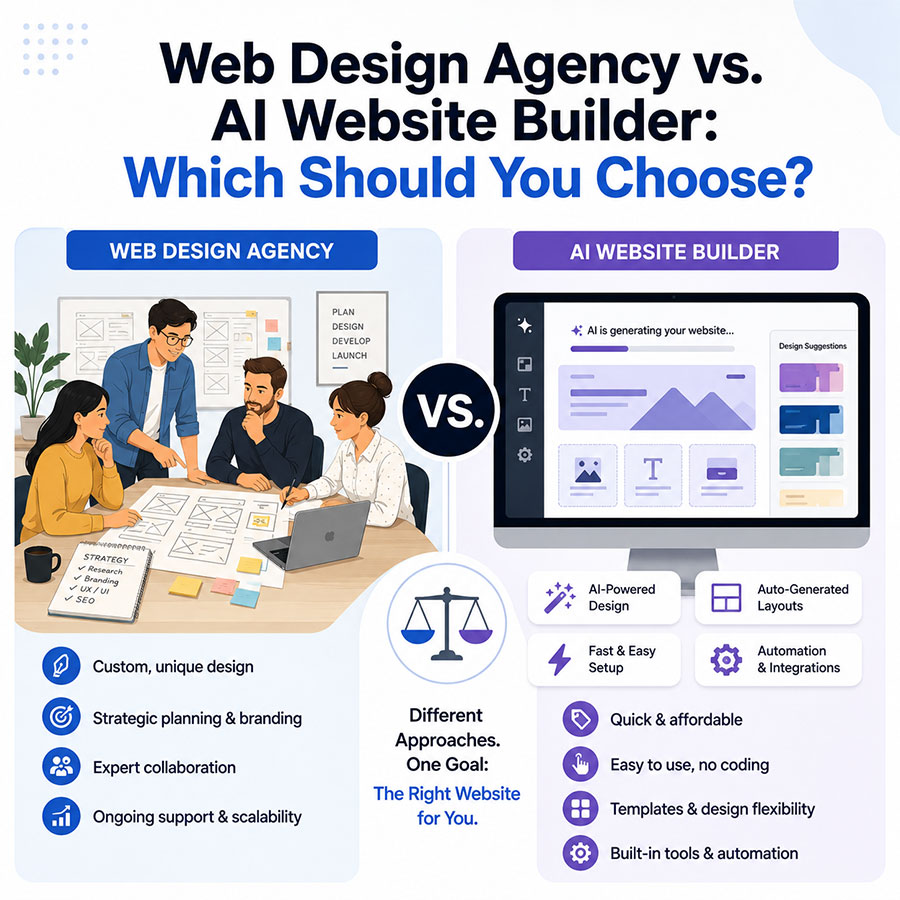
| Business Situation | Better Fit | Why |
|---|---|---|
| You need a quick temporary landing page | AI web design tool | Speed and simplicity may matter more than custom strategy |
| You need a serious business website | Web design agency | The site needs strategy, messaging, SEO, design quality, and conversion planning |
| You need ecommerce functionality | Web design agency | Product structure, checkout, payments, shipping, tax, analytics, and conversion flow require planning |
| You want to test early concepts | AI-assisted workflow | AI can help create early drafts before a larger build |
| You need custom workflows or integrations | Web design agency | Custom development needs architecture, testing, security, and technical oversight |
| You need both speed and quality | Hybrid approach | AI can support production while agency strategy guides the final result |
If the website is mainly a placeholder, AI may be enough. If the website is expected to support marketing, SEO, sales, recruitment, ecommerce, or enterprise communication, an agency-led process is usually stronger.
AI Web Design And Ecommerce
Ecommerce websites need more than attractive product pages. They need product organization, search and filtering, cart usability, secure checkout, payment configuration, shipping rules, tax settings, product content, analytics, speed, mobile usability, and trust signals.
AI can help generate product descriptions, page ideas, collection copy, promotional sections, and design inspiration. But ecommerce performance depends on the full buying experience.
Ecommerce websites need:
Product structure
Category planning
Checkout optimization
Payment setup
Shipping and tax configuration
Product page SEO
Cart and conversion testing
Mobile performance
Security and support
Businesses building online stores usually benefit from experienced ecommerce web development because technical setup, customer experience, and conversion details can directly affect revenue.
AI Web Design And WordPress
WordPress remains one of the most flexible platforms for business websites, service websites, blogs, landing pages, and content-driven SEO strategies.
AI can support a WordPress project by helping draft content, outline pages, create first-pass metadata, generate image ideas, or assist with code snippets. But WordPress still needs proper setup, theme selection or custom design, plugin management, speed optimization, security, backups, and long-term support.
A professional WordPress website design process can help businesses avoid common problems such as slow plugins, poor mobile layouts, weak content structure, thin service pages, and security risks.
AI can help build faster. Professional WordPress strategy helps build better.
Website Hosting, Maintenance, And Support Still Matter
AI can help create a website, but it does not remove the need for hosting, security, backups, updates, uptime monitoring, performance improvements, and support.
A website is not finished once it launches. It needs to be maintained.
Post-launch website needs may include:
Managed website hosting
SSL security
Regular backups
CMS updates
Plugin monitoring
Security checks
Performance optimization
Content updates
Analytics review
Ongoing technical support
Businesses that rely on their website should plan for managed website hosting and ongoing website maintenance and support, especially when the site supports sales, customer service, advertising, SEO, or ecommerce.
Common Mistakes Businesses Make With AI Web Design
AI web design can save time, but businesses should avoid assuming that faster always means better.
Common mistakes include:
Launching AI-generated content without editing
Using generic layouts that do not reflect the brand
Ignoring SEO structure
Forgetting mobile performance
Hiding important information in visuals
Skipping analytics and conversion tracking
Using AI copy that sounds vague or repetitive
Building without a support plan
Assuming a website builder replaces business strategy
A better approach is to use AI carefully:
Use AI to accelerate drafts
Use humans to refine strategy
Test performance before launch
Keep content clear and specific
Protect SEO foundations
Review accessibility and usability
Connect the website to analytics and business goals
The Future Of Web Design Is Not Human vs. AI
The future of web design is not about replacing every designer, developer, strategist, or marketer with AI. It is about using AI where it creates efficiency and using human expertise where judgment matters.
AI can help with speed, drafts, idea generation, code assistance, and repeatable tasks. A web design agency can guide strategy, positioning, creative direction, technical structure, SEO, content quality, integrations, analytics, and long-term performance.
The strongest websites will likely come from teams that know how to use both.
That means businesses should not ask only, “Can AI build my website?”
The better questions are:
Will this website support our business goals?
Will it help customers understand us faster?
Will it rank for the right searches?
Will it convert visitors into leads or customers?
Will it load quickly and work on mobile?
Will it scale as our business grows?
Will someone support it after launch?
Where Thought Media Fits
Thought Media helps businesses, enterprises, government organizations, NGOs, and public sector teams build digital experiences that combine web design, website development, WordPress website design, ecommerce web development, application development, AI strategy, SEO, AEO, digital marketing, managed hosting, website maintenance, video animation, IT services, hardware solutions, and custom AI development.
That broader approach matters because a website is rarely isolated. A strong website may need to support search visibility, ads, sales conversations, customer education, ecommerce, internal workflows, lead generation, recruitment, public communication, analytics, and long-term digital growth.
AI can help accelerate parts of the process. Human strategy helps make sure the final website is useful, credible, scalable, and aligned with business goals.
Final Thoughts
Web design with AI is not a passing trend. It is becoming part of how modern websites are planned, designed, written, tested, and improved.
But AI does not remove the need for strategy.
A web design agency brings human judgment, creative direction, technical experience, SEO planning, project management, and post-launch support. AI brings speed, efficiency, idea generation, automation, and scalability.
The best choice depends on the website’s purpose. Use AI when you need speed, testing, and draft support. Use a web design agency when the website has to perform, convert, rank, scale, and represent the business professionally. Use a hybrid approach when you want the efficiency of AI with the quality control of an experienced team.
The future of digital experiences belongs to businesses that use AI intelligently without giving up strategy, creativity, and accountability.
FAQ
Can AI replace a web design agency?
AI can replace some simple web design tasks, such as creating draft layouts, generating copy ideas, suggesting page sections, or helping with basic prototypes. However, AI does not fully replace a web design agency when a website needs strategy, custom development, SEO planning, ecommerce functionality, brand direction, integrations, analytics, or long-term support.
Is AI web design good for businesses?
AI web design can be useful for businesses that need quick drafts, simple landing pages, prototypes, or early design concepts. For more serious business websites, AI should usually be combined with professional strategy, editing, development, SEO, and performance review.
What is the difference between a web design agency and AI web design?
A web design agency provides human strategy, UX design, development, SEO planning, content structure, testing, launch support, and ongoing improvement. AI web design uses artificial intelligence to assist or automate parts of the process, such as layouts, copy drafts, concepts, and code suggestions.
When should I hire a web design agency instead of using AI?
You should consider hiring a web design agency when the website needs to generate leads, support sales, rank in search, process ecommerce transactions, integrate with other systems, represent a premium brand, meet accessibility requirements, or scale over time.
Can a web design agency use AI?
Yes. Many modern web design agencies use AI to support research, content drafts, design concepts, coding assistance, testing, automation, and optimization. The best use of AI is usually as a tool guided by experienced designers, developers, strategists, and SEO specialists.
Is AI web design cheaper than hiring an agency?
AI web design can be cheaper for simple websites, drafts, and prototypes. However, cost should be compared against risk, quality, strategy, SEO, support, and long-term business value. A low-cost website may become expensive if it fails to rank, convert, scale, or function properly.
Can AI build an ecommerce website?
AI can help with ecommerce page ideas, product descriptions, layout concepts, and some development tasks. However, ecommerce websites often need professional planning for checkout, payments, shipping, tax rules, security, analytics, product structure, SEO, and conversion optimization.
Does AI web design help with SEO?
AI can help draft SEO content, suggest keywords, outline pages, and create metadata ideas. However, SEO also requires technical structure, crawlability, content quality, internal linking, redirects, schema, speed, mobile usability, and search intent strategy.
What is a hybrid web design approach?
A hybrid web design approach combines AI tools with human expertise. AI may support drafts, layouts, research, code assistance, and content ideas, while a web design agency handles strategy, UX, brand direction, SEO, technical development, quality control, launch, and support.
Can Thought Media help with web design and AI?
Yes. Thought Media helps businesses with web design, website development, WordPress website design, ecommerce web development, application development, AI strategy, SEO, AEO, digital marketing, managed hosting, website maintenance, video animation, IT services, hardware solutions, and custom AI development.
The post Web Design Agency vs. Web Design with AI: What’s The Future? first appeared on Thought Media™.
]]>The post 13 Reasons Why A Website Management Agency in Las Vegas is Right first appeared on Thought Media™.
]]>1. Expertise in Web Technologies and Trends
The digital landscape is constantly evolving, with new web technologies and design trends emerging regularly. Staying on top of these changes can be time-consuming, especially if you’re focused on running a business. A professional agency brings specialized knowledge in web development, design and security. Instead of managing updates yourself, you’ll have a team that knows how to leverage the latest tools and techniques to improve your site’s performance.
2. Strong Focus on Security
Cybersecurity threats are on the rise, with attacks on small and medium-sized businesses becoming more common. A security breach can damage your reputation and lead to financial losses. Professional web management services prioritize keeping your website secure by implementing the latest security protocols, and installing SSL certificates. An agency will continuously monitor your site for potential risks and vulnerabilities, addressing them to avoid serious damage.
3. Optimized Website Speed
Slow websites drive visitors away. Research shows that even a delay of just a few seconds can lead to higher bounce rates and lower conversions. Experts in website management know how to optimize site performance. Whether it’s compressing images, or configuring caching, they make sure your site runs at peak speed.
4. Regular Updates without Interruptions
Content management systems (CMS), plugins, and software require regular updates to keep them secure and functioning correctly. However, updating these elements without proper technical know-how can sometimes cause the site to malfunction. Instead of risking downtime or errors, an experienced team will handle updates efficiently. They make sure everything is updated safely and that your site continues to run smoothly without disruption to users.
5. Scalability as Your Business Grows
As your Las Vegas business grows, your website must grow with it. You might need more server capacity, additional features, or enhanced functionality to handle increasing traffic and customer demands. A professional agency can ensure your website is scalable, allowing for smooth transitions as your business expands. They can build in flexibility so your site continues to perform well, even as you add new products, services, or content.
6. Enhanced User Experience (UX)
User experience is a key factor in keeping visitors engaged and converting them into customers. A website that’s difficult to navigate or confusing can drive potential customers away. By partnering with a management agency, you ensure your site is user-friendly and optimized for customer journeys. Professionals can streamline navigation, improve layout designs, and simplify the checkout process. This ensures visitors have a seamless experience from start to finish.
7. SEO-Optimized Content and Structure
It’s not enough to have a great website if no one can find it. Search engine optimization helps attract traffic, especially in a competitive market like Las Vegas. An agency can ensure that your site has SEO best practices from the start. They do this by optimizing Meta tags, improving page speed, and creating a logical site structure. Ongoing optimization ensures that your site continues to rank well for relevant search terms, helping you attract more organic visitors.
8. Fresh, Updated Content
Your website needs regular updates with new blogs, product descriptions, case studies, or other relevant material. However, constantly producing fresh content can be a challenge. A website management agency can help with content updates and strategy, ensuring that your site stays current and appealing to both users and search engines. Regular content updates also improve your SEO performance, as search engines favor fresh, relevant material.
9. Mobile Optimization
With more than half of all web traffic now coming from mobile devices, having a site that’s optimized for smartphones and tablets is essential. A site that isn’t mobile-friendly risks losing visitors quickly, leading to lower engagement and missed opportunities.
Experts in website management will ensure your site works seamlessly across all devices. This includes responsive design, fast loading times on mobile, and easy navigation for small screens. By improving the mobile experience, you’ll attract more users and improve your overall site performance.
10. Conversion Rate Optimization (CRO)
Driving traffic to your website is only the first step—the ultimate goal is to convert visitors into paying customers. Website management services can analyze your site’s performance, identify areas for improvement, and implement strategies to boost conversion rates. From simplifying the checkout process to improving calls to action (CTAs), they’ll make sure your website is set up to turn casual visitors into loyal customers.
11. Advanced Analytics and Insights
A management agency can provide advanced analytics and performance tracking using tools like Google Analytics, giving you insights into visitor behavior, traffic sources, and conversion rates. These insights allow you to optimize your marketing strategies, better understand your audience, and make data-driven decisions to grow your business.
12. 24/7 Monitoring and Technical Support
Website issues can happen at any time, and even a small amount of downtime can result in lost sales or frustrated customers. With a website management team in place, you benefit from constant monitoring and rapid response to any technical problems. The team is always there to fix problems quickly, minimizing any potential downtime.
13. Cost-Effective Solution
Managing a website in-house can be costly, especially when it requires hiring full-time developers. Working with a website management agency is a more cost-effective solution, providing you access to a team of skilled professionals without the overhead of a full-time hire. For a fraction of the cost, you’ll get the support you need to ensure your website stays secure, up-to-date, and performing at its best.
Let Thought Media Elevate Your Website
Are you ready to take your website to the next level? Contact Thought Media today for a free consultation. Let us handle your website management needs while you focus on what matters most—growing your business. With our expert team, you’ll get a site that not only looks great but drives results. Reach out to Thought Media today and discover how we can help your business thrive in Las Vegas.
The post 13 Reasons Why A Website Management Agency in Las Vegas is Right first appeared on Thought Media™.
]]>The post 7 Reasons to Hire an E-Commerce Website Design Agency in Las Vegas first appeared on Thought Media™.
]]>1. Understanding the Las Vegas Market
Las Vegas is a vibrant city with a unique mix of local customers and millions of visitors. Your e-commerce site needs to appeal to both. Tourists may look for quick deals or exclusive items, while local customers may seek out loyalty programs and personalized shopping experiences. An e-commerce design agency familiar with the Las Vegas market understands these customer needs. They can create a website that maximizes your reach to both groups. Additionally, an agency ensures your website can handle global traffic. They will ensure your site works across different countries, languages, and currencies, helping you tap into international markets.
2. a User-Friendly Experience
Studies show that 88% of users won’t return to a website after a bad experience. This is why user experience (UX) is so important. An e-commerce design agency knows how to create an intuitive and smooth user experience. From the homepage to the checkout process, the agency will design a website that makes it easy for customers to navigate and find what they need. The goal is to reduce friction and guide users through the buying process. This approach improves customer satisfaction and increases your chances of turning visitors into paying customers.

3. Optimizing for Mobile Shoppers
Mobile shopping is on the rise. In fact, over 72% of all e-commerce sales will come from mobile devices by 2024. If your website isn’t optimized for mobile, you’re missing out on a huge audience. A professional e-commerce agency focuses on mobile-first design. This means your website will work seamlessly on smartphones and tablets. The agency ensures that your site loads quickly is easy to navigate, and provides a smooth checkout experience on any device. This is critical for attracting customers who are always on the go. Mobile optimization can make a big difference in sales in a city like Las Vegas, where fast and convenient shopping is key.
4. Boosting Visibility with SEO
A great website doesn’t matter if no one can find it. This is where search engine optimization (SEO) comes in. SEO helps your website rank higher in search engine results, bringing in more traffic.
An e-commerce design agency understands SEO and incorporates it into every aspect of your website. They will optimize your site’s structure, speed, and content to ensure it ranks well for relevant keywords. A well-optimized site can help you stand out from competitors in Las Vegas and beyond. With more organic traffic, you’ll have more opportunities to convert visitors into customers—without relying heavily on paid ads.
5. Focusing on Conversions
Attracting traffic is just the first step. The real goal is to turn visitors into buyers. This is where conversion rate optimization (CRO) comes in. An e-commerce design agency specializes in optimizing your website for conversions. This means they focus on improving the elements that encourage people to purchase. They’ll analyze your site’s layout, calls to action, and checkout process to remove any barriers to buying. Small changes, like simplifying the checkout steps or improving the design of a product page can lead to significant increases in sales. With expert CRO, your site will be designed to maximize every visitor’s potential to buy.
6. Scalable Solutions for Growth
Your business will grow, and your website needs to grow with it. An e-commerce design agency can build a website that scales as your business expands. They can also integrate advanced features, like personalized shopping experiences, product recommendations, and chatbots, to keep your website competitive in a fast-changing market. Plus, many agencies offer ongoing support. This means they can help with future updates, security fixes, and new features, ensuring your website performs well over time.
7. Custom Integrations for Efficiency
An e-commerce design agency can help you integrate the tools you need to run your business efficiently. From connecting your website to inventory management systems to setting up custom payment gateways, an agency has the technical expertise to make it happen. They can also implement advanced analytics tools, helping you understand how customers interact with your site. By streamlining processes and adding custom features, you can improve the customer experience while saving your business time and resources.
Why a Local Agency is Key for Las Vegas Businesses
Las Vegas is unlike any other market. It’s home to both local shoppers and millions of tourists each year. This unique blend of audiences requires a tailored approach to e-commerce. A local e-commerce design agency understands the city’s specific market dynamics. They know how to create websites that appeal to tourists and locals, ensuring your business can thrive in this fast-paced environment. With local insights, they can also help you navigate the competitive landscape, ensuring your website stands out among the many businesses in the area.
Your E-Commerce Design Partner in Las Vegas
If you’re looking to take your e-commerce business in Las Vegas to the next level, Thought Media can help. We specialize in building custom e-commerce websites that drive results. Our team of experts focuses on creating websites that are not only beautiful but also optimized for performance, conversions, and growth.
At Thought Media, we offer:
- Custom e-commerce website design tailored to your brand and business goals
- Mobile-first design to reach customers on any device
- SEO optimization to boost visibility and attract more traffic
- Conversion rate optimization to maximize sales
- Advanced integrations to streamline your business processes
- Ongoing support to ensure your site grows with your business
Get Started with Thought Media Today
Ready to build an e-commerce website that sets your Las Vegas business apart? Contact Thought Media today for a free consultation. Let us help you create a website that looks great and drives sales, attracts customers, and grows your brand. We can build a powerful online presence that elevates your business to new heights.
The post 7 Reasons to Hire an E-Commerce Website Design Agency in Las Vegas first appeared on Thought Media™.
]]>