


 These 13 examples of AI advertising are ways companies have leveraged artificial intelligence to cut costs and rapidly create impressive advertising campaigns.
You’re not imagining it; AI ads are getting smarter. They anticipate your needs, match your vibe, and sometimes feel like they’re reading your mind. Behind this magic? Artificial Intelligence. It’s no longer a futuristic idea; it’s happening now, reshaping how brands communicate with us in ways that feel surprisingly human.
AI is making traditional advertising more intuitive, dynamic, and impactful. It’s helping brands skip the guesswork, creating campaigns that truly resonate with their audiences. From hyper-personalized content to bold, data-driven storytelling, AI is the creative powerhouse many of today’s brands swear by.
AI animation is another excellent tool many of these companies are leveraging besides creating graphic designs with AI.
In this post, we’re exploring 13 standout examples of AI in advertising. Let’s break down why they work, the tech behind them, and how they’re setting new standards for creativity and connection.
How AI Is Used In Advertising
Artificial intelligence is changing advertising because it helps brands understand audiences, create content faster, personalize campaigns, optimize media spend, and test ideas at a much larger scale.
In the past, advertising teams relied heavily on manual research, creative brainstorming, production timelines, and delayed performance reports.
AI speeds up many of those steps.
It can analyze customer behavior, identify patterns, generate campaign concepts, personalize creative, improve targeting, test ad variations, summarize performance, and help marketers make better decisions faster.
That does not mean AI replaces advertising strategy.
It means advertising teams can use AI to support better strategy, faster production, and more informed execution.
| AI Advertising Use Case | What It Does | Business Benefit |
|---|---|---|
| Audience analysis | Reviews customer behavior, interests, and patterns | Helps brands understand who they are speaking to |
| Creative generation | Produces concepts, copy, visuals, scripts, and video ideas | Speeds up campaign development |
| Personalization | Adjusts ads based on user data, preferences, location, or behavior | Makes campaigns feel more relevant |
| Predictive targeting | Uses data to predict which users may respond | Improves media efficiency |
| Dynamic creative optimization | Tests and adjusts ad creative in real time | Helps improve performance |
| Chatbots and conversational ads | Supports interactive ad experiences and customer questions | Improves engagement and response speed |
| AI video and image generation | Creates visual campaign assets from prompts or source material | Lowers production friction |
| Performance analysis | Summarizes results and identifies trends | Helps marketers optimize faster |
The most successful AI advertising examples usually combine three things:
- A strong brand idea
- Useful customer data
- Creative use of technology
AI alone is not the campaign.
AI is the engine behind the campaign.
The brand still needs a message, a reason to care, and a clear outcome.
AI Advertising Use Cases By Campaign Goal
Different AI tools support different advertising goals.
A brand awareness campaign may use AI differently than a lead generation campaign. A retail brand may use AI for personalization, while an automotive brand may use it for immersive creative. A B2B company may use AI for account-based marketing, audience segmentation, and content testing.
Before choosing a tool or campaign format, advertisers should connect AI to a clear business goal.
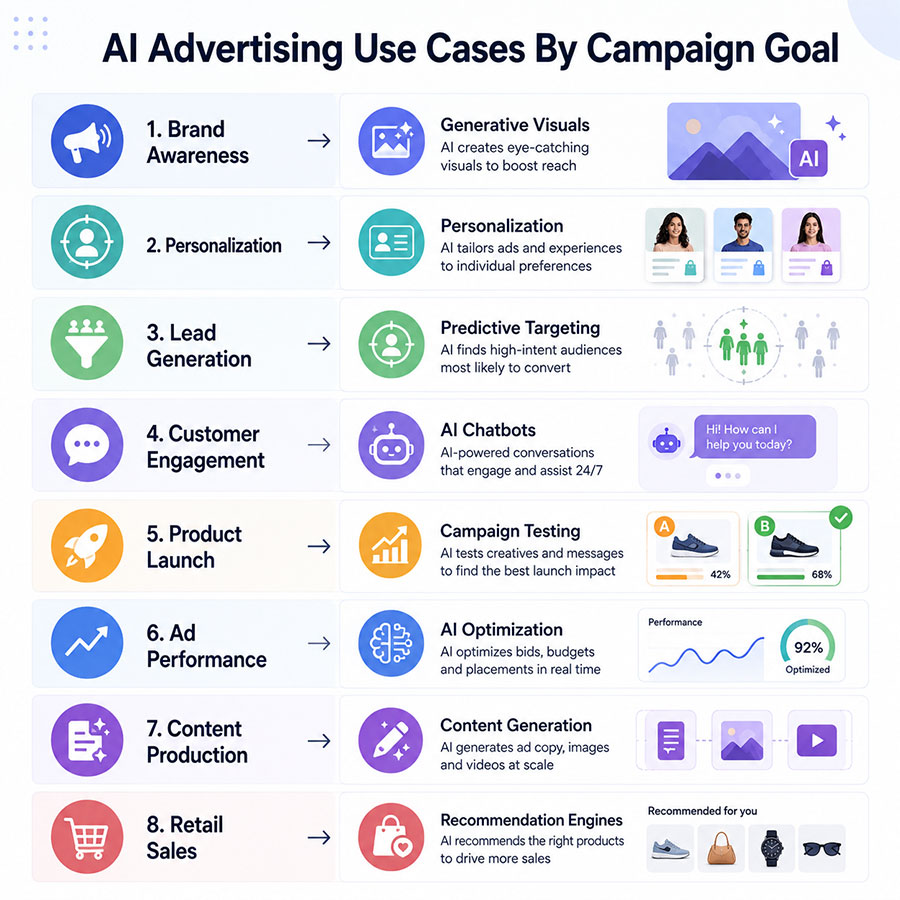
| Campaign Goal | AI Advertising Approach | Example Application |
|---|---|---|
| Increase brand awareness | Generative AI visuals, interactive social campaigns, AI video | Create shareable campaign assets that spark attention |
| Improve personalization | Product recommendations, dynamic ads, customer segmentation | Show different creative based on user preferences |
| Generate more leads | Predictive targeting, landing page testing, AI copy variations | Improve conversion rates and reduce wasted ad spend |
| Improve customer engagement | Chatbots, conversational ads, interactive quizzes | Let users interact with the brand before converting |
| Launch a new product | AI-generated product visuals, campaign concepts, audience testing | Test creative angles before production |
| Improve ad performance | Automated bidding, creative testing, audience optimization | Shift budget toward better-performing ads |
| Scale content production | AI copy, video, image, and social asset generation | Produce more campaign variations faster |
| Support retail sales | Personalized offers, recommendation engines, local inventory ads | Match products to customer intent |
AI Advertising Goal Chart
| Goal | AI Impact |
|---|---|
| Personalization | ████████████████████ Very High |
| Creative testing | ███████████████████ High |
| Audience targeting | ███████████████████ High |
| Content production | ███████████████████ High |
| Performance optimization | █████████████████ Medium-High |
| Customer engagement | ███████████████ Medium |
| Brand storytelling | ███████████████ Medium |
| Long-term brand trust | ███████████ Needs human strategy |
This is important because AI advertising can easily become gimmicky.
A campaign should not use AI just because it is trendy.
It should use AI because it helps the brand communicate better, produce smarter creative, reach the right audience, or improve campaign performance.
The strongest AI advertising campaigns are not only technically impressive.
They are strategically useful.
AI Advertising Platform And Tool Categories
AI advertising is not one single technology.
It includes many different tools and systems across the advertising workflow.
Some tools help with creative production. Some help with media buying. Some help with personalization. Others support analytics, automation, customer interaction, or campaign testing.
Businesses should understand which category they actually need before investing in AI advertising.
| Tool Category | What It Helps With | Best For |
|---|---|---|
| Generative image tools | Campaign visuals, mockups, concept art, ad variations | Creative teams and brand campaigns |
| Generative video tools | AI video clips, social content, product visuals, animation concepts | Social media, product launches, campaign testing |
| AI copywriting tools | Headlines, ad copy, email copy, scripts, captions | PPC, social ads, landing pages, email campaigns |
| Predictive analytics tools | Audience behaviour, performance forecasting, conversion patterns | Media planning and growth marketing |
| Ad platform AI | Automated bidding, targeting, placement, budget optimization | Google Ads, Meta Ads, LinkedIn Ads, programmatic campaigns |
| Personalization engines | Product recommendations, dynamic content, user-specific offers | E-commerce, retail, SaaS, content platforms |
| Chatbots and AI assistants | Conversational advertising and customer support | Lead generation, customer service, qualification |
| AI reporting tools | Performance summaries, trend detection, campaign insights | Marketing teams and executives |
AI Advertising Workflow
| Stage | AI Support |
|---|---|
| Research | Audience analysis, trend discovery, competitor review |
| Strategy | Campaign angle testing, message mapping, channel planning |
| Creative | Copy, visuals, storyboards, video, campaign concepts |
| Targeting | Audience segmentation and predictive intent |
| Launch | Automated bidding, placement, and creative delivery |
| Optimization | A/B testing, dynamic creative, performance adjustment |
| Reporting | Campaign summaries, insights, and next-step recommendations |
AI can support nearly every stage of advertising.
But the workflow still needs human direction.
A marketing team still needs to decide:
- What the campaign is trying to achieve
- Who the campaign is for
- What message should be communicated
- Which channels matter
- What creative is on-brand
- What claims need review
- What results are acceptable
- What should be tested next
AI can make advertising faster.
But human strategy keeps it focused.
Benefits And Risks Of AI In Advertising
AI can make advertising more efficient, more personalized, and more scalable.
But it also creates risks if brands use it carelessly.
The same tools that help companies generate content faster can also create generic creative, inaccurate claims, biased targeting, brand inconsistency, or customer trust issues.
That is why businesses should treat AI advertising as a strategic capability, not just a shortcut.
| Benefit | Why It Matters |
|---|---|
| Faster creative development | Teams can test more campaign concepts in less time |
| Better personalization | Ads can become more relevant to specific users |
| Improved targeting | AI can help identify stronger audience segments |
| More efficient media spend | Campaigns can shift budget toward better-performing placements |
| Scalable content production | Brands can produce more ad variations across channels |
| Better performance insights | AI can summarize data and highlight optimization opportunities |
| Stronger testing velocity | Teams can compare more headlines, visuals, offers, and landing pages |
| Risk | What Businesses Should Watch |
|---|---|
| Generic creative | AI outputs can feel repetitive without strong brand direction |
| Inaccurate claims | AI-generated copy must be fact-checked before publishing |
| Brand inconsistency | AI visuals and messaging may drift from brand standards |
| Privacy concerns | Personalization must respect data rules and customer expectations |
| Bias in targeting | AI systems can reflect flawed or incomplete data |
| Over-automation | Campaigns can lose human judgment and emotional relevance |
| Legal and licensing concerns | Businesses must review usage rights for AI-generated assets |
AI Advertising Risk-Reward Chart
| Area | Opportunity | Risk Level |
|---|---|---|
| Creative concepting | High | Medium |
| Audience targeting | High | Medium-High |
| Personalization | Very High | High |
| AI-generated visuals | High | Medium |
| AI-generated copy | High | Medium |
| Automated media buying | High | Medium |
| Customer-facing chatbots | Medium-High | Medium-High |
| Regulated industry campaigns | Medium | High |
The key is balance.
AI should help advertisers move faster without lowering quality, accuracy, or trust.
Before launching AI-generated campaign assets, businesses should review:
- Is the message accurate?
- Is the creative on-brand?
- Are claims supportable?
- Are usage rights clear?
- Is personal data being used responsibly?
- Does the campaign respect platform policies?
- Is a human reviewing the output?
- Does the campaign still feel authentic?
AI can help brands create more.
But better advertising still depends on trust.
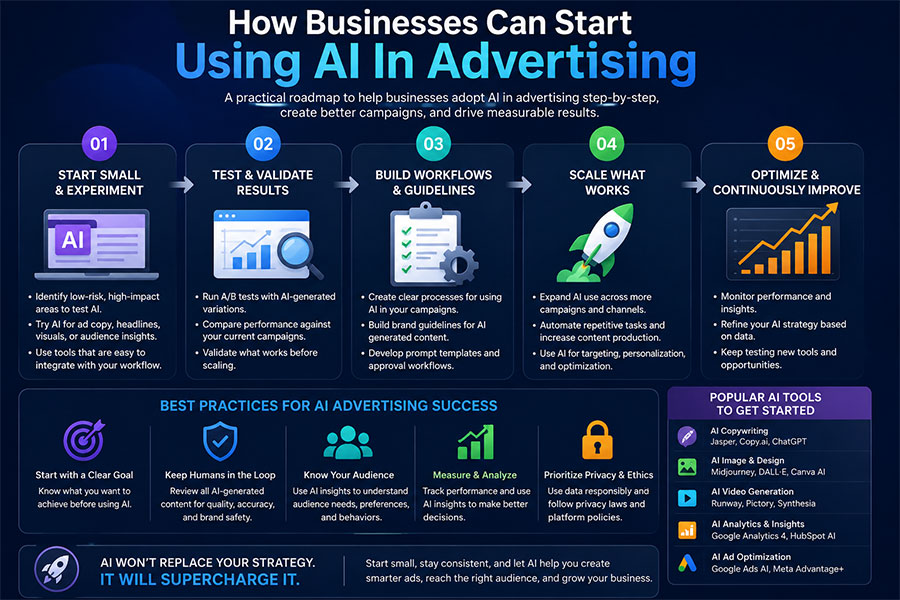
How Businesses Can Start Using AI In Advertising
Businesses do not need to rebuild their entire advertising strategy overnight.
A practical AI advertising rollout can start with one or two focused use cases.
For example, a business might begin by using AI to generate ad headline variations, summarize campaign performance, repurpose blog content into video scripts, or create early visual concepts before investing in full production.
The best approach is to start small, measure results, and expand what works.
| Starting Point | Best Use | Difficulty |
|---|---|---|
| AI ad copy variations | Test headlines, descriptions, and CTAs | Low |
| AI campaign summaries | Turn analytics data into performance insights | Low |
| AI visual concepts | Explore creative directions before production | Medium |
| AI video drafts | Create short-form social or concept videos | Medium |
| AI personalization | Tailor ads or landing pages to audience segments | Medium-High |
| Predictive audience targeting | Improve media efficiency through data modelling | High |
| Custom AI advertising systems | Build proprietary tools, dashboards, or automation | High |
Simple AI Advertising Adoption Roadmap
| Phase | Focus | What To Do |
|---|---|---|
| Phase 1 | Experiment | Test AI copy, visuals, campaign ideas, and reporting summaries |
| Phase 2 | Validate | Compare AI-assisted campaigns against existing performance |
| Phase 3 | Systemize | Create workflows, review processes, prompt libraries, and brand rules |
| Phase 4 | Scale | Expand AI use across creative, targeting, analytics, and optimization |
| Phase 5 | Customize | Build custom AI tools, integrations, dashboards, or automation systems |
Businesses should avoid using AI randomly across every campaign.
Instead, use AI where it can remove friction or improve results.
Good starting questions include:
- Where does our advertising process move too slowly?
- Where do we need more creative variations?
- Where are we wasting ad budget?
- Where do we need better customer insights?
- Which content could be repurposed into ads?
- Which campaigns need stronger personalization?
- Which reports take too long to prepare?
- Which creative ideas need faster testing?
AI works best when it solves a real bottleneck.
13 Examples of AI Advertising Campaigns
These 13 AI advertising examples are fantastic ways these companies adopted a new strategy for advertising that is often more cost efficient and quicker to launch. You can also learn more about the best AI tools for creating advertising campaigns.
1. Coca-Cola’s “Create Real Magic” Campaign

Coca-Cola has stepped boldly into the future with their “Create Real Magic” campaign. Partnering with OpenAI’s GPT-4 and DALL-E, the brand invited artists worldwide to craft AI-generated artwork using its iconic branding elements, like the classic Coke bottle and vintage ad symbols. Source
What’s brilliant about this campaign is how it marries tradition with innovation. Coca-Cola gave participants access to their rich visual archives and let them remix history with cutting-edge AI tools. The result? A flood of striking digital art that feels both familiar and fresh. The campaign does more than showcase cool tech; it builds a deeper connection with younger, tech-savvy audiences.
2. Nike’s “Never Done Evolving” Campaign
 Leave it to Nike to push boundaries. For their 50th anniversary, they turned to A.I. to create a virtual tennis match between Serena Williams from 1999 and Serena from 2017. Yep, you read that right. Nike used AI and machine learning to analyze her playing style from different points in her career and generated an epic simulation of the GOAT facing. Source
What makes this campaign so genius is how it blends nostalgia with innovation. Fans got to see Serena’s evolution as an athlete in a way that was totally fresh and unexpected. It wasn’t just about honoring her legacy; it was about showing how far both Serena and Nike have come.
3. Heinz’s “A.I. Ketchup” Campaign

Heinz, the ketchup icon we all know, decided to test a theory: when people think “ketchup,” do they picture Heinz? To find out, they teamed up with DALL-E 2, an AI image generator, and asked it to visualize “ketchup.” The results? Almost every image resembled Heinz’s signature bottle, even with prompts like “Renaissance Ketchup Bottle” and “Ketchup Tarot Card.” Source
This campaign brilliantly showcased Heinz’s dominance in the ketchup world. It was a clever way to let technology highlight their brand’s iconic status without overt self-promotion. Heinz didn’t stop there. They expanded the campaign by inviting social media users to submit their own prompts and share the AI-generated images. This interactive element not only engaged their audience but also created a buzz that spread across digital platforms.
4. Starbucks’ “Deep Brew” Initiative
 Starbucks has always been about that personal touch, knowing your name and your go-to order. But with millions of customers worldwide, how do they keep it so personal? Enter “Deep Brew,” Starbucks’ AI-driven platform designed to enhance personalization and operational efficiency. When you open the Starbucks app; you’re greeted with drink suggestions that feel like they were made just for you.
But Deep Brew isn’t just about making your coffee experience smoother; it’s also a game-changer behind the scenes. The AI optimizes store operations by predicting customer traffic patterns, ensuring that each location is adequately staffed and stocked. This level of efficiency means baristas can focus more on crafting your favorite drinks and less on juggling inventory or schedules. It’s a seamless blend of technology and human touch, enhancing the overall Starbucks experience.
5. Sephora’s AI-Powered Beauty Experiences
 Sephora has taken beauty shopping to the next level with its clever use of AI. Whether you’re a makeup newbie or a seasoned pro, they’ve made picking the perfect products ridiculously easy and super fun. One of their star tools is the Sephora Virtual Artist, a feature in their app that uses augmented reality (AR) and AI to let you try on makeup virtually. Source
Swipe through hundreds of shades of lipstick, blush, and more while seeing exactly how it’ll look on your face in real-time. No guesswork, no messy testers, just a customized experience right from your phone. Their Color IQ system scans your skin tone to pinpoint the exact foundation shade for you. It’s this seamless blend of technology and personalization that has made Sephora the gold standard in beauty retail, proving that when tech meets self-expression, magic happens.
6. BMW’s “The Ultimate AI Masterpiece” Campaign

Leave it to BMW to turn a car into a moving piece of art. In their “The Ultimate AI Masterpiece” campaign, they blended centuries of art history with cutting-edge technology to create something truly unforgettable. Source
Here’s how it worked: BMW collaborated with creative technologist Nathan Shipley and art collector Gary Yeh to feed an AI over 50,000 images spanning 900 years of art history. Then, they added works from contemporary artists connected to BMW’s cultural initiatives.
The AI processed this mix of old and new to create entirely original artwork, which was then projected onto the sleek surface of the 8 Series Gran Coupé. What makes this campaign a stroke of genius is how it bridges the gap between tradition and innovation. It’s not just a car; it’s a dynamic showcase of what happens when art meets AI.
7. L’Oréal’s Generative AI Lab

L’Oréal is proving that beauty and tech make the ultimate power couple. With their Generative AI Lab, they’ve partnered with NVIDIA and WPP Open to transform how digital marketing works in the beauty world. From creating stunning visuals to automating personalized campaigns, L’Oréal is using AI to shake up the industry in ways we didn’t know we needed. Source
The standout initiative, CreAItech, lets L’Oréal experiment with generative AI in a controlled environment. Think of it as a creative playground where the tech designs custom content, improves media planning, and even influences product development. What’s genius here is how L’Oréal is blending cutting-edge tech with their rich expertise in beauty. They’re setting a new standard for personalized customer experiences, proving that AI can amplify creativity and make every interaction feel tailored.
8. Dove’s “The Code” Campaign
Dove has always been about real beauty, and with “The Code,” they’re doubling down on their mission to keep it
 authentic. In a world where AI is shaping beauty standards with flawless, unrealistic models, Dove is saying, “Not on our watch.” Their campaign pledges to never use AI to create or manipulate images of women in their ads. It is a bold move that challenges an industry increasingly dominated by digital distortion. Source
To back this up, Dove launched the Real Beauty Prompt Playbook, a free tool for creators and brands. It’s designed to help them use AI ethically and create content that celebrates diversity and authenticity. This is especially important when Dove’s research shows that 39% of women feel pressured to change their appearance because of the hyper-perfect images they see online. By addressing these issues head-on, Dove is helping reframe what beauty looks like in the digital age.
9. Spotify’s “Only You” Campaign
Spotify knows that your music taste is as unique as your fingerprint, and they celebrated that individuality with their “Only You” campaign. Powered by AI, this campaign dives into your listening habits to craft a personalized story that’s so you. Source
Think custom playlists, quirky insights like your most-streamed artists, and even surprising pairings that show just how eclectic your musical taste really is. Your favorite genres, guilty pleasure songs, and unexpected artist combos are wrapped into a fun, shareable experience. “Only You” nailed it by making personalization exciting and social. People couldn’t wait to share their results on Instagram or Twitter, showing off their musical quirks.
10. McDonald’s AI-Generated “The Perfect Fried Chicken” Campaign

McDonald’s Thailand took a bold step into the future by teaming up with AI to discover what makes the perfect fried chicken. They started by consulting ChatGPT to understand customer preferences, then used Midjourney to create mouth-watering images based on those insights. Source
The result? A campaign that not only showcased tantalizing visuals but also resonated with what customers crave. This innovative approach allowed McDonald’s to tap into AI’s potential to decode and deliver on customer desires. The success of this campaign highlights the power of AI advertising in creating content that truly connects with audiences.
11. Coca-Cola’s AI-Generated Holiday Campaign

Coca-Cola’s holiday ads are the stuff of legend, and in 2024, they gave their classic “Holidays Are Coming” vibe a high-tech twist. Teaming up with cutting-edge AI studios, Coca-Cola created three short videos that reimagined their beloved 1995 holiday campaign. The twist? Each video featured AI-generated visuals tailored to reflect different cities, giving the iconic campaign a local and modern touch. Source
The results were bold—and yes, a little polarizing. Some loved the innovative spin, while others found the AI-crafted visuals a bit uncanny. But Coca-Cola showed they’re not afraid to experiment, blending AI’s efficiency with their signature festive warmth. It’s a daring step that sparked conversations and kept the brand at the forefront of holiday nostalgia.
12. Headway’s AI-Enhanced Ad Campaigns

Headway, the edtech startup from Ukraine, is proving that AI is a game-changer for anyone bold enough to try it. By integrating tools like ChatGPT, Midjourney, and HeyGen, they’ve completely reimagined how they create and deliver ads. The result? A 40% boost in video ad returns and over 3.3 billion ad impressions in just six months. Not bad for a startup, right? Source
At first, Headway’s team was cautious about diving into AI, but CEO Anton Pavlovsky soon saw its massive potential. He even compared its transformative power to the internet and smartphones. Once the team got on board, they created a cross-functional AI squad to embed these tools across their marketing strategy.
13. Nike’s AI-Powered “By You” Campaign

Nike gets it—your kicks should be as unique as you are. That’s why they launched their “By You” campaign, putting AI to work to give customers a next-level personalization experience. This isn’t your average sneaker customization tool. Nike’s AI-powered platform lets you play with colors and materials and even add personal touches like inscriptions, all while seeing your creation come to life in real time. Source
Nike’s AI doesn’t just let you design; it makes the process seamless by suggesting trendy combos and tapping into your style preferences. The genius of “By You” lies in how it bridges individuality with brand loyalty.
AI Advertising Is Changing The Game — Are You Ready?
AI is more than just a buzzword as well as AI advertising — it’s the creative engine behind some of the most groundbreaking campaigns today. These 13 examples show us what’s possible when brands combine technology with bold storytelling and a deep understanding of their audience. The result? Ads that don’t just sell but stick. The brands that embrace AI today are the ones shaping the future of advertising tomorrow.
Final Thoughts About Advertising with AI
Artificial intelligence is no longer a future concept in advertising.
It is already shaping how brands create campaigns, personalize experiences, analyze audiences, test creative, optimize media, and connect with customers.
The strongest examples of AI in advertising show that the technology is most powerful when it supports a real brand idea.
Coca-Cola used AI to invite creative participation.
Nike used AI to reimagine athletic legacy and personalization.
Heinz used AI to prove the strength of its brand identity.
Starbucks used AI to improve customer experience and operations.
Sephora used AI to make product discovery more personal.
BMW used AI to merge art, technology, and storytelling.
These campaigns worked because AI was not used as a gimmick.
It was connected to the brand, the audience, and the campaign objective.
For businesses, the lesson is clear.
AI can help advertising teams move faster, create more, personalize better, and optimize smarter.
But it still needs strategy.
It still needs human review.
It still needs brand judgment.
It still needs a clear reason to exist.
The future of advertising will not be AI instead of creativity.
It will be AI supporting better creativity, better data, better storytelling, and better business outcomes.
FAQ
What Is AI Advertising?
AI advertising is the use of artificial intelligence to improve advertising strategy, creative production, audience targeting, personalization, media buying, campaign optimization, and reporting. It can help businesses create better ads, test more ideas, and reach more relevant audiences.
How Is Artificial Intelligence Used In Advertising?
Artificial intelligence is used in advertising for audience analysis, ad targeting, copywriting, image generation, video generation, personalization, automated bidding, dynamic creative testing, chatbot experiences, predictive analytics, and campaign reporting.
What Are Examples Of AI In Advertising?
Examples of AI in advertising include Coca-Cola’s “Create Real Magic” campaign, Nike’s AI-powered campaigns, Heinz’s AI ketchup campaign, Starbucks’ Deep Brew personalization system, Sephora’s virtual beauty experiences, BMW’s AI art campaign, and L’Oréal’s generative AI marketing lab.
Can AI Create Advertising Campaigns?
AI can help create advertising campaign concepts, visuals, scripts, copy, audience segments, video drafts, and performance recommendations. However, strong advertising campaigns still need human strategy, brand direction, creative judgment, and final review.
Is AI Advertising Good For Small Businesses?
Yes. AI advertising can help small businesses create more content, test ad copy, improve targeting, generate social media videos, summarize analytics, and reduce production friction. Small businesses should start with practical use cases instead of trying to automate everything at once.
What Are The Benefits Of AI In Advertising?
The benefits of AI in advertising include faster creative production, better personalization, improved audience targeting, more efficient media spend, scalable content creation, faster testing, and better campaign insights.
What Are The Risks Of AI In Advertising?
The risks of AI in advertising include generic creative, inaccurate claims, privacy concerns, biased targeting, brand inconsistency, unclear licensing rights, and over-automation. Businesses should use human review and clear brand guidelines before publishing AI-generated campaign content.
Can AI Replace Advertising Agencies?
AI can support advertising agencies, but it does not fully replace strategy, creative direction, brand positioning, media planning, campaign management, or human judgment. The best agencies use AI as a tool to improve speed, insight, and execution.
What AI Tools Are Used For Advertising?
AI tools used for advertising may include generative image tools, AI video platforms, copywriting tools, predictive analytics software, ad platform automation, personalization engines, chatbots, reporting tools, and custom AI systems.
Can Thought Media Help With AI Advertising?
Yes. Thought Media helps businesses use AI in advertising through digital marketing, AI development, campaign strategy, animation, video production, web design, SEO, AEO, analytics, managed hosting, and custom business technology solutions.