


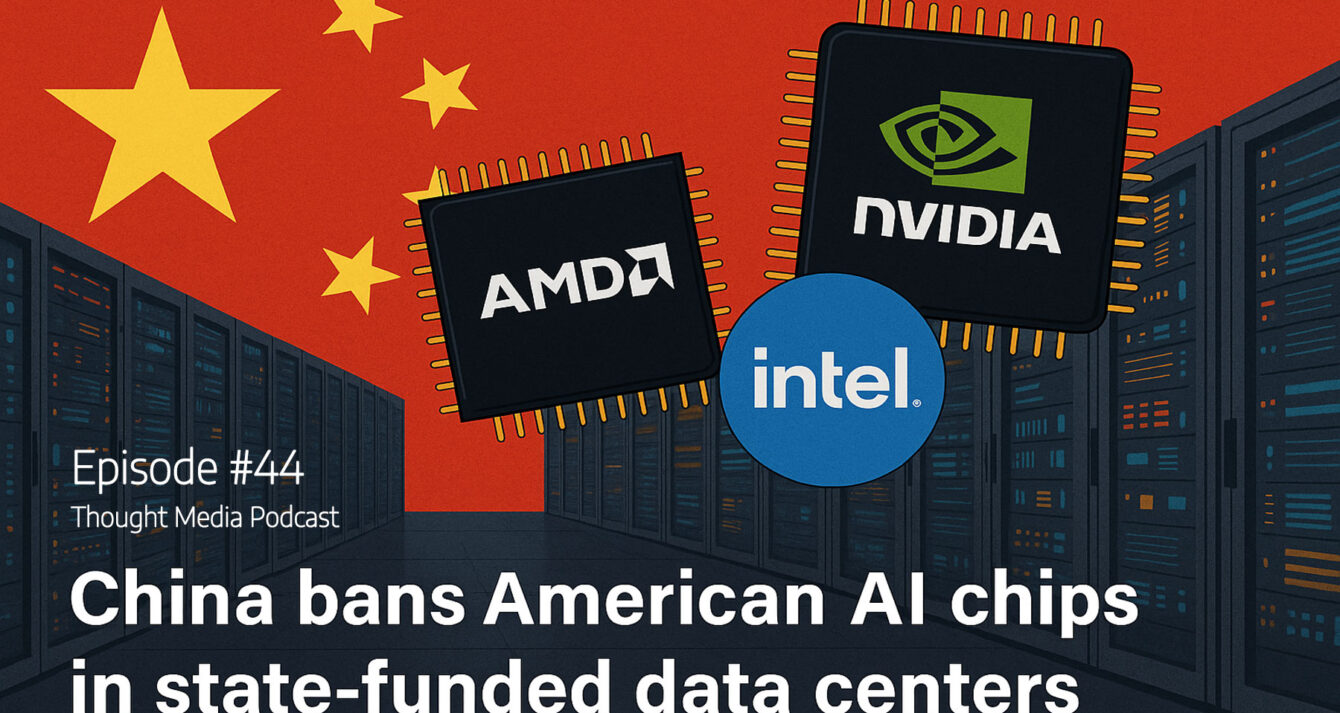


In Episode 44 of the Thought Media™ Podcast, hosts Ava and Max analyze China’s groundbreaking decision to ban foreign AI chips — including those made by NVIDIA, AMD, and Intel — from all state-funded data centers. The ruling marks a pivotal moment in the global tech landscape and represents China’s most decisive step yet toward semiconductor self-sufficiency.
Under the new policy, projects that are less than 30% complete must remove or cancel all foreign hardware, while more advanced ones will be reviewed on a case-by-case basis. The move is designed to boost domestic chipmakers like Huawei and elevate China’s control over its artificial intelligence infrastructure. By replacing U.S.-made chips with homegrown alternatives such as Huawei’s Ascend processors, China is asserting its independence in a domain long dominated by Western technology giants.
Ava and Max discuss how this shift reflects more than just industrial policy — it’s a statement of technological sovereignty. The hosts explore how the ongoing U.S.–China tech rivalry has transformed from a trade dispute into a global competition over innovation, computing power, and control of the AI future. As the U.S. tightens export restrictions, China is responding by doubling down on domestic R&D and supply chain localization.
The episode also examines how this policy could impact the global semiconductor market. NVIDIA and AMD face billions in potential losses, while Chinese startups may experience a surge in government support and funding. More broadly, this decision accelerates the formation of two parallel AI ecosystems — one led by the U.S. and its allies, and another by China.
Ultimately, Ava and Max frame this ban as a defining moment in the “AI Cold War,” where chips have become the new oil — and whoever controls them controls the pace of technological progress.