


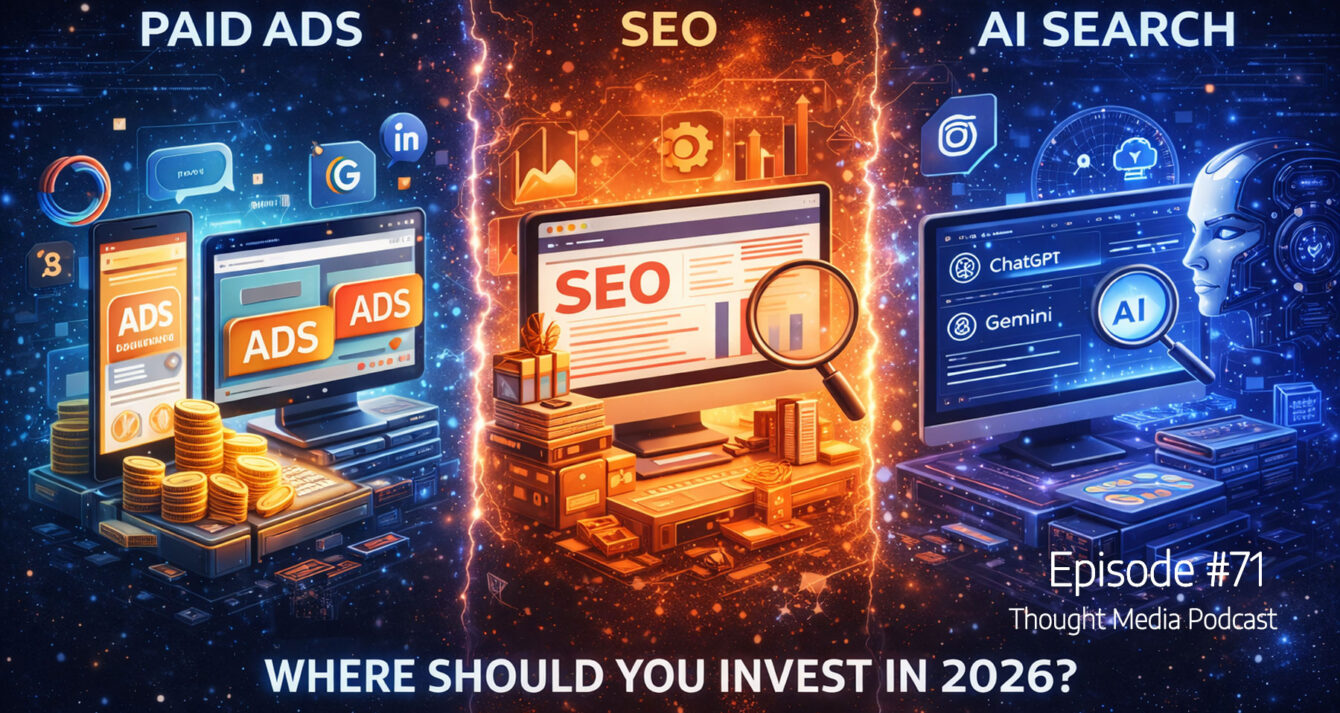


Paid Ads vs SEO vs AI Search: Where Should You Invest in 2026?
Why This Question Matters More Than Ever
If you’re running a business in 2026, you’ve probably felt the pressure. Marketing isn’t just about choosing between Google Ads and organic search anymore. There’s a new layer influencing visibility — AI-driven discovery. Platforms like ChatGPT, Gemini, and other generative systems are changing how people search, compare, and decide. So the question isn’t just “What works?” It’s “What works now — and what will still work two years from now?”
The reality is, budgets are finite. Attention is fragmented. And every marketing dollar needs to be intentional.
Paid Ads: Speed, Control, and Immediate Data
Let’s start with paid Google ads. If your business needs traction quickly, this is still the fastest lever you can pull. You can launch campaigns and start seeing traffic within days. You can test different messages, audiences, offers, and landing pages in real time. The feedback loop is immediate.
That speed is powerful. Especially for startups, new product launches, or businesses trying to validate positioning.
But here’s the tradeoff: paid traffic is rented. The moment you pause your campaigns, the flow stops. There’s no compounding effect unless you convert that traffic into something you own — like email subscribers, customers, or brand awareness.
Paid ads are excellent for acceleration. They are not equity.
SEO: Slow at First, Powerful Over Time
SEO requires patience. You won’t see overnight results. But when done correctly, it compounds in a way paid ads never will.
Strong SEO builds authority. It builds credibility. It builds digital assets that generate traffic for years. Ranking organically signals trust to users in a way ads often cannot.
But SEO in 2026 isn’t just about keywords and backlinks. Search engines are interpreting intent, context, and structure. Thin pages designed just to “rank” don’t perform the way they used to. Depth, clarity, structure, and authority matter more than ever.
SEO is not fast — but it’s durable.
AI Search: The New Layer of Visibility
This is where things get interesting. AI systems don’t just show links. They summarize answers. They recommend sources. They extract information. That means your content must be structured clearly enough for machines to understand it. Clear headings. Logical hierarchy. Structured data. Comprehensive explanations. Real authority.
AI discoverability is not separate from SEO — it’s an extension of it. But businesses that ignore this layer risk becoming invisible in the next wave of search behavior.
The companies thinking about AI search today are positioning themselves ahead of the curve.
So Where Should You Actually Invest?
There isn’t a one-size-fits-all answer. If you need revenue now, paid ads are logical. They create immediate movement. If you want long-term sustainability, SEO is essential. It builds digital equity.
If you want to future-proof visibility as artificial intelligence reshapes search behavior, you need to structure your content for machine understanding. The smartest companies in 2026 are not choosing one. They’re layering all three. Paid ads generate momentum and provide testing data. SEO turns that data into long-term assets. AI optimization ensures those assets remain visible as search evolves.
It’s not either-or anymore. It’s integrated strategy.
Why Website Structure Is the Silent Multiplier
All of this depends on your website. A slow site increases ad costs. Poor structure limits SEO potential. Weak content formatting reduces AI visibility. In 2026, your website is not a brochure — it’s infrastructure. Every marketing channel feeds into it. Every optimization decision impacts it.
That’s why businesses that treat their website as a revenue engine — rather than a static design project — consistently outperform competitors.
The Real Takeaway
Marketing in 2026 isn’t about chasing whichever channel is trending. It’s about balance. Paid ads give you speed. SEO gives you stability. AI optimization gives you adaptability. When combined strategically, they create resilience. And resilience is what separates businesses that survive algorithm shifts from those that disappear when costs rise or platforms change.
The question isn’t “Which channel is best?”. The better question is: “How do we build a system that compounds, adapts, and scales?”
The businesses that answer that correctly won’t just grow faster — they’ll grow smarter.