


Artificial intelligence companies help businesses design, build, integrate, and operate AI-powered systems, but choosing the right AI firm requires more than comparing technical capabilities. U.S. businesses should evaluate an AI partner based on business understanding, software engineering, integration experience, security, data strategy, intellectual property terms, model flexibility, implementation planning, support, and measurable return on investment.
The artificial intelligence market has expanded rapidly.
Businesses can now choose from:
✅ AI consulting firms
✅ Custom AI development companies
✅ AI agent developers
✅ Machine learning companies
✅ Generative AI firms
✅ AI automation providers
✅ AI SaaS platforms
✅ Enterprise software companies adding AI
✅ Cloud and infrastructure providers
✅ Specialized AI product companies
That abundance creates a different problem:
How do you determine which artificial intelligence company is actually capable of solving your business problem?
The answer should not begin with:
“Which company has the newest AI model?”
It should begin with:
“What business capability are we trying to create?”
A successful AI engagement may involve artificial intelligence, software development, APIs, databases, cloud infrastructure, user interfaces, automation, security, analytics, and ongoing optimization.
According to IBM’s overview of artificial intelligence, AI encompasses technologies that enable computers and machines to perform capabilities associated with learning, reasoning, problem-solving, decision-making, and autonomy.
But understanding AI technology is only the beginning.
The harder challenge is turning those capabilities into a reliable business system.
This guide focuses specifically on how U.S. businesses should evaluate and hire an artificial intelligence firm, including vendor selection, build-versus-buy decisions, technical due diligence, project ownership, pricing, AI pilots, RFPs, security, architecture, vendor lock-in, and return on investment.
What Does An Artificial Intelligence Company Actually Delivers?
An artificial intelligence firm should deliver more than access to an AI model.
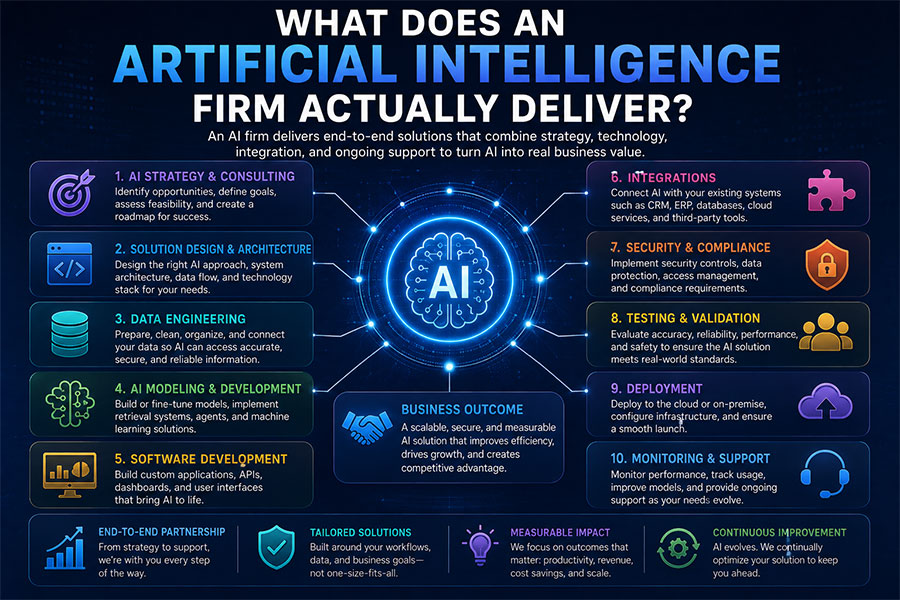
A complete AI solution may include:
- AI strategy
- workflow analysis
- software architecture
- model selection
- AI agents
- custom applications
- APIs
- databases
- retrieval systems
- data pipelines
- automation
- dashboards
- authentication
- permissions
- monitoring
- analytics
- testing
- deployment
- ongoing support
The final deliverable may be:
An internal AI assistant
A customer-facing AI application
An autonomous or semi-autonomous AI agent
A predictive analytics platform
An AI-powered workflow
A document intelligence system
An AI-enabled SaaS product
A computer vision application
A custom enterprise AI platform
The best artificial intelligence companies should be able to explain how all of those components fit together.
Should You Hire An AI Firm Or Buy An AI Platform?
This is one of the first decisions a business should make.
Not every AI requirement needs custom development.
Buy Existing AI Software When:
✅ The problem is common.
✅ A proven platform already solves it.
✅ Your workflow can adapt to the product.
✅ You need fast deployment.
✅ Customization is limited.
✅ The software economics make sense at your scale.
Examples may include:
- Meeting transcription
- basic writing assistance
- standard customer support
- image generation
- simple analytics
- productivity tools
Hire An AI Firm When:
✅ Your workflow is unique.
✅ Proprietary data matters.
✅ Multiple systems must integrate.
✅ Existing software creates too many limitations.
✅ You need a custom interface.
✅ AI will become part of a larger product.
✅ Competitive differentiation matters.
✅ You need greater control over architecture.
A custom system should solve a problem that off-the-shelf software cannot solve efficiently.
Build vs Buy AI: Quick Comparison
| Requirement | Buy AI Software | Hire An AI Firm |
|---|---|---|
| Fast Deployment | ✅ | Moderate |
| Low Upfront Cost | ✅ | Higher |
| Unique Workflow | Limited | ✅ |
| Custom Integrations | Limited | ✅ |
| Proprietary Logic | Limited | ✅ |
| Custom Interface | Limited | ✅ |
| Internal Data Integration | Depends | ✅ |
| Architecture Control | Limited | Greater |
| Vendor Independence | Lower | Potentially higher |
| Competitive Differentiation | Limited | Greater |
A hybrid strategy can also work.
A company might use established AI models while hiring an AI firm to build the proprietary application, workflow, integrations, and user experience around them.
Which Type Of AI Partner Does Your Business Need?
Different AI firms solve different problems.
AI Consulting Firm
Best when the organization needs:
- AI strategy
- opportunity assessment
- roadmap
- governance
- implementation planning
Custom AI Development Company
Best when the organization needs:
- custom software
- proprietary workflows
- integrations
- specialized interfaces
AI Agent Development Company
Best when AI needs to:
- use tools
- perform tasks
- interact with multiple systems
- automate multi-step workflows
Thought Media’s AI agent development services focus on building AI-powered agents and agentic workflows that can connect to applications, data, business systems, and automation.
Machine Learning Company
Best when the requirement involves:
- prediction
- classification
- forecasting
- anomaly detection
- recommendation
- optimization
Thought Media also provides machine learning development for data-driven applications, predictive systems, and intelligent automation.
Generative AI Company
Best when the system needs to work with:
- language
- content
- documents
- images
- code
- audio
- knowledge retrieval
Thought Media’s generative AI development can support applications involving conversational AI, intelligent content, knowledge systems, and generative workflows.
AI Integration Company
Best when the primary challenge is connecting AI to:
- CRM
- ERP
- ecommerce
- internal systems
- databases
- APIs
- cloud services
The right partner depends on the problem.
How Do You Know If Your Business Is Ready For Custom AI?
Many companies start AI projects too early.
Before hiring an artificial intelligence firm, determine whether the organization has the ingredients required for implementation.
A Clear Business Problem
Avoid starting with:
“We need AI.”
Start with:
“Our sales team spends 300 hours every month manually qualifying inbound leads.”
That is measurable.
A Defined Workflow
The current process should be understood.
If employees cannot explain how the process works today, automating it will be difficult.
Accessible Data
Ask:
- Where is the information?
- Is it structured?
- Is it complete?
- Who owns it?
- Can the system access it?
Internal Ownership
Someone inside the organization should own the AI initiative.
That person may coordinate:
- employees
- stakeholders
- IT
- compliance
- leadership
- the AI development firm
A Measurable Outcome
Examples include:
✓ Reduce processing time by 40%
✓ Improve lead response time
✓ Automate 60% of routine requests
✓ Increase support capacity
✓ Reduce manual document review
If success cannot be measured, the project may drift.
What Technical Capabilities Should An Artificial Intelligence Company Have?
An AI company should understand more than AI models.
A serious implementation may require expertise across several disciplines.
AI Engineering
The company should understand:
- LLMs
- machine learning
- agents
- embeddings
- retrieval
- model APIs
- structured outputs
- evaluation
Software Engineering
AI applications still require normal software.
That may include:
- front-end development
- backend development
- authentication
- databases
- APIs
- dashboards
- user management
Thought Media combines AI with enterprise application development for organizations that need intelligent systems integrated into larger software environments.
Data Engineering
The firm should understand:
- data sources
- pipelines
- transformation
- indexing
- storage
- permissions
- data quality
Cloud Architecture
AI applications may depend on:
- compute
- storage
- databases
- queues
- APIs
- monitoring
- scaling
Security
Security needs to extend across the complete system.
UX And Interface Design
Users still need a practical way to interact with the technology.
How Should You Evaluate AI Architecture?
Ask every potential AI firm to explain the proposed architecture.
You do not need to be an engineer.
You do need to understand the major components.
A typical architecture might involve:
User Interface
↓
Application Layer
↓
AI Orchestration
↓
Model
↓
Knowledge / Data Sources
↓
Business Integrations
The AI firm should clearly explain:
- Where the model runs
- how information reaches it
- how data is retrieved
- what information leaves your environment
- which third-party providers are involved
- how permissions are enforced
- how activity is logged
If the architecture cannot be explained clearly, the project may not be clearly designed.
How Should You Evaluate AI Integrations?
Integration is often one of the hardest parts of a project.
AI may need to connect with:
- Salesforce
- HubSpot
- Microsoft 365
- ERP systems
- accounting platforms
- ecommerce platforms
- internal databases
- support software
- communication platforms
- custom applications
Ask:
Which systems need read access?
Which systems need write access?
Which APIs are available?
What happens when an integration fails?
Who manages credentials?
How is data synchronized?
A good AI demo can be built quickly.
A reliable production integration requires much more engineering.
Who Owns The AI Code And Intellectual Property?
This should be discussed before development begins.
Potential ownership categories include:
- Custom source code
- training data
- prompts
- workflows
- proprietary business logic
- databases
- model configurations
- generated assets
- documentation
Ask directly:
Who owns the custom code?
Can we move the system to another provider?
Will we receive source files?
Who owns custom workflows?
Are third-party components being licensed?
The answers should appear in the agreement.
Who Owns Your Business Data?
Your organization should understand:
- where data is stored
- which vendors process it
- how long it is retained
- whether it is used for model training
- who can access it
- how it can be deleted
Do not assume every AI provider uses the same terms.
The AI development company should help the organization understand the data flow.
How Do You Avoid AI Vendor Lock-In?
AI technology changes quickly.
A system that depends entirely on one model or proprietary platform may become expensive or restrictive later.
Businesses should ask whether the architecture can support:
✅ Different AI models
✅ Different cloud providers
✅ API changes
✅ Model upgrades
✅ New vendors
✅ Self-hosted options where appropriate
This does not mean every system must support ten AI providers.
It means the architecture should avoid unnecessary dependency.
What Is Model Lock-In?
Model lock-in occurs when an application becomes so dependent on one AI model that switching becomes difficult.
This can happen because of:
- proprietary APIs
- unique prompting
- model-specific features
- data formatting
- fine-tuning
- embedded workflows
Ask:
If the preferred model changes in two years, how difficult will migration be?
A good AI firm should be able to discuss that risk.
What Security Questions Should You Ask Artificial Intelligence Companies?
Security should be part of vendor evaluation from the beginning.
Ask:
Data
- What data will the AI access?
- Where will it be stored?
- Which third parties process it?
Authentication
- How do users authenticate?
- Is single sign-on required?
- Are different permission levels supported?
Access Control
- Can users access only the information they are authorized to see?
Encryption
- Is sensitive information encrypted?
Logging
- Are user actions and system events logged?
Data Retention
- How long is information retained?
Incident Response
- What happens if something goes wrong?
For regulated industries, additional legal, contractual, compliance, and security requirements may apply.
Should Your AI System Have Human Approval?
Often, yes.
AI autonomy should match the risk of the action.
Low-Risk Example
AI categorizes an internal support ticket.
Automation may be reasonable.
Higher-Risk Example
AI prepares a contract worth $2 million.
Human review should probably remain involved.
Very High-Risk Example
AI makes a consequential healthcare, financial, employment, or legal decision.
Significant governance and professional oversight may be required.
The right question is not:
“Can AI do this?”
It is:
“Should AI be allowed to do this without approval?”
Should You Start With An AI Pilot Or Production System?
Most businesses should not begin with the largest possible implementation.
A pilot can validate:
- technical feasibility
- data quality
- integration
- user adoption
- accuracy
- business value
Example:
A company wants an AI knowledge system for 100,000 internal documents.
Instead of launching company-wide:
Pilot
- 2,500 documents
- one department
- 25 users
- 100 test questions
Measure
- answer accuracy
- retrieval quality
- response time
- adoption
- failure cases
Expand
If results are strong:
Increase scope.
A pilot reduces risk.
Proof Of Concept vs Pilot vs MVP
These terms are often confused.
| Stage | Primary Purpose |
|---|---|
| Proof Of Concept | Test whether the technology can work |
| Pilot | Test the solution with real users |
| MVP | Release the smallest commercially useful version |
| Production System | Deploy the mature operational system |
A strong AI firm should recommend the correct stage.
What Should Be Included In An AI Development RFP?
Larger companies may issue an RFP when evaluating artificial intelligence firms.
A strong AI RFP should include:
Business Problem
What needs to improve?
Users
Who will use the system?
Current Workflow
How does the process work now?
Data
What data sources exist?
Integrations
Which systems must connect?
Security Requirements
What controls are required?
Functional Requirements
What should the AI actually do?
Performance Expectations
What volume must the system handle?
Deliverables
What should the vendor provide?
Timeline
When should each phase be completed?
Ownership
What IP and source code terms are required?
Support
What happens after launch?
Pricing
Ask vendors to separate:
- development
- infrastructure
- licensing
- support
- AI usage
A vague RFP will produce vague proposals.
How Much Does An Artificial Intelligence Firm Cost In The U.S.?
AI development pricing depends heavily on complexity.
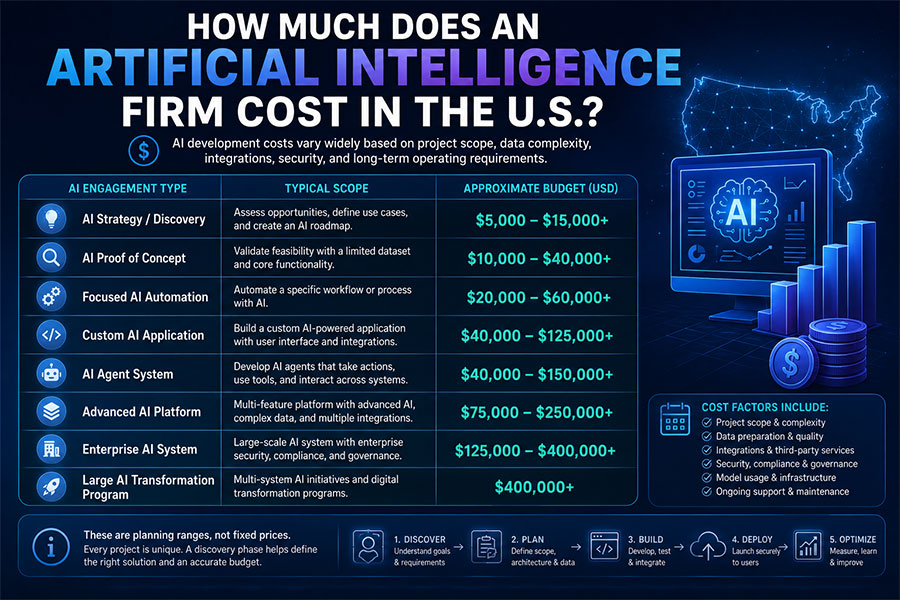
A practical U.S. planning range might look like:
| AI Engagement | Approximate Budget (USD) |
|---|---|
| AI Strategy / Discovery | $5,000–$15,000+ |
| AI Proof Of Concept | $10,000–$40,000+ |
| Focused AI Automation | $20,000–$60,000+ |
| Custom AI Application | $40,000–$125,000+ |
| AI Agent System | $40,000–$150,000+ |
| Advanced AI Platform | $75,000–$250,000+ |
| Enterprise AI System | $125,000–$400,000+ |
| Large AI Transformation Program | $400,000+ |
These are planning estimates rather than fixed prices.
Projects can fall above or below these ranges.
What Determines AI Project Cost?
Major factors include:
Number Of Workflows
One workflow costs less than twenty.
Data Complexity
Messy data requires more preparation.
Integrations
Each system adds engineering.
User Interface
Custom software increases design and development requirements.
Security
Enterprise security increases scope.
Volume
High-volume AI applications require stronger infrastructure.
AI Usage
Model API costs increase with usage.
Testing
Higher-risk systems need more evaluation.
Custom Machine Learning
Training or fine-tuning custom models can increase cost significantly.
What AI Engagement Models Are Common?
Artificial intelligence firms may price projects differently.
Fixed Project Fee
Best when scope is clearly defined.
Advantages:
✅ Predictable budget
Disadvantages:
❌ Scope changes can create additional cost.
Time And Materials
The client pays for actual development time.
Advantages:
✅ Flexible
Disadvantages:
❌ Budget may be less predictable.
Dedicated Team
A development team works continuously on the project.
Best for:
- large systems
- evolving requirements
- long-term development
Monthly Retainer
Useful for:
- optimization
- support
- continued AI development
- ongoing integrations
Ask the firm which engagement model fits the project and why.
What Ongoing Costs Should You Expect?
AI systems usually have operating expenses.
Potential costs include:
- AI API usage
- cloud hosting
- databases
- storage
- monitoring
- vector databases
- third-party software
- support
- maintenance
- security
- future development
Businesses should request an estimate for:
Year 1
and:
Steady-state annual operating cost.
That gives a more realistic total cost of ownership.
How Should You Score Competing AI Companies?
Use a weighted scorecard rather than relying only on the sales presentation.
| Evaluation Category | Suggested Weight |
|---|---|
| Business Understanding | 15% |
| AI Technical Expertise | 15% |
| Software Engineering | 15% |
| Architecture & Integration | 15% |
| Security & Data | 10% |
| IP / Ownership Terms | 10% |
| Testing & Reliability | 5% |
| Project Management | 5% |
| Pricing Transparency | 5% |
| Post-Launch Support | 5% |
Score each provider consistently.
How Do You Compare AI Proposals?
Do not compare only the total price.
Compare:
Scope
Are the vendors actually quoting the same thing?
Deliverables
What will you receive?
Integrations
Which systems are included?
Testing
Is testing part of the project?
Ownership
Who owns the final system?
Support
What happens after launch?
Infrastructure
Are cloud and model costs included?
Revisions
How are changes handled?
The cheapest proposal may simply contain less scope.
What Does A Strong AI Implementation Roadmap Look Like?
A practical roadmap may have six phases.
Phase 1: Opportunity Assessment
Identify high-value AI use cases.
Phase 2: Discovery
Understand workflows, systems, users, and data.
Phase 3: Prototype
Validate the core capability.
Phase 4: Pilot
Test with real users.
Phase 5: Production Deployment
Build the reliable operational system.
Phase 6: Optimization
Measure results and improve.
This phased approach reduces risk.
How Should AI Projects Be Prioritized?
Businesses may identify dozens of possible AI use cases.
Rank them using:
Business Value
How much improvement could this create?
Feasibility
Can the technology actually work?
Data Readiness
Is the required information accessible?
Implementation Effort
How difficult is the project?
Risk
What happens if the AI is wrong?
A useful starting project usually has:
High value + high feasibility + manageable risk.
How Do You Measure The ROI Of An AI Firm?
AI ROI should be tied to business outcomes.
Example:
A customer service department handles:
40,000 requests per month.
AI safely resolves:
12,000 routine requests.
That can create value through:
- lower service cost
- faster responses
- greater employee capacity
- reduced backlog
Other AI ROI metrics may include:
✅ Hours saved
✅ Tasks automated
✅ Revenue generated
✅ Conversion improvement
✅ Reduced errors
✅ Faster processing
✅ Improved forecasting
✅ Increased capacity
✅ Customer satisfaction
The metric should be selected before implementation.
What Does AI ROI Look Like In Sales?
A sales AI system might improve:
- lead response time
- qualification
- follow-up
- CRM accuracy
- proposal preparation
Suppose the sales team receives:
5,000 leads per month
but only follows up effectively with 60%.
If AI improves coverage to 90%, the business gains significantly more opportunities without increasing lead generation.
That is measurable.
What Does AI ROI Look Like In Operations?
An operations team may manually review:
10,000 documents per month.
If AI automatically processes 70% and sends only exceptions to employees:
Human workload drops substantially.
The ROI is not simply:
“AI is faster.”
It is:
“Employees spend fewer hours processing routine documents.”
Why AI Vendor Selection Fails
Many AI projects fail before development begins.
Common vendor-selection mistakes include:
❌ Choosing based on the best demo
❌ Selecting the lowest bid
❌ Ignoring integration complexity
❌ Failing to define ownership
❌ Not estimating operating costs
❌ No internal project owner
❌ No measurable KPI
❌ No security review
❌ Trying to launch too much at once
❌ Assuming the AI model is the entire product
The vendor-selection process should reduce these risks.
What Are The Biggest AI Firm Red Flags?
Watch for statements such as:
❌ “We can automate everything.”
❌ “The AI will always be accurate.”
❌ “Human review is unnecessary.”
❌ “We do not need to review your data.”
Also watch for:
❌ No architecture discussion
❌ No security questions
❌ No testing process
❌ No explanation of integrations
❌ No ownership terms
❌ No ongoing cost estimates
❌ No support plan
A professional AI company should be comfortable discussing limitations.
Should You Hire An AI Freelancer Or AI Firm?
A freelancer may be appropriate for:
- small prototype
- isolated automation
- experimental project
An AI firm is usually better suited for projects requiring multiple disciplines.
| Capability | Freelancer | AI Firm |
|---|---|---|
| Small Prototype | ✅ | ✅ |
| AI Engineering | Depends | ✅ |
| Full-Stack Development | Depends | ✅ |
| UX Design | Depends | ✅ |
| Data Engineering | Depends | ✅ |
| Integrations | Depends | ✅ |
| QA | Limited | ✅ |
| Project Management | Limited | ✅ |
| Enterprise Support | Variable | ✅ |
Larger AI systems often require a team.
Should You Hire A Specialized Artificial Intelligence Company Or Full-Service Technology Firm?
This depends on the project.
Specialized AI Company
May be ideal when:
- the AI technology is highly specialized
- deep model expertise dominates the project
- limited integration is required
Full-Service Technology Firm
May be better when the project requires:
- AI
- applications
- APIs
- websites
- databases
- UX
- cloud infrastructure
- ongoing development
Many real-world AI systems cross several technical disciplines.
How To Shortlist Artificial Intelligence Companies
Start with three to five qualified firms.
Give each vendor the same brief.
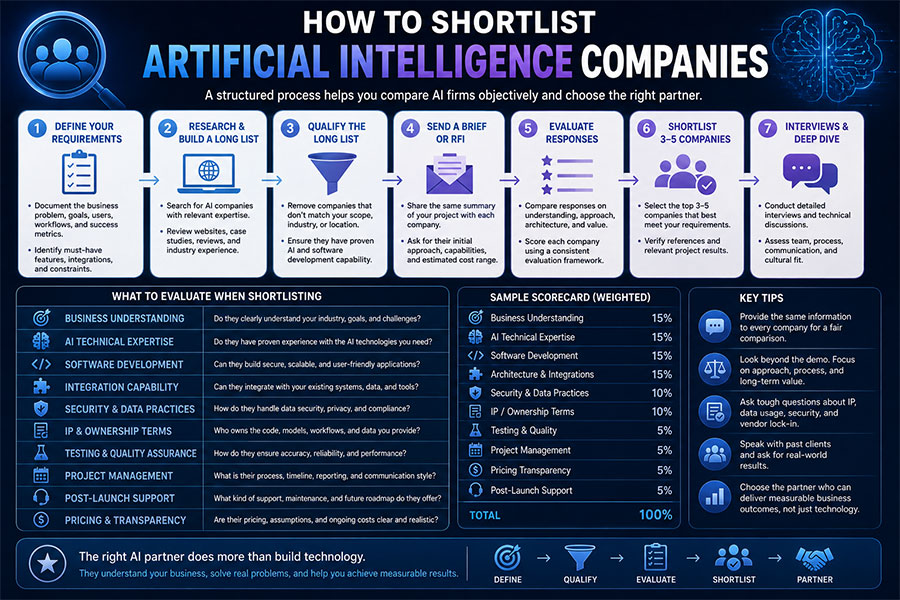
Ask them to explain:
- How they understand the business problem.
- What architecture they recommend.
- What they would build first.
- What they would not build.
- How they would handle data.
- How they would manage integrations.
- How they would test the AI.
- What the system would cost to operate.
- Who owns the final product.
- How they would measure success.
The differences between proposals will become much clearer.
What Should Happen Before You Sign An AI Contract?
Before signing:
✅ Confirm scope.
✅ Confirm deliverables.
✅ Confirm project milestones.
✅ Confirm pricing.
✅ Confirm ownership.
✅ Confirm third-party costs.
✅ Confirm data handling.
✅ Confirm support.
✅ Confirm acceptance criteria.
✅ Confirm change-request process.
Do not leave important terms to assumption.
Why Work With Thought Media™ As An AI Firm?
Thought Media™ provides artificial intelligence development as part of a broader technology offering that includes application development, web development, digital marketing, animation, managed hosting, IT services, and hardware solutions.
Our AI capabilities include:
✅ AI agent development
✅ Generative AI
✅ Machine learning
✅ Intelligent automation
✅ Custom AI applications
✅ AI integrations
✅ Data-driven systems
That broader technical capability can matter because artificial intelligence usually becomes part of a larger business environment.
An enterprise AI application may require:
- Custom software
- APIs
- authentication
- databases
- dashboards
- integrations
- hosting
- user experience
- monitoring
- ongoing development
Thought Media™ has worked with businesses and organizations since 2009 and develops AI systems with a focus on practical implementation rather than AI technology in isolation.
The objective is not simply:
“Add artificial intelligence.”
The objective is:
Build a system that produces measurable business value.
Final Thoughts: How To Choose An AI Firm
Choosing among artificial intelligence companies should be treated as a technology and business decision.
The best AI firm should understand:
Your business.
Your workflow.
Your data.
Your systems.
Your users.
Your risks.
Your goals.
It should also be able to explain:
✓ Which AI approach makes sense
✓ Which approach does not
✓ How integrations will work
✓ Who owns the code and data
✓ How vendor lock-in will be managed
✓ How security will be handled
✓ How the AI will be tested
✓ What happens when the AI is wrong
✓ What the system will cost to operate
✓ How success will be measured
Do not choose an artificial intelligence company because its demo looks impressive.
Choose the firm that can turn artificial intelligence into a reliable, secure, scalable business system.
The model is only one component.
Implementation is what creates value.
Frequently Asked Questions
How do I choose an artificial intelligence company?
Choose an artificial intelligence company based on business understanding, AI expertise, software engineering, architecture, integration capability, security, data experience, intellectual property terms, testing, pricing transparency, and ongoing support. The best AI firm should understand the business problem before recommending a specific technology.
Should I hire an AI firm or buy existing AI software?
Buy existing AI software when a proven product already solves the requirement effectively. Hire an AI firm when your organization has unique workflows, proprietary data, complex integrations, custom interface requirements, or opportunities where custom AI can create competitive differentiation.
How much does it cost to hire an AI firm in the United States?
AI development costs vary widely. A proof of concept may cost approximately $10,000–$40,000+ USD, focused AI automation may range from $20,000–$60,000+, custom AI applications may cost $40,000–$125,000+, and enterprise AI systems may range from $125,000–$400,000+ or more depending on complexity.
What should be included in an AI development contract?
An AI development agreement should clearly define project scope, deliverables, pricing, milestones, data handling, intellectual property ownership, source-code rights, third-party services, security responsibilities, acceptance criteria, ongoing costs, support, and the process for handling scope changes.
How can a business avoid AI vendor lock-in?
Businesses can reduce AI vendor lock-in by using modular architecture, understanding third-party dependencies, clarifying source-code ownership, avoiding unnecessary proprietary components, documenting integrations, and designing systems that can support alternative AI models or providers when practical.