


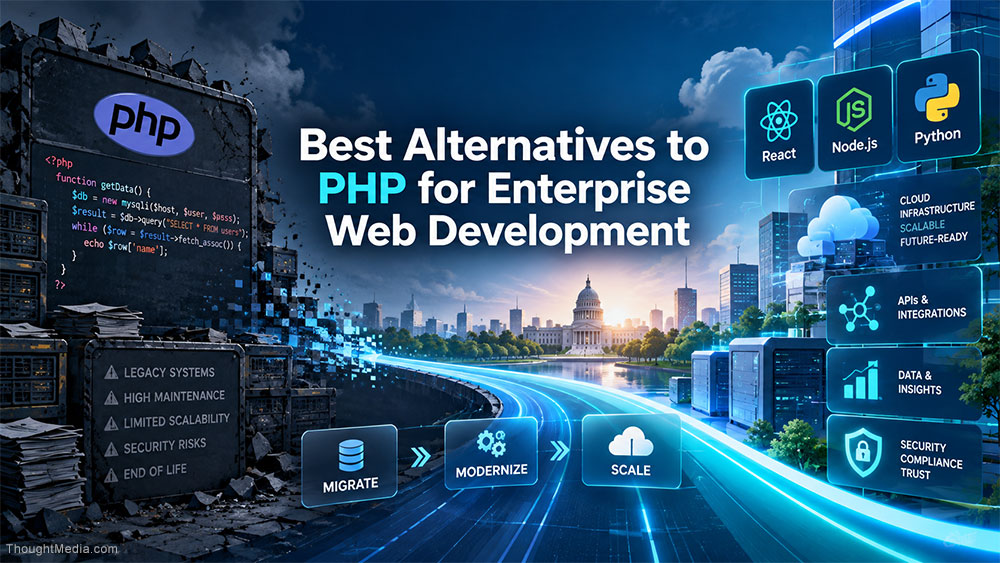
When enterprises and public-sector organizations are running aging PHP websites, applications, portals, or internal systems, the critical question is increasingly becomes:
Should we keep maintaining the existing PHP platform, or is it time to modernize the technology stack?
PHP remains an important part of the web, and a modern, properly maintained PHP application is not automatically obsolete or insecure.
But many organizations are not operating modern PHP environments.
They are maintaining systems created years—or sometimes decades—ago around legacy PHP versions, tightly coupled CMS platforms, custom plugins, outdated frameworks, aging infrastructure, undocumented integrations, and code that has accumulated technical debt through successive redesigns and patches.
The October 2026 disclosure of serious vulnerabilities in the PHP runtime created an important reminder of that architectural risk.
On October 21, 2026, the PHP project released PHP 8.5.12, 8.4.27, 8.3.36, and 8.2.35 to address CVE-2026-109618 and CVE-2026-109619, two critical vulnerabilities capable of enabling unauthenticated remote code execution under affected conditions. The PHP project strongly encouraged users to update immediately.
Organizations running PHP should first patch affected environments immediately.
But security teams, CIOs, CTOs, IT directors, digital directors, procurement leaders, and public-sector technology managers should also ask a broader strategic question:
Is our current web technology stack still the right foundation for the next five to ten years?
For many organizations, the answer may increasingly be no.
Modern web platforms are moving toward component-based front ends, API-driven architectures, cloud infrastructure, containerized services, modern identity systems, TypeScript, Node.js, Python, Java, .NET, React, Next.js, Django, FastAPI, and other architectures designed around scalability, automation, integrations, observability, security, and artificial intelligence.
That does not mean every organization should immediately abandon PHP.
It means organizations should evaluate whether maintaining PHP still makes strategic sense—or whether a controlled migration to a modern architecture would reduce technical debt and provide a stronger foundation for the future.
What Are the Best Alternatives to PHP?
The best alternatives to PHP for modern enterprise web development include Node.js, Python with Django or FastAPI, Java with Spring Boot, .NET with ASP.NET Core, Go, and API-driven architectures paired with React or Next.js on the front end.
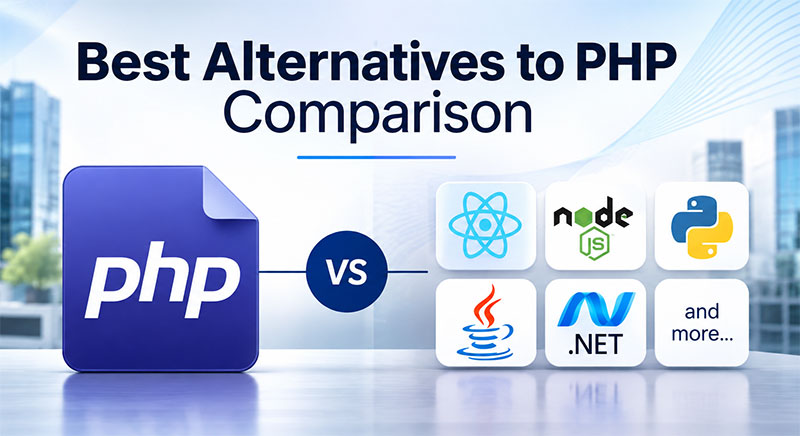
The right replacement depends on the organization.
There is no universal PHP substitute.
A government portal, ecommerce platform, enterprise SaaS application, public information website, internal operations platform, and high-volume transactional system may each require a different architecture.
Best Alternatives to PHP Comparison
| PHP Alternative | Best For | Key Advantages | Considerations |
|---|---|---|---|
| Node.js + React / Next.js | Modern web applications, portals, SaaS, interactive platforms | JavaScript/TypeScript across stack, large ecosystem, real-time capabilities, strong API support | Requires disciplined architecture and dependency management |
| Python + Django | Enterprise platforms, government applications, data-heavy systems | Mature framework, strong security model, excellent Python ecosystem | Can be heavier than lightweight API frameworks |
| Python + FastAPI + React | APIs, AI applications, data platforms, modern services | Fast development, AI/ML ecosystem, typed APIs, excellent performance | Architecture usually requires separate front-end planning |
| Java + Spring Boot | Large enterprise and mission-critical systems | Mature ecosystem, strong typing, governance, scalability | Greater engineering overhead |
| ASP.NET Core | Microsoft-centric enterprises and government | Excellent Azure integration, mature security tooling, enterprise support | Best fit where Microsoft ecosystem is already established |
| Go | High-performance services, APIs, cloud-native systems | Fast, efficient, simple deployment, strong concurrency | Smaller web ecosystem than JavaScript or Python |
| React / Next.js + API Backend | Public websites, enterprise portals, digital services | Modern UX, component architecture, server rendering, flexible backend | React itself does not replace the PHP backend |
| Headless / Composable Architecture | Content-heavy enterprise platforms | Separates content, presentation and services; highly flexible | More architectural complexity than traditional CMS deployment |
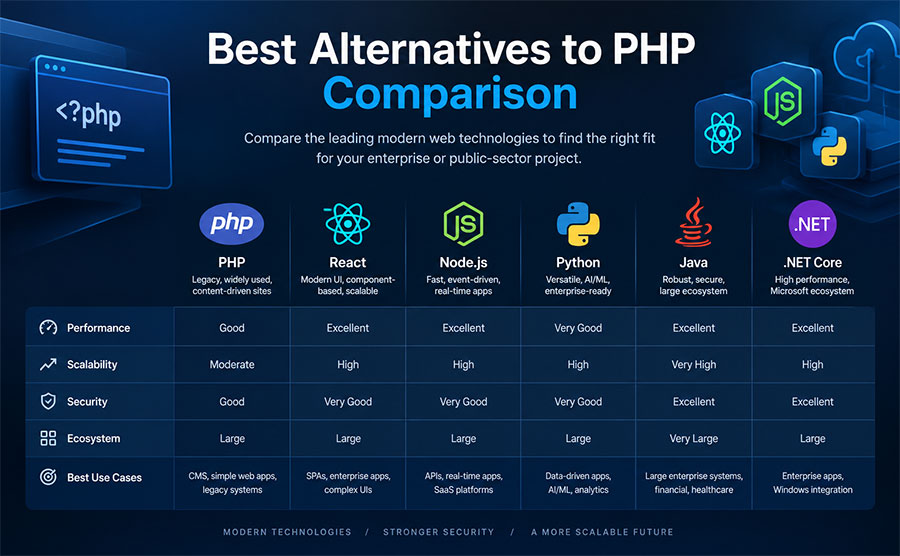
Is React an Alternative to PHP?
React (common with MERN stack) is an alternative to PHP for some front-end responsibilities, but React by itself does not replace PHP as a server-side technology.
PHP commonly performs server-side functions such as:
- Authentication
- database operations
- application logic
- API processing
- session management
- content rendering
React primarily handles the user interface.
A PHP migration might therefore replace:
PHP backend → Node.js, Python, Java, .NET or Go
while replacing:
PHP-rendered frontend → React or Next.js
For many organizations, the real modernization strategy becomes:
React or Next.js + modern API backend + cloud infrastructure
rather than simply “PHP versus React.”
What Are Modern Alternatives to PHP?
Modern alternatives to PHP increasingly reflect a broader change in how websites and applications are designed.
Traditional platforms often followed a structure such as:
Browser → Web Server → PHP Application → Database
Modern enterprise platforms may look more like:
React / Next.js Front End → API Gateway → Application Services → Databases → Cloud Services → Identity → AI Services → Analytics
That architecture creates opportunities for:
- Independent front-end development
- API integrations
- microservices
- cloud scaling
- AI integrations
- automated testing
- continuous deployment
- stronger observability
- centralized identity
- reusable services
- mobile application integration
Thought Media™ provides custom website development using modern technology stacks including MERN, MEAN, MEVN, Django + React, Python, and other architectures based on project requirements.
Why Are Enterprises Reconsidering Legacy PHP Platforms?
The issue is usually not PHP alone.
The issue is technical debt.
A legacy platform may have been modified continuously for 10 or 15 years.
One development company created the original website.
Another redesigned it.
Internal developers added functionality.
A contractor installed plugins.
A marketing team changed the CMS.
A third-party vendor added authentication.
Another vendor connected the CRM.
Years later, nobody has a complete understanding of the platform.
This creates problems including:
❌ Unsupported dependencies
❌ End-of-life PHP versions
❌ Poor documentation
❌ Fragile plugins
❌ Custom code nobody wants to modify
❌ Difficult integrations
❌ Security exposure
❌ Slow deployment
❌ Poor automated testing
❌ Difficult cloud migration
❌ Limited scalability
❌ High maintenance costs
❌ Difficulty introducing AI capabilities
Eventually, the organization is no longer maintaining a website.
It is maintaining a collection of historical technical decisions.
What Happened With the October 2026 PHP Vulnerabilities?
The October 2026 incident provides a useful example of why technology-stack governance matters.
The PHP Security Team disclosed two critical vulnerabilities:
CVE-2026-109618
and
CVE-2026-109619
The vulnerabilities involved memory-safety problems within PHP itself and could enable remote code execution in affected environments.
Wiz Research demonstrated exploitation against WordPress, Drupal, and Joomla environments, while emphasizing that the issue existed in PHP itself rather than in those applications. Wiz also reported that vulnerable conditions could expose sensitive process memory containing information such as authentication tokens, credentials, and API keys.
The PHP project published patched releases on October 21 and advised users to update immediately. Organizations can review the official PHP security advisory for CVE-2026-109618 and CVE-2026-109619.
CISA also issued an alert concerning the vulnerabilities on October 21, 2026.
Does This Mean PHP Is No Longer Safe?
No. That conclusion would be misleading.
Every major technology ecosystem experiences vulnerabilities.
React, Node.js, Python packages, Java frameworks, operating systems, cloud services, and JavaScript dependencies all require active security management.
The lesson is not:
PHP is unsafe.
The more useful lesson is:
Organizations cannot treat their technology stack as static infrastructure.
Software must be:
- inventoried
- patched
- monitored
- tested
- upgraded
- governed
- periodically re-evaluated
And when a platform has become too difficult to update safely, modernization becomes a strategic security decision.
How Do You Know When It Is Time to Move Away From PHP?
Organizations should consider a structured modernization assessment when several warning signs appear together.
Your PHP Version Is Unsupported
If the system depends on versions or components that no longer receive regular security updates, the risk increases.
Upgrades Constantly Break the Application
If upgrading PHP, the framework, CMS, plugins, or server environment requires extensive emergency remediation, technical debt may be limiting maintainability.
Nobody Fully Understands the Codebase
Institutional knowledge is a security and continuity issue.
Integrations Are Becoming Difficult
Modern organizations increasingly depend on:
- Salesforce
- ServiceNow
- Microsoft 365
- ERP platforms
- cloud APIs
- identity platforms
- payment systems
- analytics
- AI services
- internal APIs
Legacy architectures can make those integrations unnecessarily difficult.
The Website Is Becoming an Application
Many corporate and government websites now include:
- dashboards
- portals
- authentication
- workflows
- transactions
- document systems
- AI assistants
- personalized content
- complex search
- data visualization
At that point, the technology requirements may have moved beyond the architecture originally selected for the website.
Security Requirements Have Changed
An application designed in 2013 was not built for the threat landscape of 2026.
Organizations may now require:
- zero-trust principles
- modern identity
- MFA
- SSO
- centralized logging
- security monitoring
- automated dependency scanning
- secrets management
- API security
- cloud-native controls
- AI security
How to Move a Website Away From PHP
Moving a website away from PHP should usually be treated as a controlled platform migration rather than a conventional website redesign.
The objective is not simply to rewrite code.
The objective is to preserve business functionality while replacing the underlying architecture.
A typical migration involves the following stages.
1. Inventory the Existing PHP Environment
Before deciding what should replace PHP, determine what exists.
Document:
- PHP version
- framework
- CMS
- database
- plugins
- custom modules
- APIs
- authentication
- integrations
- scheduled jobs
- forms
- transactions
- analytics
- hosting
- DNS
- email dependencies
- third-party services
Large organizations frequently discover dependencies nobody included in the original project documentation.
2. Patch the Existing Environment First
Do not delay critical security work because a migration is being planned.
If the PHP environment is affected by a known vulnerability:
patch first.
Migration projects can take months.
Security remediation may need to happen today.
3. Identify Business Requirements
Do not begin by asking:
Should we use React or Python?
Begin by asking:
What does the organization need this platform to do over the next five to ten years?
Requirements might include:
- millions of visitors
- authenticated citizen services
- enterprise CRM integration
- AI agents
- multilingual content
- APIs
- accessibility
- secure payments
- internal workflows
- analytics
- mobile applications
- cloud deployment
- automated scaling
Architecture should follow requirements.
4. Select the Target Architecture
A technology assessment might recommend:
React + Node.js
Next.js + Node.js
React + Django
React + FastAPI
Angular + .NET
React + Spring Boot
or another architecture.
Thought Media’s enterprise application development practice focuses specifically on scalable enterprise systems, integrations, automation, cloud synchronization, and secure application architecture.
5. Separate the Interface From Business Logic
One of the most valuable modernization steps is reducing unnecessary coupling.
Instead of placing:
presentation + database logic + business rules + integrations
inside one monolithic application, modern architectures can separate those responsibilities.
This makes individual components easier to:
- test
- replace
- secure
- scale
- integrate
6. Build an API Layer
APIs create a controlled interface between systems.
A modern platform may expose services for:
- authentication
- content
- users
- documents
- payments
- search
- reporting
- workflows
The website then becomes one consumer of those services.
A mobile application or AI system can use the same underlying APIs.
7. Migrate Incrementally Where Possible
Organizations do not always need to replace everything on one launch date.
A strangler migration pattern can replace portions of the legacy platform gradually.
For example:
Phase 1: New React frontend
Phase 2: Authentication service
Phase 3: Content APIs
Phase 4: Customer portal
Phase 5: Remaining PHP services
The legacy platform becomes smaller until it can eventually be retired.
This can substantially reduce migration risk.
8. Migrate Data Carefully
The database is often more important than the code.
A migration plan should address:
- schemas
- customer records
- permissions
- audit trails
- documents
- metadata
- historical transactions
- retention requirements
Government and enterprise migrations may require rigorous validation before cutover.
9. Rebuild Identity and Access Controls
Authentication should not simply be copied from the legacy application.
Modernization creates an opportunity to introduce:
- SSO
- MFA
- role-based access
- centralized identity
- least privilege
- improved session management
Identity architecture should be designed before the new platform goes live.
10. Run Security Testing Before Launch
Testing should include more than visual QA.
Depending on the platform, organizations may require:
✅ Dependency scanning
✅ Static analysis
✅ Dynamic testing
✅ Penetration testing
✅ API testing
✅ Access-control testing
✅ Infrastructure review
✅ Logging validation
✅ Load testing
✅ Disaster-recovery testing
11. Operate Old and New Platforms in Parallel
For mission-critical systems, parallel operation can reduce risk.
The new platform is validated while the existing environment remains available as a fallback.
12. Decommission PHP Deliberately
When the new platform is proven stable:
- remove legacy servers
- disable old credentials
- archive required data
- terminate unused services
- remove DNS records
- revoke API keys
- close firewall rules
- document the final architecture
A legacy system that remains online “just in case” can become a forgotten attack surface.
How Do You Take a Website Off PHP Without Losing SEO?
This is an important question.
A poorly executed platform migration can destroy years of organic search equity.
Changing the programming language itself does not inherently damage SEO.
Changing URLs, content, rendering behavior, metadata, internal links, structured data, and page performance does.
A PHP modernization project should preserve:
✅ Existing high-value URLs
✅ Page titles
✅ H1 structure
✅ Content
✅ Canonical URLs
✅ Internal links
✅ Structured data
✅ Image URLs where practical
✅ Metadata
✅ XML sitemaps
If URLs must change, use proper 301 redirects.
Search migration testing should happen before launch—not after rankings disappear.
How Do You Upgrade a Website From PHP?
An upgrade website from PHP project can follow three broad approaches.
Full Replacement
Rebuild the entire system on the new stack.
Best when the existing architecture is fundamentally obsolete.
Incremental Migration
Replace modules over time.
Best for large organizations that cannot tolerate a major cutover.
Hybrid Modernization
Keep stable PHP components while rebuilding areas that require modernization.
Best when some parts of the application still perform well.
The smartest strategy is often not ideological.
It is architectural.
Keep what still creates value.
Replace what creates risk or limits future development.
Which Stack Is Best for Enterprise Web Development?
For enterprise web development, technology selection should prioritize organizational requirements rather than developer preference.
Node.js
Node.js works particularly well when organizations want JavaScript or TypeScript across the development stack.
Strong use cases include:
- portals
- real-time applications
- APIs
- dashboards
- ecommerce
- SaaS
Python
Python has become especially important because of its relationship with:
- artificial intelligence
- machine learning
- data science
- automation
- analytics
Django provides a mature full-stack framework.
FastAPI provides a modern approach to API development.
Java
Java remains a major enterprise platform because of its maturity, tooling, governance, and scalability.
.NET
ASP.NET Core is particularly attractive to organizations already standardized around:
- Microsoft Azure
- Active Directory
- Microsoft 365
- enterprise Microsoft environments
Go
Go is increasingly useful for:
- cloud services
- APIs
- infrastructure tools
- high-performance services
What Stack Is Best for Public Sector Web Development?
Public sector web development should prioritize security, accessibility, maintainability, interoperability, procurement longevity, documentation, and operational continuity.
Government systems often remain in production much longer than startup applications.
Technology selection must therefore consider:
- accessibility
- citizen experience
- security
- privacy
- records management
- integration
- procurement
- vendor continuity
- supportability
- staff turnover
Thought Media™ provides digital solutions for federal government organizations including secure, scalable websites, system integrations, AI strategy, and digital modernization.
Public platforms should be built so another qualified team can understand and maintain them years later.
That requires documentation and architecture discipline.
Modern Digital Transformation Is More Than Rebuilding a Website
A PHP migration can become the entry point into a broader modern digital transformation initiative.
Organizations should ask whether the new architecture can support:
- cloud deployment
- APIs
- mobile applications
- CRM integration
- ERP integration
- automation
- business intelligence
- AI assistants
- AI agents
- document intelligence
- predictive analytics
- customer personalization
This is why modernization decisions should involve more than the web team.
They may affect:
IT
security
marketing
operations
data
customer service
procurement
executive leadership
A website can become part of the organization’s digital operating layer.
AI Is Changing Both Development and Cybersecurity
Artificial intelligence is accelerating software development.
It is also accelerating cybersecurity research and exploitation.
The October PHP research provides an important example.
Wiz reported that frontier AI models substantially reduced the difficulty involved in developing and adapting complex exploits for vulnerabilities that had existed in PHP for years.
That changes the security equation.
Organizations should assume that AI will increasingly assist both:
defenders
and
attackers.
This makes architecture, patching, access control, monitoring, and software governance more important—not less.
AI Security Is Becoming Its Own Technology Discipline
Organizations are now adding AI agents and AI-powered workflows that can interact with:
- CRMs
- databases
- code repositories
- cloud infrastructure
- support systems
- ecommerce platforms
- internal files
- enterprise applications
Traditional application security remains essential.
But organizations also need to evaluate what happens when AI systems are allowed to take consequential actions.
This emerging field of <a href=”https://asyrx.com/” target=”_blank” rel=”noopener noreferrer”>AI Security</a> focuses increasingly on questions such as:
What action is the AI attempting?
What systems can it affect?
What data is exposed?
What is the potential blast radius?
Should a human approve the action?
As AI becomes embedded into enterprise platforms, security architecture will need to account for both conventional software risks and autonomous system behaviour.
Why Modernization Should Include Cloud Architecture
Moving away from PHP without reconsidering infrastructure can result in a modern application running on an outdated operational model.
Modern platforms can take advantage of:
- AWS
- Microsoft Azure
- Google Cloud
- containers
- managed databases
- automated deployment
- autoscaling
- centralized logging
- disaster recovery
- infrastructure as code
Thought Media’s managed cloud services support enterprise and government workloads across AWS, Google Cloud Platform, and Microsoft Azure.
Cloud migration should still be designed carefully.
“Cloud” alone does not guarantee security or good architecture.
Should You Rebuild Internally or Hire an Enterprise Web Development Agency?
Large organizations often assume modernization can be handled internally.
Sometimes it can.
But there is a difference between maintaining a system and migrating one.
A modernization project requires experience across:
legacy architecture
modern architecture
data migration
security
cloud infrastructure
SEO
accessibility
UX
testing
integrations
deployment
change management
That range of responsibilities can make experienced outside leadership valuable.
Why DIY Platform Modernization Is Risky
DIY modernization can look inexpensive at the beginning.
It becomes expensive when teams discover undocumented dependencies halfway through the project.
Typical problems include:
- incomplete system discovery
- underestimated migration complexity
- missing redirects
- data discrepancies
- security gaps
- performance regressions
- broken integrations
- deployment failures
Enterprise migrations are rarely “just development.”
They are transition programs.
What About Hiring New Internal Developers?
New internal hires can become valuable long-term members of the organization.
But hiring several developers does not automatically create a modernization capability.
A new employee must first understand:
- the organization
- existing systems
- stakeholders
- legacy code
- infrastructure
- security requirements
- internal processes
An experienced modernization partner can help establish the architecture and migration framework while transferring knowledge to internal teams.
The two approaches do not need to compete.
They can work together.
What About Freelancers and Vibe Coding?
AI-assisted development has made it possible to produce software much faster.
That is useful.
But production enterprise architecture is not the same thing as generating working code.
A prototype can appear functional while lacking:
- security architecture
- automated tests
- observability
- documentation
- accessibility
- migration planning
- deployment controls
- rollback procedures
- disaster recovery
- dependency governance
This becomes particularly important when using freelancers or “vibe coding” approaches for systems involving:
citizen data
financial information
customer accounts
health information
government systems
enterprise operations
AI can accelerate professional development.
It should not replace professional engineering governance.
Why Long-Term Agency Experience Matters
Technology changes quickly.
The strategic value of an experienced agency is not that it knows one framework better than everyone else.
It is that it has lived through multiple technology eras.
Thought Media™ has operated since 2009, spanning major shifts from traditional websites and LAMP stacks through responsive design, mobile applications, cloud infrastructure, modern JavaScript frameworks, APIs, AI development, and emerging agentic systems.
That continuity matters during modernization.
A technology partner should be capable of asking:
What should remain?
What should be replaced?
What should be integrated?
What should be retired?
What architecture will still make sense five years from now?
Framework popularity alone should never determine an enterprise technology strategy.
Enterprise Modernization Requires More Than Developers
Successful modernization programs often involve:
Enterprise Architects
Define target architecture.
Front-End Developers
Build the user interface.
Back-End Developers
Create services and business logic.
DevOps Engineers
Automate infrastructure and deployments.
Security Specialists
Evaluate threats and controls.
UX Designers
Improve user journeys.
Accessibility Specialists
Ensure inclusive access.
SEO Specialists
Protect search visibility.
Data Engineers
Manage migration and analytics.
Project Managers
Coordinate stakeholders, schedule, scope, and risk.
This multidisciplinary model is one reason complex organizations often benefit from an experienced agency rather than assembling the entire capability from scratch.
A Practical PHP Modernization Decision Matrix
| Current Situation | Recommended Direction |
|---|---|
| Modern PHP, supported versions, clean architecture | Maintain and continue upgrading |
| WordPress site functioning well | Do not migrate solely because it uses PHP |
| Legacy custom PHP application with growing technical debt | Conduct modernization assessment |
| Unsupported PHP version | Patch/upgrade immediately |
| Frequent security and compatibility problems | Evaluate replacement architecture |
| Need extensive AI integration | Consider Python, Node.js, or API-driven architecture |
| Need enterprise portal or modern application | Consider React + modern backend |
| Microsoft-heavy organization | Consider ASP.NET Core |
| Data/AI-heavy platform | Consider Python |
| Real-time JavaScript application | Consider Node.js |
| Mission-critical legacy system | Plan phased migration rather than abrupt rewrite |
Should WordPress Websites Move Away From PHP?
Not necessarily.
WordPress continues to rely on PHP, and a properly maintained WordPress environment can remain appropriate for many organizations.
A marketing website does not need to become a React application simply because React is newer.
Migration becomes more compelling when the platform:
- cannot satisfy security requirements
- cannot integrate effectively
- cannot scale
- creates excessive maintenance
- limits functionality
- has accumulated severe technical debt
Technology should solve organizational problems.
Modernization for its own sake creates different problems.
What Should an Enterprise PHP Modernization Assessment Include?
Before approving a migration budget, leadership should request an assessment covering:
Current-State Architecture
What systems exist?
Security
What needs immediate remediation?
Technical Debt
What is creating risk or cost?
Integrations
Which systems depend on the platform?
Data
What needs to migrate?
SEO
Which URLs and content must be preserved?
Accessibility
Which standards must the replacement platform meet?
Target Architecture
Which stack is recommended and why?
Migration Plan
Can the system be replaced incrementally?
Cost
What is the realistic lifecycle cost?
Timeline
What dependencies affect delivery?
Risk
What happens if something goes wrong?
That assessment gives decision-makers something much more valuable than:
“We should rebuild it in React.”
The Future of Enterprise Web Development
The future of the web is unlikely to belong to one programming language.
The more important trend is toward modular, interoperable, secure architectures.
Modern enterprise platforms increasingly combine:
- component-based front ends
- APIs
- cloud-native infrastructure
- managed services
- automated deployment
- modern identity
- observability
- AI
- machine learning
- strong cybersecurity controls
React may eventually be replaced by something else.
Node.js may evolve.
Python frameworks will change.
AI development tools will become more capable.
The architecture should therefore make individual components replaceable.
That is the real meaning of future-proofing.
Not choosing a framework that lasts forever.
Building a system capable of changing.
Modernizing Enterprise and Public-Sector Platforms With Thought Media™
Thought Media™ works with businesses, enterprises, and government organizations on digital modernization projects involving websites, applications, cloud infrastructure, artificial intelligence, integrations, and digital experiences.
Our approach begins with the organization rather than the programming language.
We evaluate:
where the organization is today
where the platform needs to go
what should remain
what should change
and
how the transition can happen without disrupting operations.
For organizations planning an enterprise web development, public sector web development, or broader modern digital transformation initiative, the objective should not simply be getting off PHP.
The objective should be moving toward an architecture that is:
secure
scalable
maintainable
integrated
observable
AI-ready
and
adaptable to the next generation of technology.
PHP may be the starting point of the conversation.
The real discussion is about the future of the organization.
Frequently Asked Questions
What are the best alternatives to PHP?
The best alternatives to PHP include Node.js, Python with Django or FastAPI, Java with Spring Boot, ASP.NET Core, and Go. Many modern platforms pair one of these back-end technologies with React or Next.js on the front end. The best choice depends on security requirements, existing infrastructure, integrations, scalability, internal expertise, and long-term organizational goals.
Is Node.js better than PHP for enterprise web development?
Node.js can be a better fit for organizations building real-time applications, API-driven platforms, interactive portals, or systems where JavaScript and TypeScript are used throughout the technology stack. PHP may still be appropriate for content-heavy websites and established applications. Architecture should be selected according to business requirements rather than language popularity.
How do you move a website away from PHP?
Start by inventorying the current PHP platform, patching immediate vulnerabilities, identifying integrations and data dependencies, selecting a target architecture, building APIs, migrating functionality incrementally, testing security and SEO, running the new platform in parallel where necessary, and deliberately decommissioning the legacy environment after validation.
How do you take a website off PHP without losing Google rankings?
Preserve high-value URLs, content, metadata, headings, structured data, internal links, canonical tags, and page intent. Where URLs change, implement accurate 301 redirects. Crawl and test the replacement website before launch and monitor indexing, rankings, traffic, and crawl errors after migration.
Should enterprises move away from PHP after CVE-2026-109618 and CVE-2026-109619?
Not automatically. Organizations should immediately patch affected PHP installations and then evaluate the broader condition of their platform. A supported, well-maintained PHP application may remain appropriate. Migration becomes more compelling when the organization is also dealing with unsupported software, technical debt, difficult integrations, security limitations, scalability problems, or major modernization requirements.