


If you’re thinking about launching an online store, chances are you’ve fallen into the same rabbit hole most business owners do. You Google something simple like, “What’s the best website builder for e-commerce?” and suddenly you’re comparing Shopify vs WooCommerce vs Wix vs Squarespace vs something your cousin swears by. It’s overwhelming. Every platform claims it’s “the easiest.” Every review says something different. And somehow every YouTube video is sponsored.
So let’s cut through the noise. Here’s a real-world, practical comparison of the most popular website builders for e-commerce sites. No hype. Just clarity.
What Actually Matters When Choosing an E-Commerce Website Builder?
 Before comparing platforms, let’s define what you should actually care about when it comes to E-Commerce website development. Not just pretty templates.
But things like:
- Ease of use
- Payment integration
- Product management
- Scalability
- SEO capability
- Customization flexibility
- Transaction fees
- Long-term growth potential
Because building a small shop for 10 products is very different from building a brand that plans to scale to 5,000 SKUs.
Now let’s look at the major players.
Shopify
Shopify is often the first name that comes up in e-commerce conversations. And for good reason.
It was built specifically for online selling. That focus shows in its product management system, checkout flow, and app ecosystem.
Shopify is ideal for entrepreneurs who want to launch quickly without dealing with heavy technical setup. Hosting is included. Security is handled. Payments integrate easily.
However, customization beyond templates can get expensive, especially if you need advanced functionality. App costs add up. Transaction fees can sneak in if you are not using Shopify Payments.
If you want simplicity and speed, Shopify is hard to beat.
WooCommerce (WordPress)
WooCommerce is not technically a standalone builder. It’s a very robust plugin and enhancement for WordPress Website Design sites.
This means flexibility. A lot of it. With WooCommerce, you can customize nearly everything. Design, checkout experience, product structure, integrations. If you can imagine it, you can probably build it.
But here’s the tradeoff. You are responsible for hosting, security, performance, and maintenance. WooCommerce can be incredibly powerful, but it requires either technical skill or a development partner. For businesses that want full control and long-term scalability, WooCommerce is often the strongest option.
Wix E-Commerce
Wix has improved dramatically over the years.
It is beginner-friendly and extremely visual. Drag-and-drop editing makes it appealing to small business owners who want control without coding. For small catalogs and local businesses, Wix works well. It handles payments, product listings, and basic automation. Where it struggles is advanced scalability. Complex inventory systems, large catalogs, and heavy customization can become limiting. Wix is perfect for small to medium stores that prioritize ease over deep customization.
Squarespace Commerce
Squarespace is known for beautiful design.
If you’re a creative brand, artist, or boutique shop, Squarespace templates look stunning out of the box. E-commerce functionality is solid for smaller stores. Inventory management is straightforward. Integrations are clean. But like Wix, deeper customization and complex back-end systems can feel restrictive. SEO flexibility is decent but not as powerful as WordPress-based systems. Squarespace works well for visually driven brands that want design elegance without technical complexity.
BigCommerce
BigCommerce is often seen as a direct competitor to Shopify.
It offers strong built-in features without requiring as many third-party apps. Scalability is solid. Enterprise-level plans exist. It tends to be slightly more complex than Shopify, but it also offers more flexibility in pricing and product options. For growing brands that want robust features without jumping fully into custom development, BigCommerce is worth serious consideration.
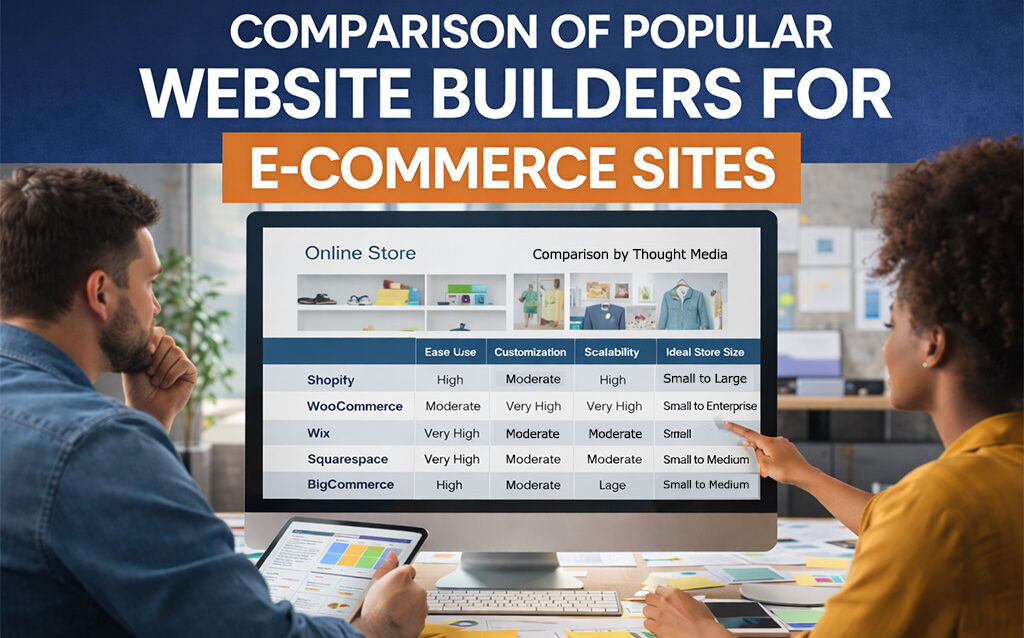
E-Commerce Website Builder Comparison Table
| Platform | Best For | Ease of Use | Customization | Scalability | Built-in Hosting | Ideal Store Size |
| Shopify | Quick launches, growing brands | High | Moderate | High | Yes | Small to Large |
| WooCommerce | Full control, long-term scaling | Moderate | Very High | Very High | No | Small to Enterprise |
| Wix E-Commerce | Beginners, small stores | Very High | Moderate | Moderate | Yes | Small to Medium |
| Squarespace | Design-focused brands | High | Moderate | Moderate | Yes | Small to Medium |
| BigCommerce | Growing mid-size businesses | Moderate | High | High | Yes | Medium to Large |
Which E-Commerce Website Builder Is Best?
The honest answer may be frustrating for some, but simply put it really on the situation.
If you want:
- Fast setup and minimal tech headaches → Shopify
- Full ownership and maximum flexibility → WooCommerce
- Simple drag-and-drop control → Wix
- Beautiful branding with clean design → Squarespace
- Strong built-in features for scaling → BigCommerce
But here is something most comparison articles will not tell you. The platform matters less than the strategy behind it. A poorly structured Shopify store will not outperform a well-built WooCommerce store. And vice versa. Design, SEO, conversion strategy, product positioning, and performance optimization matter more than brand name alone. A professional web design company will have experience across the board with all platforms, and know the ins and outs of how to setup and optimize each. In many cases if you want to avoid the headache of needing to make the switch from DIY to working with a professional e-commerce development agency it’s best to do so from the start. If you’re part of a large company or enterprise then it definitely makes sense to work with a team of professionals right away to ensure the best results.
When DIY Stops Making Sense
At some point, many store owners realize something. They did not start a business to become part-time web developers. Managing plugins, security updates, abandoned carts, speed optimization, checkout flow improvements, and SEO architecture can become overwhelming. That’s when growing/scaling businesses shift from asking, “Which website builder should I use?” to “Who can build this properly for me?”. There is nothing wrong with starting DIY for very small businesses. Just know when growth demands professional support and decades of experience.
Frequently Asked Questions (FAQ)
What is the best website builder for e-commerce?
The best website builder depends on your needs. Shopify is great for ease of use. WooCommerce offers maximum customization and is part of WordPress (the mode widely used website platform online). Wix and Squarespace work well for smaller stores. BigCommerce supports growing brands.
Is Shopify better than WooCommerce for online stores?
Shopify is easier to set up and manage. WooCommerce offers more customization and long-term flexibility but requires more technical management.
Can I build an e-commerce site without coding?
Yes. Platforms like Shopify, Wix, and Squarespace allow you to build online stores without coding. However, advanced customization may require developer support.
Which e-commerce website builder is best for SEO?
WooCommerce, because it runs on WordPress, typically offers the most SEO flexibility. However, Shopify and BigCommerce also provide strong SEO capabilities when properly configured.
When should I hire a professional for my e-commerce website?
You should consider hiring a professional when you need advanced customization, improved performance, stronger SEO, or when your store begins scaling beyond basic functionality.
Conclusion
Choosing an e-commerce website builder is not about picking the most popular name. It is about aligning the platform with your business goals, technical comfort level, and growth plans.