


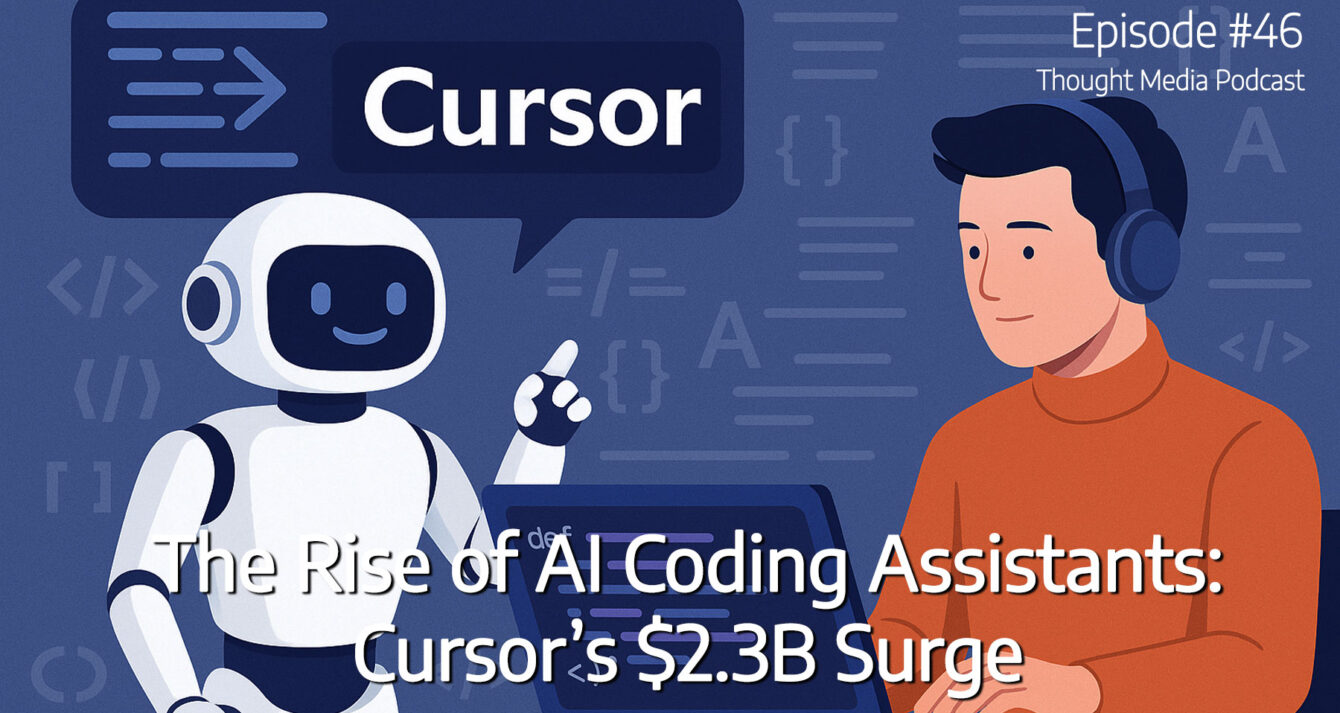


In Episode 46 of the Thought Media™ Podcast, hosts Ava and Max explore the explosive rise of AI-powered coding tools — spotlighting Cursor, the fast-growing AI coding assistant startup that just secured a staggering $2.3 billion valuation, only five months after its previous funding round. This milestone marks a major shift in how software development is evolving, with AI stepping deeper into core engineering workflows.
The episode breaks down what AI coding assistance actually entails: machine learning models that can analyze natural language, project context, and codebases to generate working code across various programming languages. From Python and JavaScript to Java, C++, SQL, Swift, and beyond, these tools help developers write functions, debug issues, refactor logic, and even design initial architecture patterns — all at unprecedented speed.
Ava and Max also dive into the emerging concept of vibe-coding, a new development style where engineers “co-create” with artificial intelligence in a conversational, fluid manner. Instead of manually writing every line, developers collaborate with AI models in real time, refining ideas, asking for variations, restructuring large sections of logic, and brainstorming solutions like they would with a human pair-programmer.
The hosts explain that Thought Media™ already uses AI coding tools, including Cursor-style assistants, to accelerate prototypes, improve debugging efficiency, and support large project pipelines. However, they emphasize that these tools augment human developers — they do not replace them. Skilled engineers are still required for system architecture, performance optimization, security hardening, and final QA.
Looking ahead, Ava and Max discuss predictions for 2030, when AI coding platforms may become capable of fully handling complex end-to-end software projects. Even then, human oversight will remain essential for quality assurance, safety, ethical decision-making, and real-world reliability.
This episode highlights a key message: AI isn’t taking over coding — it’s transforming it into a more collaborative, efficient, and creative discipline.