


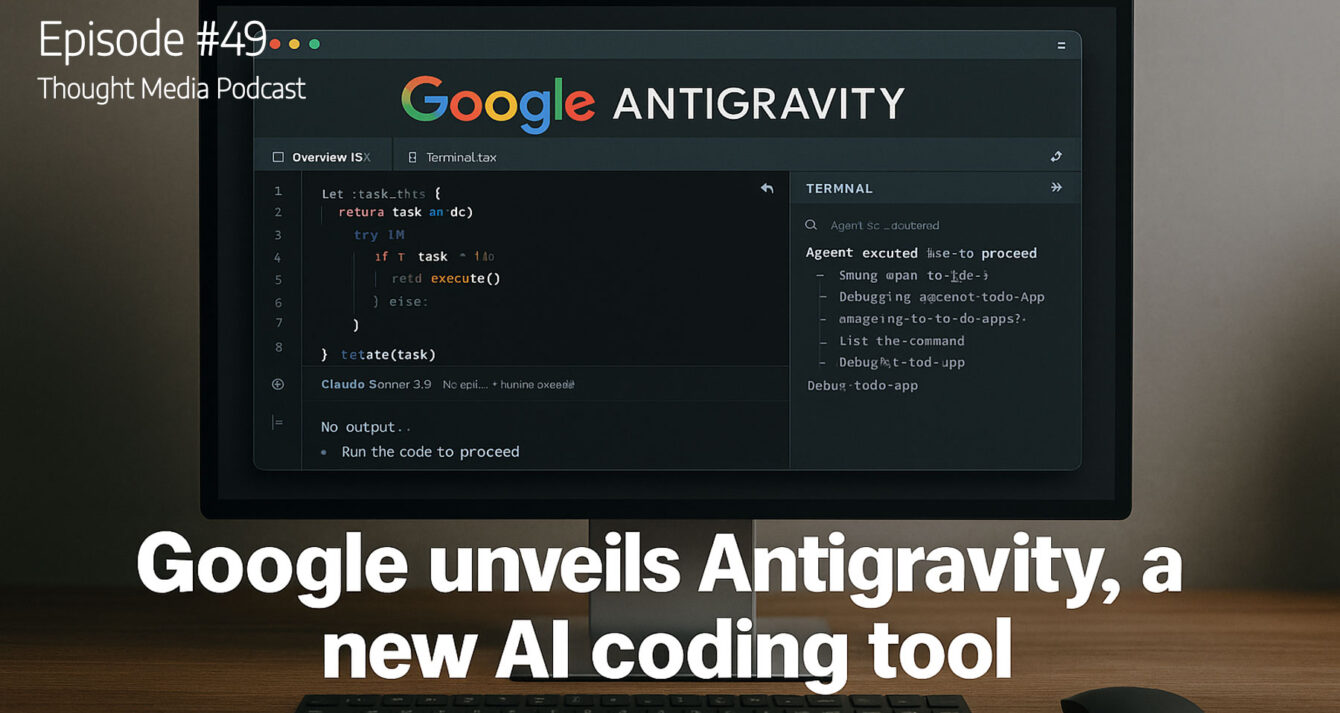


Episode 49 of the Thought Media™ Podcast explores Google Antigravity, a free (for now) AI-powered coding tool and environment built to accelerate software development through agentic workflows. Hosts Ava and Max unpack why this tool is already being described as a game-changer for programmers and how it positions Google as a major player in the next evolution of AI-native software engineering.
Antigravity is designed as an agent-first IDE, meaning artificial intelligence agents can autonomously operate across the editor, terminal, and browser — just like a real developer. Instead of simply generating code, Antigravity can run commands, debug issues, test applications, analyze logs, and manage multi-step workflows without constant user intervention. Developers can assign a high-level task, and Antigravity orchestrates the required steps automatically.
Ava and Max highlight that Antigravity supports an impressive lineup of AI models: Gemini 3 Pro, Claude Sonnet 4.5, and Google’s new GPT-OSS open models. Even more notable, Antigravity currently offers unlimited completions, unlimited agent commands, and unlimited workflow actions — all completely free, signaling Google’s intention to dominate developer adoption quickly.
The episode also breaks down how Antigravity compares to competitors like Cursor, GitHub Copilot Workspace, Windsurf, and other emerging agentic IDEs. What makes Antigravity stand out is its deep integration potential with the Google ecosystem, including future links to Google Cloud, Firebase, Chrome DevTools, and web testing tools. This positions Antigravity to become a central hub for AI-augmented development.
Ava and Max discuss how agentic coding changes the developer workflow. Instead of writing every line manually, developers can issue goals like “build a Next.js dashboard,” “set up OAuth,” or “fix API errors,” and Antigravity will execute tasks across environments autonomously. This pushes software engineering closer to a collaborative partnership between human developers and AI agents.
From Thought Media™’s viewpoint, Ava and Max note that while tools like Antigravity significantly speed up prototyping, automation, and experimentation, skilled developers remain crucial. Humans still provide architectural judgment, system design, security review, quality assurance, and final deployment oversight.
The episode concludes with a key insight: Google’s release of Antigravity — especially as a free, unlimited tool — signals the beginning of a major shift. The future of software will be built with AI, through AI, and alongside AI, and Antigravity is one of the strongest steps toward that reality.