


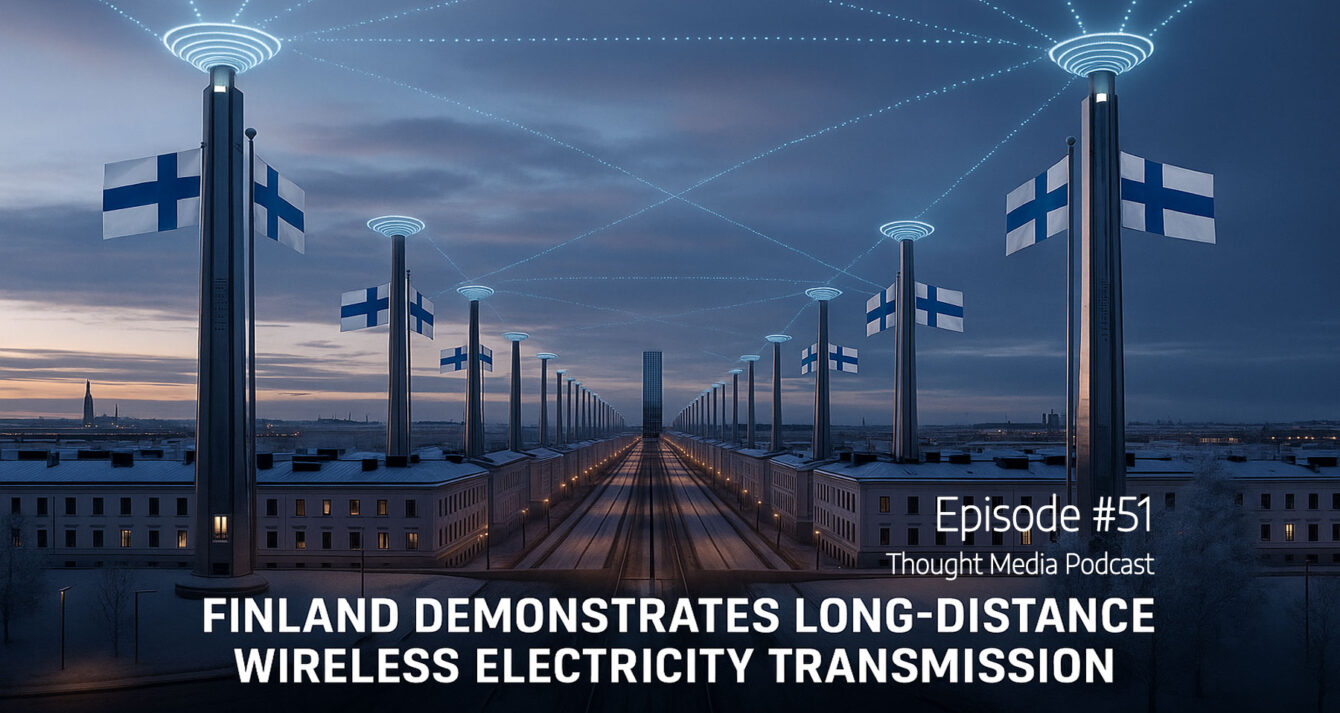


Finland has just introduced one of the most transformative breakthroughs in modern energy innovation: long-range wireless electricity transmission. Episode 51 of the Thought Media™ Podcast explores this revolutionary achievement and breaks down how it could reshape global infrastructure, mobility, and the way humans interact with power systems.
The episode begins by examining the core of the technology. Finnish engineers have demonstrated a system capable of sending electricity across distance through the air using high-frequency magnetic fields paired with superconducting receivers. Unlike traditional wireless charging pads or short-range induction coils, this new method supports far greater range and efficiency, allowing electricity to move freely without cables, tunnels, or physical connections.
Ava and Max highlight how this innovation fundamentally reframes energy distribution. If developed and scaled, electricity could work similarly to Wi-Fi — ambient, invisible, always available. Drones could fly indefinitely without needing to land. Electric vehicles could recharge while moving. Factories could power machinery without complex wiring. And remote regions — from islands to mountainous terrain — could receive energy without costly infrastructure projects.
The hosts explain that this technology could drastically reduce reliance on bulky power lines, transformers, and fragile grid architecture. Wireless electricity also increases flexibility. Cities, buildings, and devices would no longer be bound by fixed grid layouts, making urban planning far more dynamic. Emergency situations could benefit as well — disaster zones could be powered instantly without rebuilding infrastructure.
Of course, Ava and Max emphasize that this is still early-stage research. Finland’s demonstration proves feasibility, but not yet commercial readiness. Many challenges remain: scaling superconducting materials, ensuring safety at wider ranges, preventing interference, and achieving stable mass deployment. However, the foundation is solid — and global interest is rapidly growing. This concept is quite similar to that proposed and tested by Nikola Tesla in the 1800’s and early 1900’s.
The episode concludes by exploring the broader vision. Wireless electricity has the potential to redefine the next century of energy innovation. It aligns with renewable transitions, supports emerging technologies, and removes long-standing limitations in battery efficiency and mobility. Finland’s breakthrough may mark the beginning of a world where electricity is not something we plug into — it’s something that flows freely around us, instantly accessible wherever we are.