


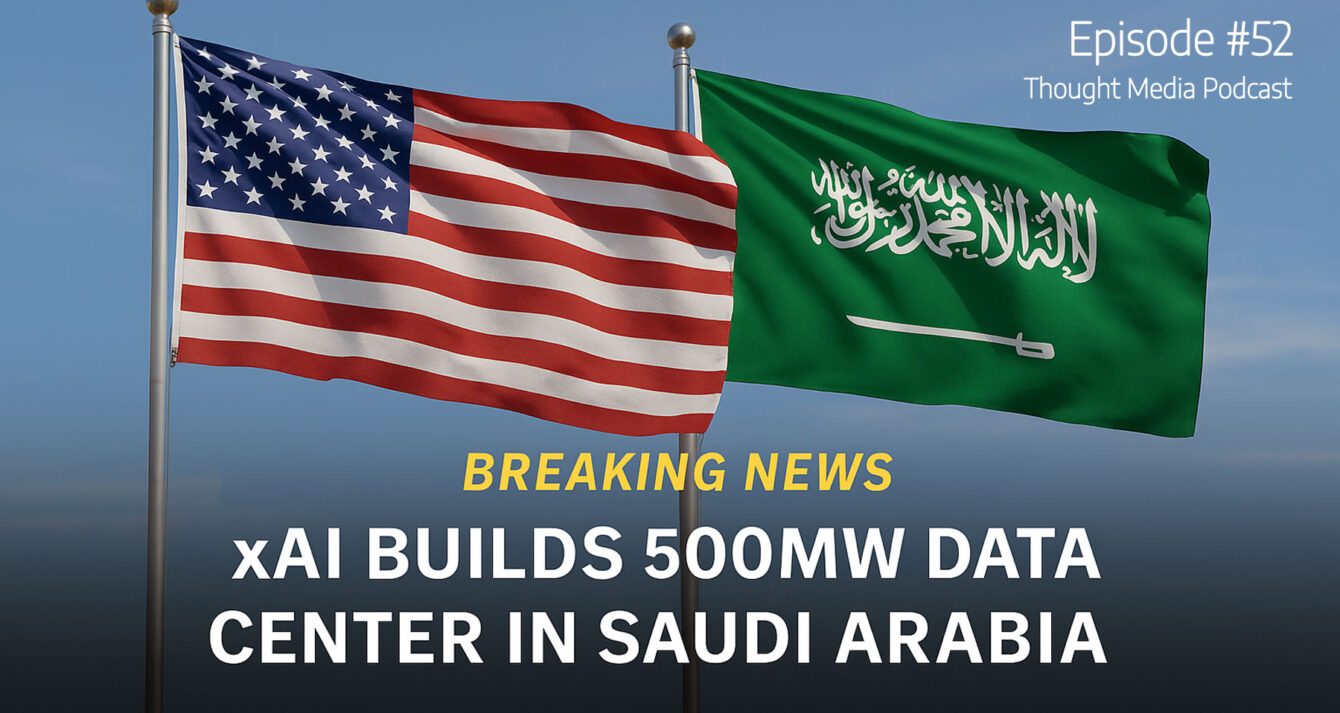


Episode 52 of the Thought Media™ Podcast analyzes Elon Musk’s announcement that xAI will construct a 500-megawatt data center in Saudi Arabia, making it the largest xAI facility outside the United States. Revealed at the U.S.–Saudi Investment Forum, this move represents one of the most significant global expansions of AI compute infrastructure to date. Ava and Max break down the strategic motives, geopolitical implications, and the logistical challenges that come with the project.
The data center will be built in partnership with Humain, Saudi Arabia’s state-owned AI startup. This aligns with the Kingdom’s ambitious Vision 2030 initiative, which seeks to position Saudi Arabia as a global AI superpower through massive investments in technology, talent, and infrastructure. For Musk, the partnership provides access to a nation eager to fund and support frontier-level AI projects at unprecedented scale.
A major highlight of the episode is Musk’s objective: scaling compute for Grok, xAI’s flagship model. With Grok competing directly against OpenAI’s GPT family, Anthropic’s Claude, and Google’s Gemini models, xAI must secure enormous GPU capacity. A 500MW data center signals Musk’s intention to accelerate both training and inference speed at a pace that matches — or surpasses — competitors.
However, Ava and Max discuss a major complication: Saudi Arabia is banned from purchasing Nvidia’s latest GPUs due to Trump-era export restrictions, which remain in effect. To navigate this, xAI will act as the primary operator and customer of the Nvidia hardware, allowing the data center to legally function even if Saudi entities cannot directly buy the chips. This workaround highlights the growing intersection of AI development and geopolitical regulation.
The episode underscores how the project also deepens Musk’s financial ties to Saudi Arabia. Kingdom Holding Company was one of the largest backers of Musk’s Twitter acquisition, and this new partnership further intertwines their strategic interests.
Despite its potential, the project faces hurdles — politics, chip supply chain constraints, and the sheer complexity of building a half-gigawatt AI facility in a foreign nation. Still, Ava and Max emphasize that this marks a clear trend: AI companies are no longer building compute only on U.S. soil. They are expanding globally, forming partnerships with countries willing to pour billions into the AI race.
This episode paints a vivid picture of how AI power, politics, and infrastructure now intersect on a global scale.