


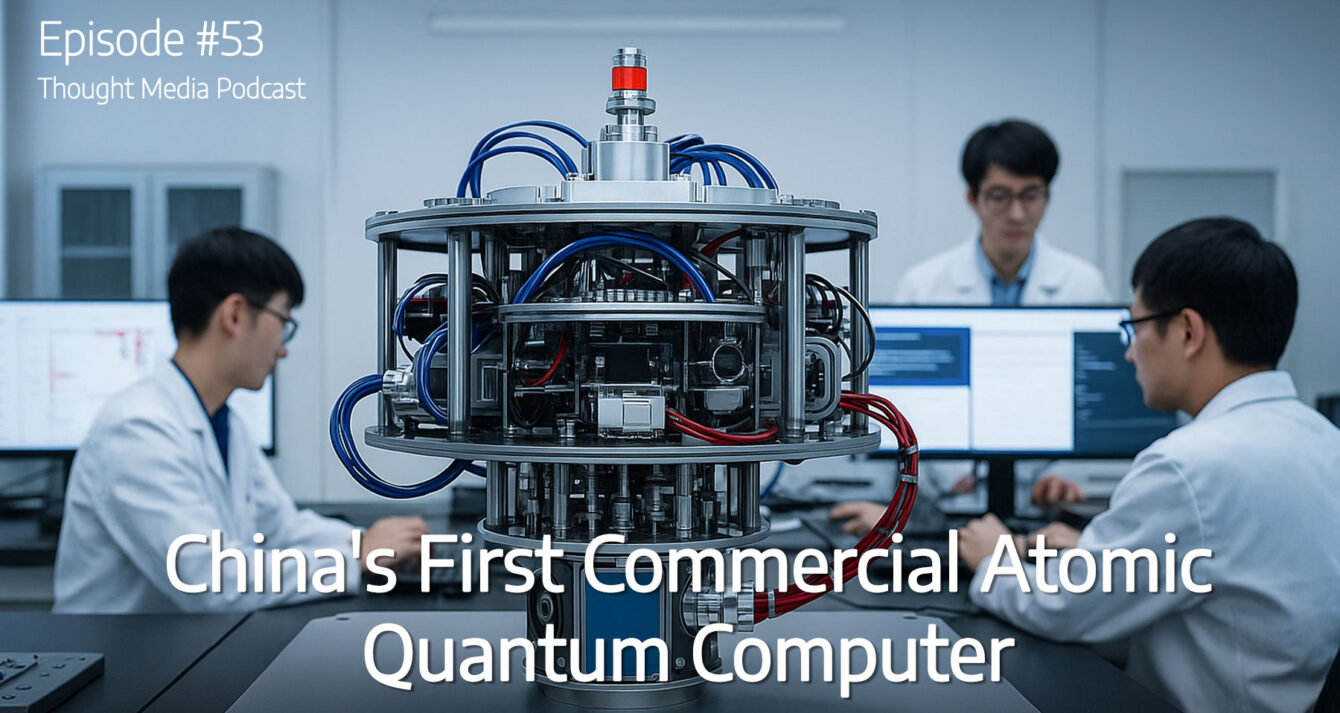


Episode 53 of the Thought Media™ Podcast explores one of the most consequential technological milestones of the decade: China’s launch of Hanyuan No. 1, the world’s first commercially available atomic quantum computer. This breakthrough signals a transition from experimental research systems to market-ready quantum products, positioning China at the forefront of global quantum capability.
Hosts Ava and Max begin by breaking down the fundamentals: what quantum computing is, how it differs from classical computing, and why the technology represents such a massive leap forward. While traditional computers operate using bits that are either 0 or 1, quantum systems use qubits, which can exist in multiple states simultaneously through superposition. Qubits can also become entangled, enabling complex computations that grow exponentially as more qubits are added. The result is a computing paradigm capable of solving problems that would take classical supercomputers thousands — or even millions — of years.
Hanyuan No. 1 represents a new class of quantum device. Unlike superconducting quantum processors that require extremely low temperatures, the Chinese system uses neutral atoms as qubits, arranged and controlled with laser arrays. This architecture allows room-temperature operation, significantly reducing the cost, complexity, and infrastructure typically associated with quantum machines. The system is compact, energy-efficient, and built entirely from domestic Chinese components, advancing China’s goal of technological self-sufficiency.
In the episode, Ava and Max explore how neutral-atom quantum systems could scale faster than competing architectures. Neutral atoms offer high coherence times, flexible layouts, and the potential to manipulate thousands of qubits simultaneously. This puts China’s approach on a trajectory for rapid expansion in commercial and industrial contexts.
The hosts then examine how quantum computing will reshape the world over the next 5–15 years. In the near term (5 years), quantum systems are expected to excel in specialized applications like chemical simulation, financial risk modeling, and optimization challenges. By 10 years, Ava and Max discuss the emergence of quantum-enhanced AI, where machine learning models are trained using quantum accelerators to dramatically improve efficiency and pattern recognition. Over a 15-year horizon, society may face the profound implications of quantum cryptography — including both quantum-secure communication and the risk that quantum systems could break today’s encryption standards.
China’s commercial quantum release signals more than technical progress; it marks a geopolitical shift. The ability to deploy, manufacture, and export quantum hardware will influence national security, economic competition, and global technology leadership.
Ultimately, Episode 53 frames Hanyuan No. 1 as a historic step toward a future where quantum computing becomes an accessible, commercially viable tool — one capable of transforming science, industry, and the balance of global power.