


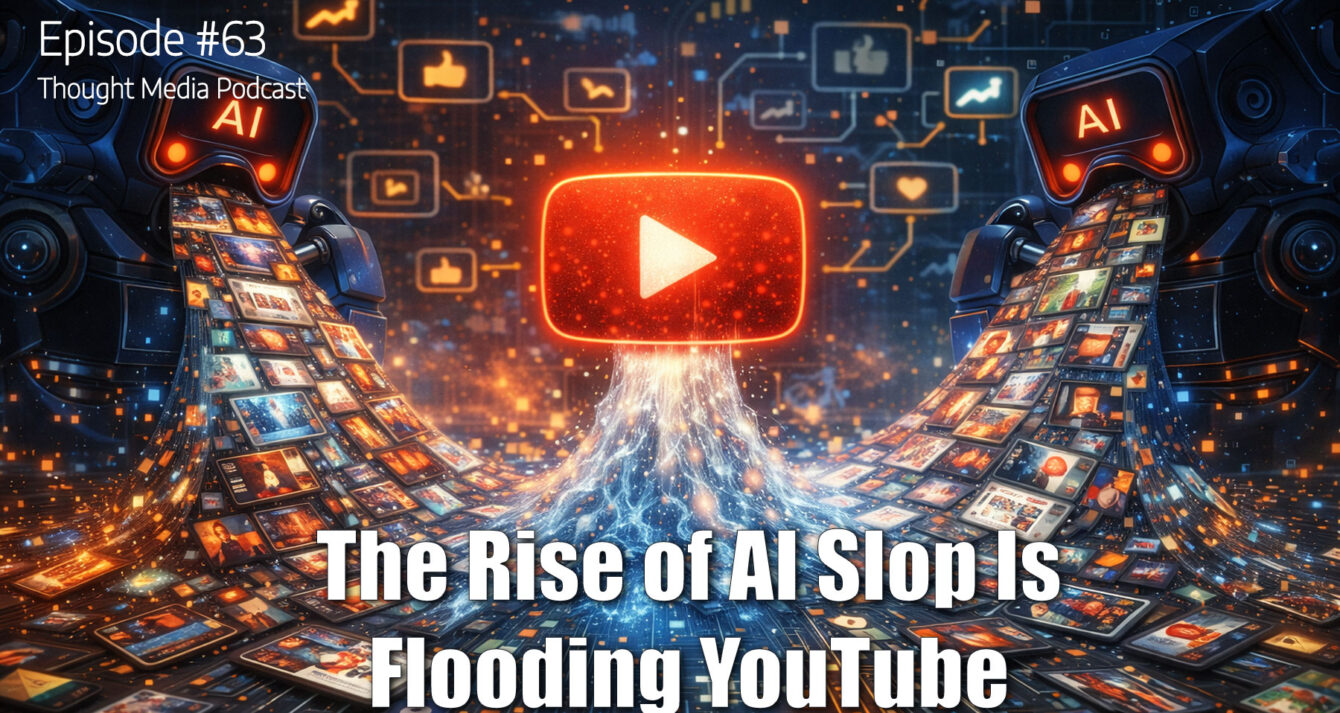


Episode 63 of the Thought Media™ Podcast examines a growing issue reshaping online video platforms: the rapid spread of low-quality, mass-produced AI content — commonly referred to as “AI slop.” Recent reports from The Guardian and Kapwing reveal that more than 20% of videos shown to new YouTube users are now AI-generated, raising serious questions about content quality, trust, and the future of digital media.
Ava and Max begin by explaining what AI slop actually is. These videos are typically generated using text-to-video tools, AI voices, automated editing software, and templated scripts. They are designed to be produced at massive scale, often recycling the same narratives, visuals, and formats across hundreds or thousands of uploads. The goal isn’t creativity or insight — it’s algorithmic optimization.
The episode highlights why new YouTube users are especially affected. Recommendation systems rely heavily on early viewing behavior to personalize content. When a user has no history, the algorithm defaults to what performs best globally — and increasingly, that means AI-generated videos optimized for clicks, watch time, and ad revenue. As a result, first impressions of the platform are being shaped by synthetic explainers, AI narration over stock footage, fake documentaries, and low-effort shorts.
Kapwing’s research shows this phenomenon is global. AI slop is being produced in dozens of languages and across nearly every content category — from history and finance to health and current events. Because production costs are extremely low, creators can upload hundreds of videos per week, overwhelming the platform with volume.
Ava and Max emphasize that the problem is not AI itself or AI Animation, but scale without quality control. AI tools can empower creators, speed up workflows, and unlock new forms of storytelling. However, when platforms reward consistency and output over originality and accuracy, low-quality content naturally rises to the top.
One of the most concerning aspects discussed is misinformation. Many AI slop videos present incorrect or misleading information with high confidence, making them difficult for viewers to evaluate — especially when paired with professional-sounding AI voices and polished visuals. Researchers warn this could erode trust in online video as a source of knowledge.
The episode also explores the impact on human creators. High-effort channels are increasingly competing against automated content farms that can flood the algorithm. At the same time, responsible creators who use AI as a tool risk being lumped into the same category as spam producers.
YouTube has acknowledged the issue, stating it is investing in detection systems and policy updates. However, enforcement remains inconsistent, and the volume of AI-generated uploads continues to grow faster than moderation systems can adapt.
The episode concludes by framing AI slop as a cultural challenge, not just a technical one. As content creation becomes frictionless, platforms must decide what they value: sheer output or meaningful contribution. The next phase of the creator economy may depend less on tools and more on trust, curation, and human judgment — determining whether AI enhances the internet or overwhelms it.