


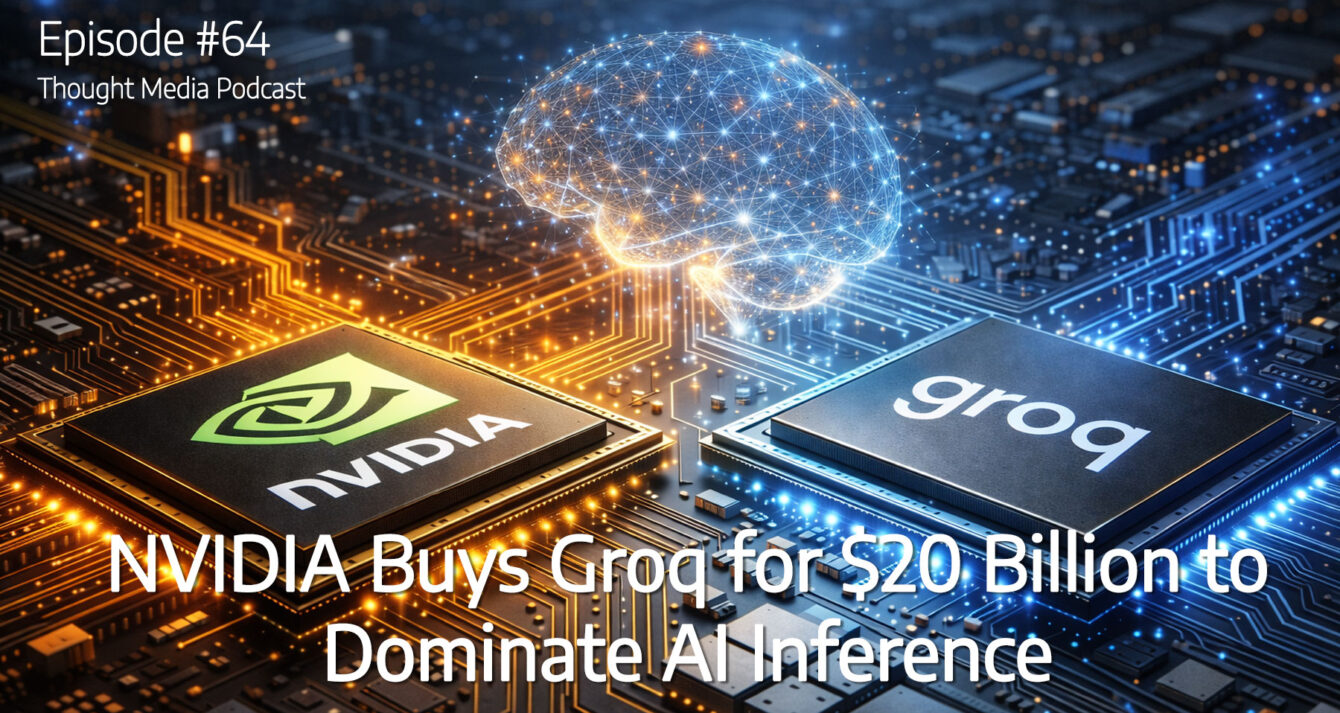


NVIDIA’s $20 Billion Groq Acquisition Signals Total Control of AI Inference
Episode 64 of the Thought Media™ Podcast examines NVIDIA’s $20 billion acquisition of AI chip startup Groq, the company widely regarded as one of the most promising challengers in the AI inference space. This deal is NVIDIA’s largest acquisition to date and represents a decisive move to dominate not just AI training, but the entire lifecycle of artificial intelligence computation.
Ava and Max begin by explaining why inference matters so much. While training large AI models captures headlines and consumes massive compute resources, inference — running those models in real time — is where the majority of long-term demand will exist. Every chatbot response, search result, recommendation, autonomous decision, and real-time AI system relies on inference. As AI becomes embedded in everyday products and services, inference workloads are expected to vastly outpace training in total volume.
Groq built its reputation by focusing exclusively on inference performance. Unlike traditional GPUs, which are optimized for flexible parallel workloads, Groq’s architecture is designed for deterministic, pipeline-based execution. This allows Groq chips to deliver extremely low latency, predictable performance, and high energy efficiency — key requirements for real-time AI applications.
The episode highlights how this complements NVIDIA’s existing strengths. NVIDIA already dominates AI training through its H100 and H200 GPUs, along with its CUDA software ecosystem. By acquiring Groq, Nvidia gains a specialized inference engine that fills a critical gap in its portfolio. Instead of relying solely on GPUs for inference — where efficiency can be suboptimal — Nvidia can now offer purpose-built inference hardware alongside its training platforms.
Ava and Max also discuss the competitive implications. Groq had been emerging as a serious alternative to GPU-based inference, attracting attention from enterprises and cloud providers seeking lower latency and reduced operating costs. By acquiring Groq, NVIDIA neutralizes a potential rival while absorbing its technology and talent into Nvidia’s broader platform.
The deal strengthens NVIDIA’s position with hyperscalers, governments, and enterprises looking for end-to-end AI infrastructure. From training to inference to networking and software orchestration, NVIDIA is increasingly positioning itself as a one-stop provider for AI compute at scale.
The hosts note that this acquisition reflects a broader industry trend toward consolidation. As AI infrastructure becomes more capital-intensive and strategically important, leading players are securing key technologies rather than allowing independent challengers to scale. Inference, in particular, is emerging as the next major battleground — and NVIDIA is moving early to secure dominance.
The episode concludes by framing the Groq acquisition as a long-term strategic investment rather than a short-term financial play. The $20 billion price tag underscores NVIDIA’s belief that inference will become a trillion-dollar market as AI systems proliferate across every sector of the economy.
With this deal, NVIDIA is no longer just the leader in AI training hardware. It is positioning itself as the central architect of AI computation, from model creation to real-time deployment — a move that could define the next decade of artificial intelligence infrastructure.