


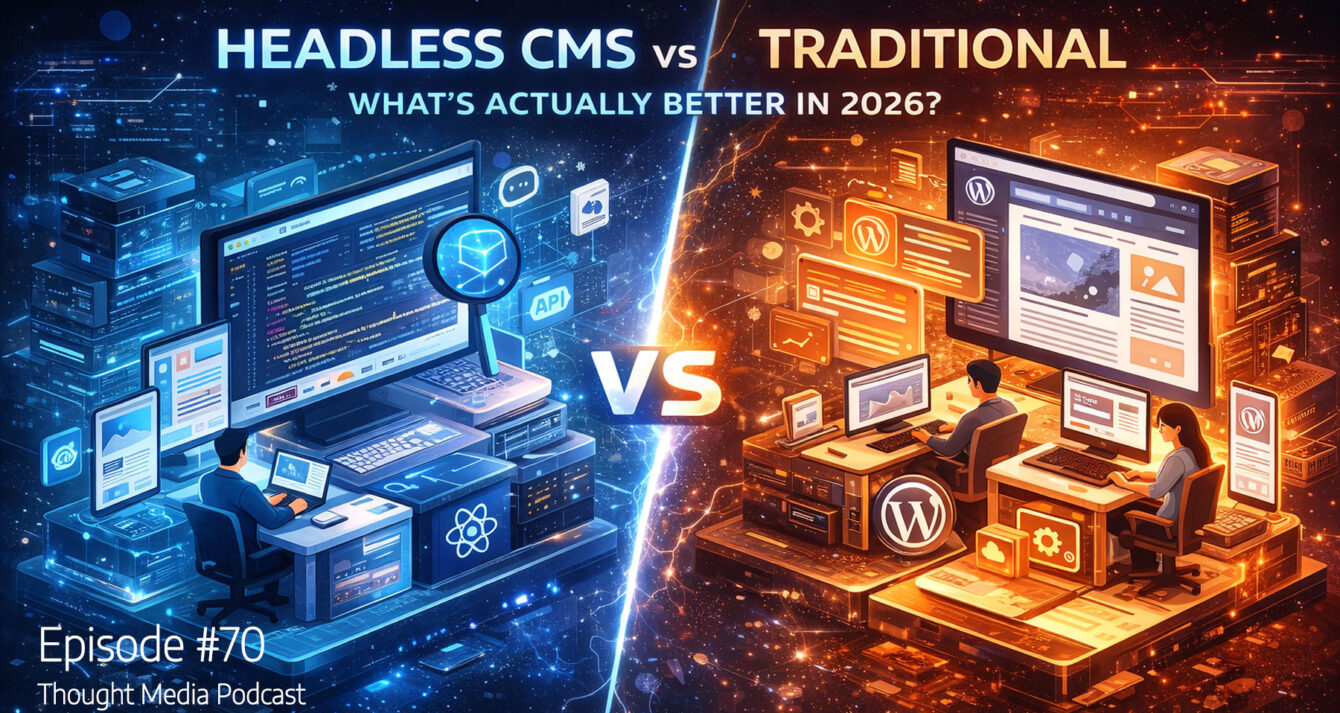


Headless CMS vs Traditional WordPress: What’s Actually Better in 2026?
The debate between headless CMS architecture and traditional WordPress has intensified in 2026. As performance expectations rise, AI integrations become standard, and user experiences grow more dynamic, businesses are questioning whether their website infrastructure is built for the future — or stuck in the past.
In Episode 70 of the Thought Media™ Podcast, this topic takes center stage as a natural continuation of Episode 69, where hosts Ava and Max discussed how AI search is reshaping SEO and website design. If AI is changing how websites are discovered, the next logical question is: how should websites be built to support that future?
Let’s break it down.
What Is Traditional WordPress?
Traditional WordPress is a monolithic CMS. That means the content management system and the front-end presentation layer live together. WordPress controls:
-
Content creation
-
Page rendering
-
Plugin integrations
-
Theme management
-
SEO tools
-
eCommerce capabilities
It remains the most widely used CMS in the world — powering over 40% of websites globally.
Why WordPress Still Works in 2026
Despite the rise of headless systems, traditional WordPress web design remains extremely powerful when properly built and optimized.
Benefits include:
-
Faster deployment
-
Lower development costs
-
Extensive plugin ecosystem
-
Strong SEO support
-
Ease of use for content teams
-
Massive global community support
With modern hosting, caching layers, performance tuning, and clean development practices, WordPress can achieve excellent Core Web Vitals scores and scale far beyond what most businesses require.
For small to mid-sized businesses, service providers, local companies, and many enterprise marketing sites, WordPress remains more than sufficient.
What Is a Headless CMS?
A headless CMS separates the content backend from the frontend presentation layer.
Instead of the CMS determining how the website looks, content is delivered via APIs to a separate frontend built with frameworks like:
-
React
-
Next.js
-
Vue
-
Nuxt
-
Svelte
The “head” (frontend) is removed from the CMS — hence the term “headless.”
Why Headless Has Gained Popularity
Headless architecture provides:
-
Greater frontend flexibility
-
Stronger performance optimization
-
Improved security separation
-
Multi-platform content distribution
-
Scalability across apps, websites, kiosks, and IoT
It’s particularly useful for:
-
SaaS platforms
-
Large eCommerce operations
-
Media publishers
-
Enterprise ecosystems
-
Multi-device digital products
When paired with static site generation or edge rendering, headless setups can be incredibly fast and globally optimized.
The Performance Conversation
One of the biggest arguments in favor of headless architecture is performance.
Because headless systems often use static generation or server-side rendering with modern frameworks, they can reduce overhead and improve load times dramatically.
However, this doesn’t mean WordPress is inherently slow.
In Episode 69, Ava and Max emphasized how AI search systems now prioritize structured, well-organized, high-performance websites. Speed and clarity are critical — but performance can be achieved in both traditional and headless systems when engineered correctly.
A poorly optimized headless site can be slower than a well-optimized WordPress site.
Architecture alone does not guarantee performance.
Complexity and Cost Considerations
Here’s where many businesses misunderstand the tradeoffs.
Headless systems require:
-
Frontend developers
-
Backend engineers
-
DevOps infrastructure
-
Ongoing API management
-
More complex deployment pipelines
This increases both upfront cost and long-term maintenance complexity.
Traditional WordPress:
-
Has a lower barrier to entry
-
Is easier for internal teams to manage
-
Offers a more consolidated ecosystem
-
Requires fewer specialized developers
For many organizations, especially those without in-house engineering teams, WordPress remains the more practical solution.
AI Integration and Future-Proofing
As discussed in Episode 69, AI search and AI-driven personalization are reshaping digital strategy.
Both headless and traditional systems can support:
-
Structured data
-
Schema implementation
-
AI-driven personalization
-
API integrations
-
AI content systems
The key is not whether the system is headless — it’s whether it’s architected strategically.
Headless may offer more flexibility for large-scale AI-powered applications.
But for most marketing-driven websites, WordPress can support AI integration extremely well when built with clean architecture.
When Should You Choose Headless?
Headless makes sense when:
-
You are building a product, not just a website
-
You need cross-platform content distribution
-
You have high engineering resources
-
You require deep frontend customization
-
You expect massive traffic scaling
If your website functions more like a software platform, headless can provide long-term flexibility.
When Should You Choose WordPress?
WordPress makes sense when:
-
Your primary goal is marketing and lead generation
-
You need SEO strength
-
You want lower development overhead
-
You value speed-to-market
-
You don’t have a full in-house engineering team
For most businesses, WordPress remains the most efficient and scalable choice.
The Strategic Takeaway
The real question isn’t “Which is better?”
It’s “Which aligns with your business model, growth trajectory, and technical capacity?”
Trends often drive architecture decisions. Strategy should drive them instead.
In Episode 70, the conclusion is clear:
Headless isn’t automatically superior. WordPress isn’t outdated.
Smart architecture in 2026 is about alignment — not hype.
How Thought Media™ Approaches It
At Thought Media™, we build both traditional WordPress and headless architectures depending on the needs of the client.
Our evaluation process considers:
-
SEO strategy
-
AI discoverability (as discussed in Episode 69 with Ava and Max)
-
Scalability goals
-
Performance requirements
-
Marketing workflows
-
Budget realities
-
Long-term maintainability
We don’t recommend platforms based on trends. We recommend them based on results.
With over 500 WordPress builds and extensive experience in modern web stacks, our team understands how to engineer solutions that perform today — and adapt tomorrow.
Final Thoughts
In 2026, website architecture decisions are more important than ever. AI search, performance expectations, and user experience standards are evolving rapidly.
But complexity does not equal superiority.
For most organizations, traditional WordPress — properly built — remains incredibly powerful.
For others, headless architecture provides flexibility that justifies the investment.
The future isn’t WordPress versus headless.
It’s intelligent, strategic development aligned with real business goals.