


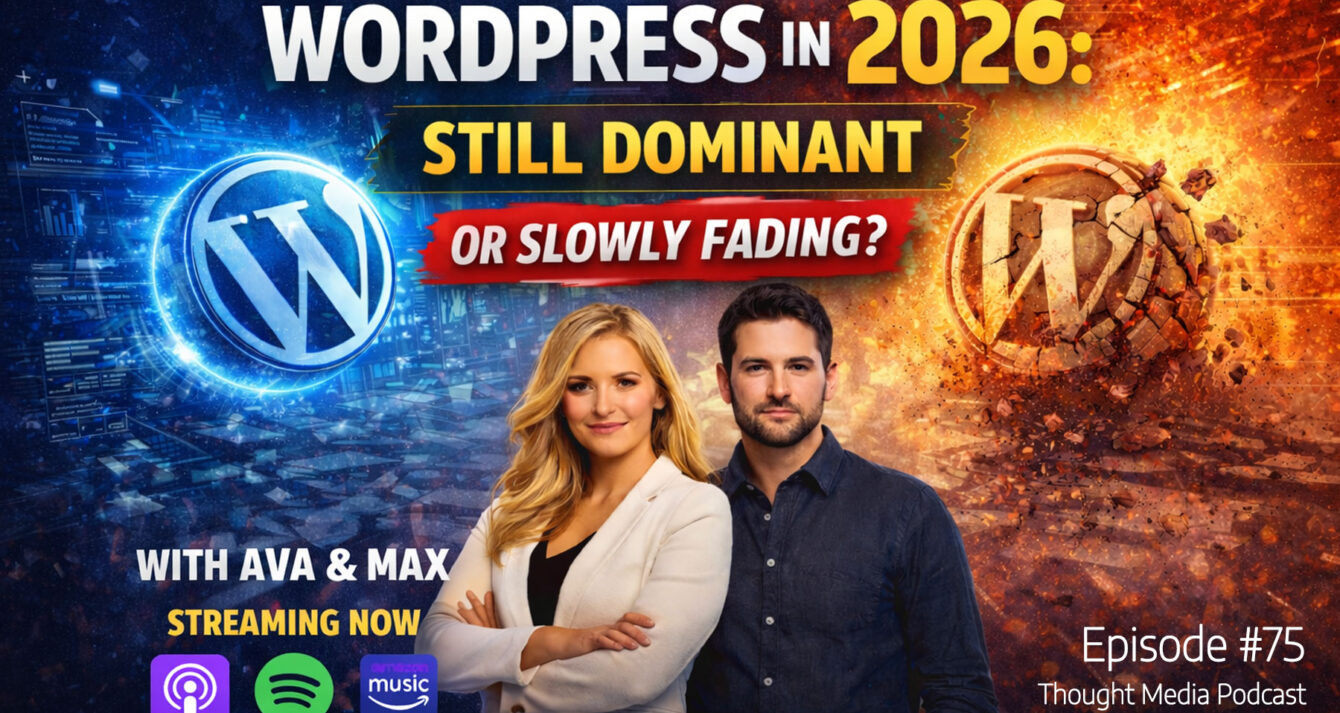


WordPress in 2026: Still Dominant or Slowly Fading?
For more than a decade, WordPress has been the backbone of the internet. At one point WordPress website design powered everything from personal blogs and startup landing pages to enterprise corporate websites and major media platforms. Even today, WordPress still powers over 40% of the web, which is an astonishing number when you consider how many alternatives have emerged in recent years.
But technology evolves quickly. New platforms appear. Expectations shift. AI tools are rewriting how websites are built and managed. That leads to a question many developers, agencies, and business owners are now asking: is WordPress still the dominant platform in 2026, or is it slowly fading?
In Episode 75 of the Thought Media™ Podcast, hosts Ava and Max dive into this topic and explore what’s actually happening in the website ecosystem. The answer, as it turns out, isn’t as simple as “yes” or “no.”
The Reality: WordPress Still Powers the Internet
Despite growing competition, WordPress remains one of the most widely used website platforms in the world. Its longevity comes from something very simple: flexibility. WordPress isn’t just a website builder. It’s an open framework that can be customized in almost unlimited ways.
Unlike closed platforms, WordPress gives developers full control over code, hosting environments, databases, and integrations. That level of control is why it continues to dominate many professional and enterprise-level builds.
Large organizations still rely on WordPress because it can scale, integrate with complex systems, and support advanced customization. From news publications to SaaS companies and government websites, WordPress remains deeply embedded across industries.
But the landscape around it is changing.
The Rise of SaaS Website Builders
Over the past several years, SaaS website platforms like Webflow, Shopify, Wix Studio, and Squarespace have gained enormous traction. These platforms promise something that WordPress often does not: simplicity.
With SaaS builders, hosting, security, updates, and infrastructure are handled automatically. Business owners can launch websites quickly without needing to worry about plugin conflicts, server management, or technical maintenance.
For small businesses, startups, and creators, this convenience is extremely appealing. Many companies simply want a website that works without having to think about backend systems.
This shift has created a divide in the market. Smaller projects are increasingly choosing SaaS solutions, while more complex projects still rely on flexible platforms like WordPress.
AI Is Changing Website Expectations
Another major factor reshaping the web development landscape is artificial intelligence. AI-powered website builders and design tools are appearing rapidly, promising to generate layouts, copy, and design elements automatically.
In the past, building a website often required multiple specialists — designers, developers, content writers, and SEO strategists. AI tools are beginning to automate parts of that process, allowing businesses to create functional websites in minutes rather than weeks.
This shift raises a new question for traditional CMS platforms. Can they evolve quickly enough to remain competitive in an AI-first world?
WordPress has already started integrating AI tools through plugins and extensions, but the ecosystem remains fragmented. Unlike fully integrated SaaS builders, AI capabilities within WordPress are often modular rather than native.
Headless WordPress Is Emerging
One of the most important developments in modern web architecture is the rise of headless CMS frameworks. In a headless setup, the backend content management system is separated from the frontend user interface.
WordPress can function extremely well in this role. Developers can use WordPress as a content engine while building the frontend using modern frameworks like React, Next.js, or Vue.
This approach allows teams to combine WordPress’s powerful content management capabilities with the performance and flexibility of modern web technologies.
However, headless WordPress setups require technical expertise. They are not designed for beginners or casual website owners. As a result, this approach is typically used for enterprise-level applications or highly customized projects.
The Security and Plugin Debate
Another reason WordPress often receives criticism is its plugin ecosystem. With thousands of plugins available, the platform offers incredible flexibility, but that flexibility can also create problems.
Poorly maintained plugins can introduce security vulnerabilities or performance issues. Inexperienced users may install too many plugins, slowing down their websites or creating compatibility conflicts.
That said, these problems usually arise from poor management rather than flaws in the platform itself. When built and maintained properly, WordPress websites can be extremely secure and performant.
Professional agencies and experienced developers understand how to manage plugin ecosystems carefully and build optimized environments.
WordPress Website Ownership vs. Renting
One of the biggest philosophical differences between WordPress and SaaS platforms comes down to ownership.
When you build a website using WordPress, you own the entire infrastructure. The files, the database, and the hosting environment belong to you. You have complete control over how your website evolves.
With SaaS builders, you’re effectively renting space within someone else’s ecosystem. While this can simplify management, it also limits flexibility and long-term control.
For businesses planning long-term digital growth, ownership can be an important factor.
So Is WordPress Website Design Fading?
The reality is more nuanced than a simple decline. WordPress isn’t disappearing, but the role it plays in the web ecosystem is evolving.
Smaller websites may increasingly shift toward all-in-one SaaS platforms for convenience. At the same time, professional and enterprise-level builds will likely continue relying on WordPress because of its flexibility and open architecture.
In Episode 75 of the Thought Media™ Podcast, Ava and Max describe this shift as a natural maturation of the platform rather than a decline. The low-effort WordPress builds may become less common, but engineered, performance-driven implementations remain incredibly powerful.
WordPress is not dying. It’s simply becoming more specialized.
Conclusion
The internet is constantly evolving, and the tools used to build it evolve alongside it. WordPress web design may no longer be the automatic choice for every small business website, but it still holds a powerful position in the web development ecosystem.
Its flexibility, open architecture, and massive developer community ensure that it will remain relevant for years to come. The difference is that businesses now have more options than ever before.
Instead of asking whether WordPress is fading, a better question might be: are you choosing the right platform for your specific goals?
That question matters far more than the platform itself.
And as Ava and Max discuss in Episode 75 of the Thought Media™ Podcast, the future of web development isn’t about one platform replacing another. It’s about choosing the right tools for the right problems.