



In the competitive field of investment, a polished and strategic venture capital website design can make the difference between being noticed and blending into the background. With the rise of start-up ecosystems and the demand for transparency, more firms are seeking a distinct venture capital web design to showcase credentials, attract founder applicants, and impress limited partners. In this article, we present 15 standout venture capital websites, analyse what makes them effective, and explore how a venture capital web design company can help your firm emulate their success. Let’s dive into these real-world examples and extract actionable insight.

What A Venture Capital Website Design Needs To Communicate
A venture capital website is not just a digital brochure.
It is a trust signal.
Founders use it to decide whether the firm understands their market, stage, and ambition. Limited partners use it to understand credibility, focus, discipline, and investment philosophy. Portfolio companies use it to understand how the firm supports growth. Press, recruiters, advisors, and partners use it to quickly understand where the firm fits in the investment ecosystem.
That means venture capital website design needs to communicate more than style.
It needs to communicate position.
| Website Message | Why It Matters | What To Include |
|---|---|---|
| Investment thesis | Shows what the firm believes and where it invests | Sector focus, stage focus, geography, philosophy |
| Founder fit | Helps startups know whether they should reach out | Ideal company profile, funding stage, founder resources |
| Portfolio credibility | Builds proof through existing investments | Portfolio grid, filters, founder stories, exits, case studies |
| Team trust | Shows who founders and LPs will work with | Partner bios, operating experience, investment background |
| LP confidence | Supports institutional credibility | Firm history, strategy, responsible disclosures, contact paths |
| Deal flow clarity | Helps the right founders self-select | Application path, pitch submission, contact form |
| Thought leadership | Shows market intelligence and category expertise | Insights, reports, podcasts, essays, newsletters |
| Brand differentiation | Makes the firm memorable | Visual identity, voice, storytelling, design system |
A strong venture capital website should answer the most important visitor questions quickly:
- What does this firm invest in?
- What stage does the firm focus on?
- What kind of founders should reach out?
- Who is on the investment team?
- What companies has the firm backed?
- What makes the firm different?
- How does the firm help after investment?
- How should a founder or LP contact the firm?
If the website does not answer those questions clearly, the design may look polished but still fail strategically.
The best venture capital websites usually combine:
✓ Clear investment focus
✓ Strong portfolio visibility
✓ Founder-friendly messaging
✓ Simple navigation
✓ Credible team presentation
✓ Thought leadership
✓ Fast mobile experience
✓ Strong visual identity
✓ Easy contact or pitch pathways
For VC firms, clarity is not basic.
Clarity is competitive.
Venture Capital Website Design Priorities
Not every venture capital firm needs the same website.
A seed-stage fund, growth equity firm, corporate venture group, emerging manager, crypto fund, healthcare investment firm, or climate-focused VC may need different positioning and content architecture.
However, most strong VC websites share a similar set of priorities.
| Design Priority | Importance | Why It Matters |
|---|---|---|
| Investment thesis clarity | 20% | Visitors need to understand the firm’s focus quickly |
| Portfolio presentation | 20% | Existing investments are the strongest proof of credibility |
| Team and partner trust | 15% | Founders and LPs want to know who is behind the firm |
| Founder conversion path | 15% | Startups need a clear way to pitch or connect |
| Thought leadership | 10% | Insights show expertise and market perspective |
| Visual brand identity | 10% | A distinctive identity helps the firm stand out |
| Technical performance | 10% | Speed, mobile usability, SEO, and accessibility affect trust |
Venture Capital Website Priority Chart
| Priority | Weight |
|---|---|
| Investment thesis clarity | ████████████████████ 20% |
| Portfolio presentation | ████████████████████ 20% |
| Team and partner trust | ███████████████ 15% |
| Founder conversion path | ███████████████ 15% |
| Thought leadership | ██████████ 10% |
| Visual brand identity | ██████████ 10% |
| Technical performance | ██████████ 10% |
This kind of scorecard helps VC firms avoid a common mistake:
Designing a website around aesthetics before defining the strategic message.
A beautiful website is useful.
But a beautiful website that does not explain the firm’s investment focus, founder value, team credibility, portfolio proof, and contact path may create friction for the wrong reasons.
Venture capital website design should be evaluated through practical questions:
- Can a founder understand the firm’s investment focus in 10 seconds?
- Is the portfolio easy to browse?
- Are partner bios credible and human?
- Is the firm’s thesis clear?
- Is the website easy to use on mobile?
- Is there a clear pitch or contact path?
- Does the design feel differentiated from other funds?
- Does the site support SEO and AI search visibility?
- Can the internal team update portfolio companies, news, and insights?
- Does the website create trust with founders and LPs?
The best venture capital websites do not overwhelm visitors with unnecessary content.
They make the right information obvious.
Venture Capital Website Structure And Content Checklist
A venture capital website needs to serve multiple audiences at once.
That can make the structure difficult.
Founders want speed and clarity. LPs want credibility and discipline. Portfolio companies want support. Press and partners want context. Search engines and AI answer tools need structure and readable content.
A strong website architecture can serve all of these audiences without creating confusion.
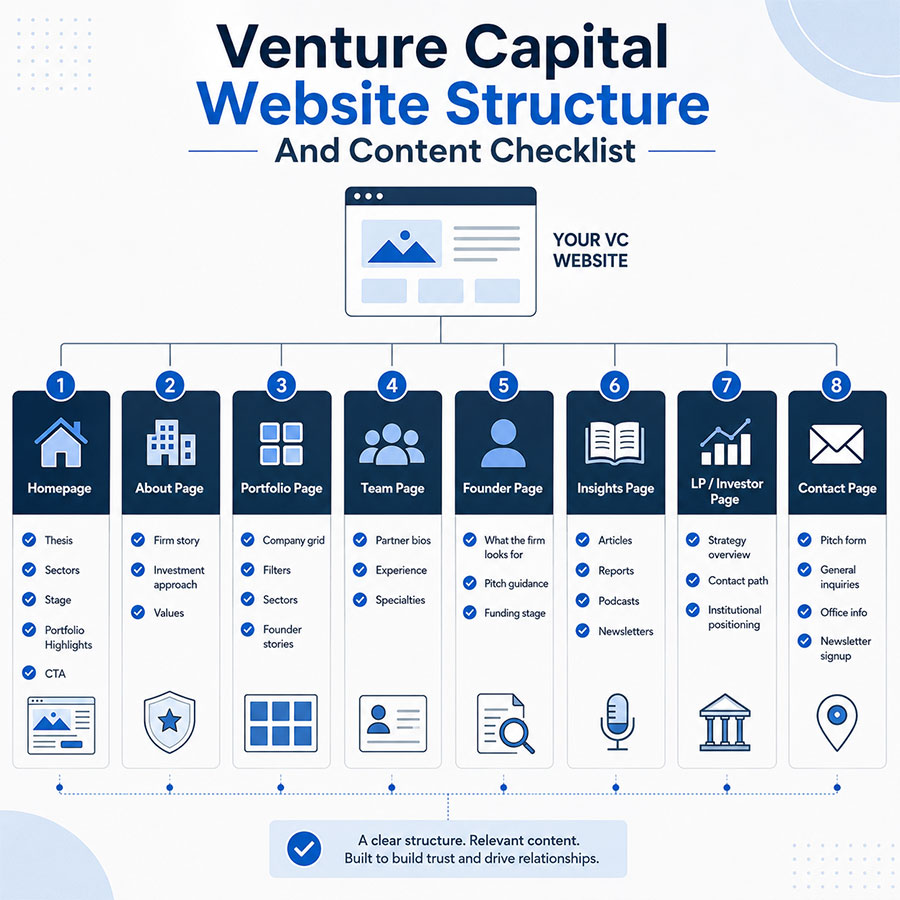
| Website Section | Purpose | Recommended Content |
|---|---|---|
| Homepage | Create immediate positioning and trust | Thesis, sectors, stage, portfolio highlights, CTA |
| About page | Explain the firm’s story and philosophy | Firm history, investment approach, values, differentiation |
| Portfolio page | Prove credibility through investments | Company grid, filters, sectors, stages, founder stories |
| Team page | Humanize the firm | Partner bios, experience, specialties, LinkedIn links |
| Founder page | Help startups decide whether to reach out | What the firm looks for, pitch guidance, funding stage |
| Insights page | Show thought leadership | Articles, market reports, podcasts, essays, newsletters |
| LP or investor page | Support investor confidence where appropriate | Strategy overview, contact path, institutional positioning |
| Contact page | Reduce friction | Pitch form, general inquiries, office info, newsletter signup |
VC Website Content Checklist
| Content Element | Recommended For |
|---|---|
| Clear investment thesis | Every VC website |
| Sector and stage focus | Every VC website |
| Portfolio filters | Funds with many investments |
| Founder-facing CTA | Firms seeking inbound deal flow |
| Partner bios | Every VC website |
| Founder stories | Firms with strong portfolio narratives |
| Market insights | Firms building authority |
| Newsletter signup | Firms publishing regular content |
| Pitch submission form | Firms accepting inbound pitches |
| Press/media page | Larger or highly visible firms |
| SEO and schema markup | Every modern VC website |
| CMS editing tools | Every active VC website |
A good venture capital website should be easy to manage after launch.
The internal team may need to update:
- New investments
- Exits
- Portfolio company descriptions
- Team bios
- News mentions
- Market insights
- Event announcements
- Podcast episodes
- Reports
- Founder resources
- Job board content
This is why CMS planning matters.
A venture capital website should not be designed as a static artifact.
It should be built as a living platform that supports the firm’s reputation, recruiting, deal flow, content, and long-term brand authority.
Venture Capital Website Budget And Timeline Expectations
The cost and timeline for venture capital website design depends on the scope of the project.
A simple website refresh is very different from a full custom VC website with brand strategy, custom design, portfolio database, insights system, founder resources, animation, SEO, analytics, and managed hosting.
| Project Type | Typical Scope | Estimated Timeline | Best Fit |
|---|---|---|---|
| Basic VC website refresh | Updated pages, improved design, basic CMS, simple portfolio page | 4–8 weeks | Emerging funds or smaller firms |
| Custom VC website | Strategy, custom design, team pages, portfolio system, insights/blog | 8–14 weeks | Established funds needing stronger positioning |
| Advanced VC platform | Custom CMS, filters, founder resources, thought leadership, animations | 12–20 weeks | Active funds with content and portfolio complexity |
| Enterprise investment website | Advanced architecture, integrations, security, accessibility, governance | 16–28+ weeks | Large firms, multi-fund platforms, institutional investors |
Venture Capital Website Timeline Chart
| Website Scope | Timeline |
|---|---|
| Basic VC website refresh | ██████ 4–8 weeks |
| Custom VC website | ███████████ 8–14 weeks |
| Advanced VC platform | ███████████████ 12–20 weeks |
| Enterprise investment website | █████████████████████ 16–28+ weeks |
A strong VC website project usually includes:
- Brand and positioning review
- Website strategy and sitemap
- Audience mapping for founders, LPs, and partners
- Content planning
- UX direction and wireframes
- Visual design system
- Portfolio structure
- Team and insight templates
- Website development
- SEO and schema setup
- Testing and mobile optimization
- Launch and post-launch support
The biggest mistake is treating a venture capital website as a small design exercise.
For an investment firm, the website is often the first serious credibility checkpoint.
It should support the firm’s thesis, deal flow, portfolio reputation, founder relationships, and investor confidence.
15 Inspiring Venture Capital Website Design
To see the possibilities of venture capital website design, exploring existing examples is essential. Below is a curated selection of high-performing venture capital websites that combine branding, usability, and trust. Each one can serve as inspiration when your firm seeks to elevate its online presence.
-
Thought Media™
Thought Media™ is a leading web design and branding agency, trusted by companies across the finance, investment, and technology sectors. Their approach to venture capital website design emphasizes clean navigation, bold typography, and interactive features that enhance trust. By combining branding expertise with technical execution, Thought Media™ demonstrates how design agencies can set a standard for venture capital website design and branding.
-
Sequoia Capital
Sequoia’s website is often praised for its gallery-style layout, blending bold visual storytelling with a clean architecture. Their content focus includes perspectives, news, spotlights, and animations that subtly enrich interactions.
-
First Round Capital
Known for clarity and personality, First Round integrates its FAQ directly on its homepage. Their team pages are humanized, with first-person bios and an approachable tone.
-
Lux Capital
Lux uses bold typography and dynamic navigation (left sidebar) to emphasize its identity. Their homepage video and animated X motif merge branding and interactivity.
-
Upfront Ventures
Upfront opts for simplicity: strong colour accents, hero visuals, and clean layouts. Their mobile design retains clarity and usability.
-
Index Ventures
Index Ventures’ homepage features modern styling, strong whitespace, and intuitive navigation to portfolio and insight pages.
-
Lightspeed Venture Partners
A sleek, contemporary venture capital website design, combining high-quality imagery, vibrant accents, and direct messaging.
-
Craft Ventures / NextView Ventures
These sites emphasize bold contrast, minimal layouts, and ease of reading. Their interfaces prioritize portfolio visibility, insights, and direct paths to contact.
-
Balderton / Human Ventures
Some firms go more expressive: human-centered visuals, color experimentation, and playful typography. These are still venture capital websites but lean more toward brand storytelling.
-
DNA Capital
DNA Capital experiments with layout; its “Companies” page uses unexpectedly arranged portfolio visuals. The overall site offers breathing room, readable typography, and modern animation.
-
Andreessen Horowitz (a16z)
The site takes an editorial approach and reads much like a digital magazine; a mixture of thought leadership, podcasting, and industry opinions with clear navigation and bold graphics.
-
Bessemer Venture Partners
Bessemer’s design imbues authority and trust. Regarded as xerophilous, this design comprises a structured layout alongside a portfolio section to tell clear stories that confer on the firm its long legacy.
-
Accel
Accel’s website design equates to a mix of professionalism and casualness, featuring shining depictions of partner bios, portfolio highlights, and a stand-alone, simple design for mobile view.
-
Greylock Partners
For Greylock, clarity and mentorship are regions emphasized within the design, with minimalist layouts, and with a side focus on resources for entrepreneurs in addition to portfolio companies.
-
GV (Google Ventures)
GV’s site is sleek and modern, with a bold typeface, large amounts of negative space, and vibrant imagery. The stories of founders are highlighted, as are investment philosophy and actionable insights.
These venture capital websites show a spectrum: from minimal and professional to expressive and branded. What unites them is clarity, strong portfolio display, human connection, and intentional navigation. They demonstrate what a venture capital web design company can achieve with a custom design tailored to the brand and market.
What Makes These Venture Capital Website Designs Effective & Trends to Adopt?

Seeing great examples is one thing, understanding why they work is another. When evaluating venture capital website design examples, you want underlying design principles and emerging trends that deliver impact.
Venture Capital Website: Core Design Principles
- Clear messaging and voice
The best venture capital web designs speak in a tone distinct to the firm. They don’t muddy the value proposition. As one article puts it, top VC sites “adopt a voice that’s undeniably theirs.” - Human connection & team presence
Firms ensure that their teams appear approachable, not faceless. Bios are personal, images are diverse, and narratives focus on people. That builds trust. - Portfolio-first presentation
Every strong venture capital website design features a portfolio or companies’ section prominently. Interactivity, filtering, case studies, and metrics reinforce credibility. - Clean architecture and navigation
Clutter is avoided. Menus are limited and intuitive; pages are digestible; navigation paths lead to conversion (apply, contact, learn more). - Visual polish with subtle motion
Animation, micro-transitions, and scroll effects are used tastefully. They help with focus and delight without overwhelming.
Emerging Trends in Venture Capital Website
- Dark mode and contrast play
Using dark backgrounds, vivid accents, and high contrast typography gives visual strength and modernity (e.g., some VC firms use black and white with bold accent colours). - Scroll-based storytelling
Many venture capital website design examples guide the user through a narrative as they scroll, combining visuals, copy transitions, and kinetic movement. - Micro animations & responsive feedback
Hover effects, subtle motion in portfolios, transitions between sections, these enhancements help signal interactivity and polish. - Mobile-first priority
Some designs opt to prioritize mobile layout first, then adapt to desktop. Simplicity and efficiency are key elements. - Dynamic CMS and content flexibility
Many venture capital web design companies include easy updating of news, deal flows, blog content, and featured portfolio items, making the site live and evolving. - Integrated user paths for founders & LPs
Some firms build dual conversion flows: one path for start-up founders (apply, pitch) and another for investors (reports, partnership). The design must accommodate both without confusion.
Final Thoughts
Venture capital website design is about more than a modern layout.
It is about trust, focus, and credibility.
The best VC websites quickly communicate what the firm invests in, who the firm supports, why founders should care, and what proof exists through the portfolio.
Some firms use bold visual identities.
Some use editorial storytelling.
Some keep the experience extremely minimal.
Some use motion, dark mode, data, founder stories, or thought leadership to stand out.
But the strongest examples all share the same foundation:
They are clear.
They are credible.
They are easy to navigate.
They make the portfolio visible.
They humanize the team.
They create a path for the right founders and partners to connect.
For venture capital firms, the website should not only look premium.
It should help the right people understand the firm faster.
That is the real value of strategic venture capital website design.
FAQ
What Is Venture Capital Website Design?
Venture capital website design is the process of creating a professional website for a VC firm, investment fund, or private capital organization. It usually includes brand positioning, portfolio presentation, team pages, founder-facing messaging, investor credibility, content strategy, SEO, and website development.
What Should A Venture Capital Website Include?
A venture capital website should include a clear investment thesis, portfolio page, team bios, founder information, contact or pitch submission path, insights or thought leadership section, firm background, sector focus, stage focus, and clear navigation.
Why Is Website Design Important For Venture Capital Firms?
Website design is important for venture capital firms because founders, LPs, portfolio companies, advisors, journalists, and partners often use the website to evaluate credibility. A strong website helps communicate trust, focus, portfolio strength, and investment philosophy.
What Makes A Good Venture Capital Website?
A good venture capital website is clear, credible, fast, mobile-friendly, visually polished, and easy to navigate. It should explain the firm’s thesis, showcase portfolio companies, humanize the team, and provide clear paths for founders or partners to connect.
How Much Does A Venture Capital Website Cost?
Venture capital website design costs depend on scope. A basic refresh may cost less, while a custom VC website with strategy, design, portfolio systems, insights, animation, SEO, and managed hosting may require a larger investment. Advanced or enterprise investment websites can cost significantly more.
How Long Does A Venture Capital Website Project Take?
A basic VC website refresh may take 4 to 8 weeks. A custom venture capital website may take 8 to 14 weeks. An advanced VC website platform may take 12 to 20 weeks, while enterprise investment websites can take 16 to 28 weeks or longer.
Should A Venture Capital Website Have A Portfolio Page?
Yes. A portfolio page is one of the most important sections of a venture capital website. It helps demonstrate credibility, investment focus, sector experience, and the type of companies the firm supports.
Should A VC Website Include Founder Resources?
Yes, if the firm wants to attract founder interest or inbound deal flow. Founder resources may include investment criteria, pitch guidance, funding stage information, FAQs, market insights, newsletters, or contact forms.
Does SEO Matter For Venture Capital Websites?
Yes. SEO matters because founders, LPs, partners, and industry audiences may search for venture capital firms by sector, location, investment stage, or topic. SEO, schema, fast performance, clear content, and structured pages can help improve visibility.
Can Thought Media™ Help With Venture Capital Website Design?
Yes. Thought Media™ helps venture capital firms and investment organizations with website design, website development, branding, SEO, AEO, digital marketing, managed hosting, animation, AI development, and long-term website support.