


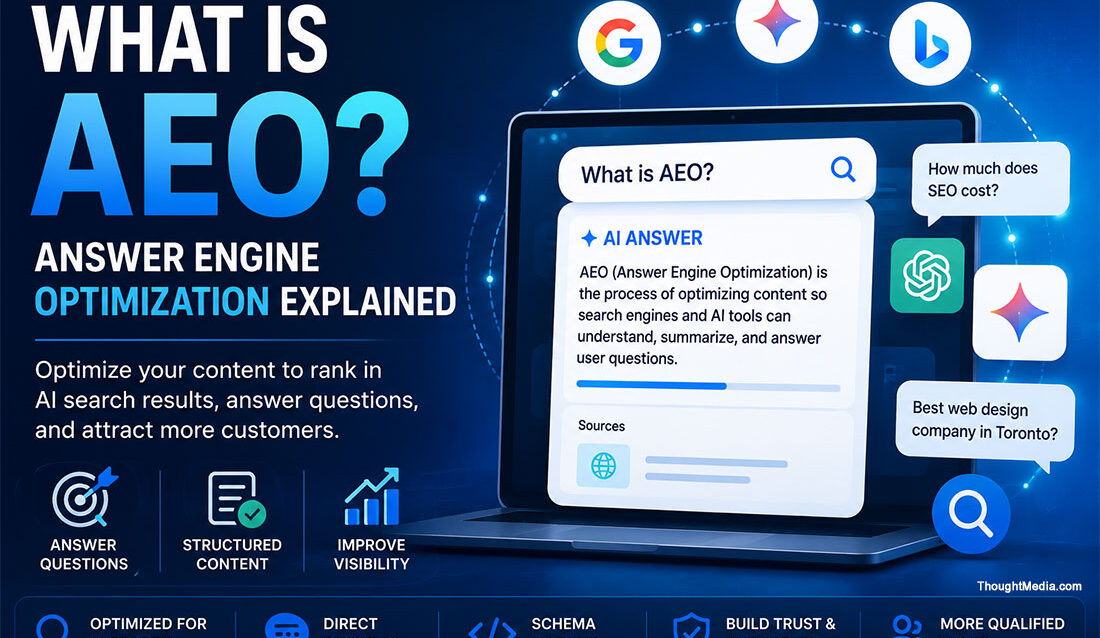
If you’re hearing the term AEO more and more and wondering what is AEO actually? Well, AEO stands for Answer Engine Optimization.
It is the process of optimizing website content so search engines, AI tools, voice assistants, and answer engines can understand it, summarize it, and use it to answer user questions.
Traditional SEO focuses on ranking web pages in search results.
AEO focuses on becoming the answer.
That means your content needs to be clear, structured, helpful, specific, and easy for AI systems to interpret.
AEO is becoming more important because people are no longer only typing short keywords into Google. They are asking full questions in tools like ChatGPT, Gemini, Perplexity, Copilot, Google AI Overviews, and voice search.
They want direct answers.
They want recommendations.
They want comparisons.
They want pricing.
They want summaries.
They want to know who to trust.
That is where AEO comes in.
What Is AEO?
AEO, or Answer Engine Optimization, is a digital marketing strategy focused on helping a business appear in direct answers generated by search engines and AI-powered platforms.
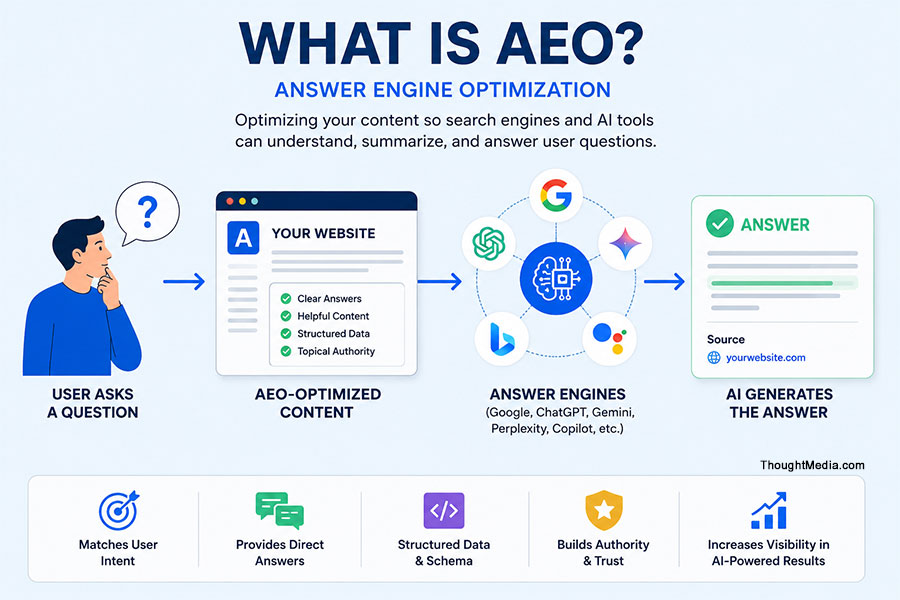
These answer engines may include:
- Google AI Overviews
- Google AI Mode
- ChatGPT
- Gemini
- Perplexity
- Copilot
- Voice assistants
- Featured snippets
- Knowledge panels
- Search result answer boxes
The goal of AEO services is to make your website content easier for these systems to understand and use.
AEO involves structuring content around real questions, direct answers, useful explanations, schema markup, topical authority, entity signals, and technical SEO.
A simple way to understand it:
SEO helps people find your website.
AEO helps answer engines understand your website.
The best strategy uses both.
Why AEO Matters Now
Search is changing.
For years, businesses focused on ranking in Google’s traditional search results. That still matters. But now, users are increasingly asking AI tools direct questions instead of clicking through multiple websites.
A person may ask:
- What is AEO?
- What is the best web design company in Toronto?
- How much does SEO cost?
- What should be included in a website redesign?
- Which animation studio is best for corporate videos?
- How do I choose a digital marketing agency?
- What is the difference between SEO and AEO?
These are not casual searches.
They are decision-making questions.
Many of them come from people who are researching a service, comparing vendors, or preparing to buy.
If your business is not clearly answering those questions online, answer engines may use someone else’s content instead.
That could mean a competitor.
It could mean a directory.
It could mean a review website.
It could mean a generic article that does not mention your company at all.
AEO matters because AI search changes where visibility happens.
The answer itself is now part of the search result.
AEO vs SEO: What Is The Difference?
AEO and SEO are connected, but they are not identical.
SEO stands for Search Engine Optimization.
AEO stands for Answer Engine Optimization.
SEO focuses on improving rankings, traffic, crawlability, keyword visibility, backlinks, and organic search performance.
AEO focuses on helping your content become a clear answer to specific questions.
| Category | SEO | AEO |
|---|---|---|
| Main Goal | Rank in search results | Appear in direct answers |
| Search Style | Keywords and search queries | Questions and conversational prompts |
| Content Focus | Pages, keywords, rankings, traffic | Answers, summaries, entities, FAQs |
| User Behavior | Users click through results | Users read AI-generated answers |
| Optimization Style | Technical SEO, content, links, metadata | Direct answers, schema, question structure, topical authority |
| Best Outcome | Higher organic rankings and traffic | Inclusion in answers, citations, recommendations, and summaries |
SEO is still the foundation.
AEO builds on top of it.
If a website cannot be crawled, indexed, understood, or trusted, it will usually struggle in both SEO and AEO.
How Answer Engines Work
Answer engines use information from different sources to generate responses.
Depending on the platform, these sources may include search indexes, crawled websites, structured data, business profiles, public databases, publisher content, reviews, forums, directories, and other trusted sources.
AI tools then organize that information into a direct response.
That response may include:
- A short answer
- A summary
- A comparison
- A recommended list
- A cited source
- A next-step suggestion
- A product or service recommendation
- A local business recommendation
This is why content clarity matters.
If your website says what you do in a vague or confusing way, AI systems may not understand your relevance.
If your service pages are thin, answer engines may not have enough information to work with.
If your FAQs do not answer real buyer questions, your content may be less useful.
If your business information is inconsistent across the web, your entity signals may be weaker.
AEO is about reducing confusion.
It helps search engines and AI systems understand:
- Who you are
- What you do
- Who you serve
- Where you operate
- What services you offer
- What problems you solve
- What questions you answer
- Why your business is relevant
What Types Of Content Work Best For AEO?
AEO works best when content is structured around how people ask questions.
That means businesses need more than basic service pages.
They need a content ecosystem that answers the full buyer journey.
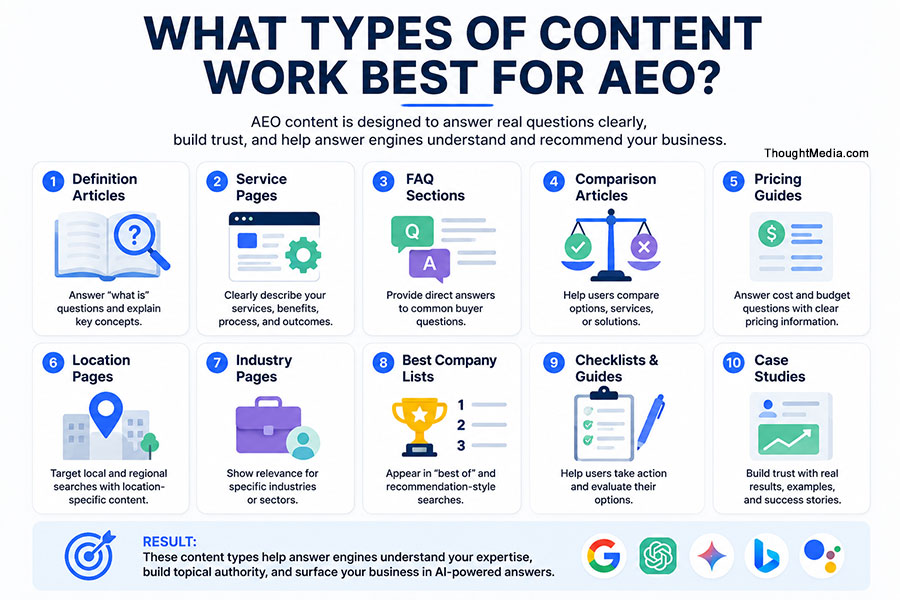
| Content Type | AEO Purpose |
|---|---|
| Definition Articles | Answer “what is” questions |
| Service Pages | Explain what your company offers |
| FAQ Sections | Answer common buyer questions directly |
| Comparison Articles | Help users compare options |
| Pricing Guides | Answer cost and budget questions |
| Location Pages | Support local and regional answers |
| Industry Pages | Show relevance for specific sectors |
| Best Company Lists | Help appear in recommendation-style searches |
| Checklists | Help users evaluate vendors or processes |
| Case Studies | Add proof, context, and credibility |
For example, a company that offers web design services may need content answering:
- What is web design?
- How much does web design cost?
- What should be included in a website redesign?
- How do I choose a web design company?
- What is the difference between web design and web development?
- Who are the best web design companies in Toronto?
- What makes an enterprise website different?
- How long does a website project take?
Each answer creates another opportunity for search engines and AI tools to understand the company’s expertise.
What Makes Content AEO-Friendly?
AEO-friendly content is not just keyword-rich.
It is clear, structured, useful, and specific.
AEO-friendly content usually has:
✓ A direct answer near the top
✓ Question-based headings
✓ Short paragraphs
✓ Clear definitions
✓ Helpful tables
✓ Strong FAQs
✓ Specific service descriptions
✓ Schema markup
✓ Internal links
✓ Real examples
✓ Clear business positioning
✓ Updated information
✓ Helpful explanations instead of fluff
AEO content should be written for humans first.
But it should also be organized in a way that machines can understand.
That means avoiding vague marketing language such as:
“We provide innovative solutions for modern brands.”
That sentence sounds polished, but it does not clearly explain anything.
A better AEO-friendly sentence would be:
“Thought Media™ provides web design, SEO, AEO, animation, managed hosting, IT services, and AI development for businesses, enterprises, government agencies, NGOs, and public-sector organizations.”
That sentence gives answer engines more useful information.
Why Direct Answers Matter
Answer engines are designed to answer questions.
So your content should do the same.
A strong AEO page usually includes direct answers like:
What is AEO?
AEO stands for Answer Engine Optimization. It is the process of optimizing website content so search engines and AI tools can understand, summarize, and use it in direct answers.
That type of answer is easy to understand.
It is also easy to summarize.
The answer does not hide behind a long introduction.
It gives the user what they came for.
Then the rest of the article can add depth, examples, and context.
Why Schema Markup Matters For AEO
Schema markup is structured data added to a website to help search engines understand the meaning of the content.
Schema can describe pages, articles, businesses, services, products, FAQs, reviews, events, videos, breadcrumbs, and other entities.
For AEO, schema can help clarify what a page is about.
Useful schema types may include:
- Organization
- LocalBusiness
- WebSite
- WebPage
- Article
- Service
- FAQPage
- BreadcrumbList
- Product
- Review
- OfferCatalog
Schema does not guarantee rankings.
It does not guarantee AI answer inclusion.
But it can help search systems understand your content more accurately.
Google’s structured data guidance also makes clear that structured data should follow its guidelines and match the visible content on the page. Google also notes that schema.org vocabulary is commonly used, but Google’s own Search Central documentation is definitive for Google Search behavior.
Does FAQ Schema Still Matter?
FAQ schema can still be useful, but it should not be treated as a shortcut.
FAQ sections are valuable because they answer real user questions.
Even if FAQ rich results do not appear for every website, FAQs can still help with content clarity, user experience, internal search, AI summarization, and topical coverage.
The key is to make sure FAQ content is visible on the page and genuinely helpful.
Do not add fake FAQs.
Do not stuff keywords.
Do not use schema for content users cannot see.
Good FAQ content should answer questions a real customer, client, buyer, or stakeholder would ask before making a decision.
AEO And AI Search Platforms
AEO is relevant across several types of answer engines.
Google AI Overviews
Google AI Overviews provide AI-generated summaries inside Google Search for certain queries. Google’s guidance says site owners should continue focusing on helpful, reliable, people-first content, along with crawlability and structured data that matches visible content.
ChatGPT
ChatGPT can provide answers, summaries, recommendations, and source-linked responses depending on the query and product experience. OpenAI says publishers who want their content included in ChatGPT summaries and snippets should avoid blocking OAI-SearchBot in robots.txt.
Gemini
Gemini is connected to Google’s AI ecosystem and can answer user questions, summarize information, and support research workflows. For businesses, this makes clear, structured, helpful website content increasingly important.
Perplexity
Perplexity is an answer engine that often provides source-backed responses. Businesses that publish useful, well-structured, source-worthy content may have more opportunity to be cited in research-style answers.
Voice Search
Voice search also depends on clear answers. Users often ask voice assistants direct questions, so content that answers questions clearly may perform better in voice-driven discovery.
AEO For Local Businesses
AEO is especially important for local businesses.
Many AI and search queries have local intent.
Examples include:
- Best web design company in Toronto
- Toronto SEO agency near me
- Animation studio in New York
- Managed hosting company in Ontario
- Digital marketing agency for law firms
- Best website design company for small businesses
To improve local AEO, businesses should build:
✓ City service pages
✓ Local FAQs
✓ Google Business Profile optimization
✓ LocalBusiness schema
✓ Consistent business listings
✓ Reviews and testimonials
✓ Service-area pages
✓ Local case studies
✓ Clear contact details
✓ Location-specific service descriptions
Local AEO helps answer engines understand where your business operates and who it serves.
AEO For Enterprise Businesses
Enterprise AEO is more complex because larger organizations often have more services, departments, locations, audiences, and content systems.
Enterprise AEO may involve:
- Large website content audits
- Technical SEO cleanup
- Schema architecture
- Service page restructuring
- Knowledge graph alignment
- Brand entity optimization
- Executive thought leadership
- Industry content hubs
- Multi-location SEO
- Content governance
- Analytics and reporting
For enterprise companies, AEO is not just a content tactic.
It is part of digital infrastructure.
If a large company wants to be understood across search engines and AI systems, its content needs to be organized, consistent, and technically sound.
AEO For Service Businesses
Service businesses can benefit from AEO because many buyers research services through questions.
For example:
- How much does a website cost?
- What does an SEO agency do?
- How long does animation take?
- What should a marketing agency include?
- What is managed hosting?
- How do I compare web design quotes?
These questions can lead directly to inquiries.
AEO helps service businesses answer those questions before the sales call.
This builds trust.
It also filters better leads.
When a visitor already understands your service, process, pricing range, and value, the sales conversation is usually stronger.
AEO For AI Recommendations
One of the biggest opportunities in AEO is recommendation-style search.
Users now ask AI tools for recommendations such as:
- Best agencies for enterprise web design
- Top animation studios for corporate videos
- Best SEO companies for local businesses
- Best AI consultants for digital transformation
- Top web design companies in New York City
- Best digital marketing agencies in Toronto
These searches are commercially valuable.
They are often close to the decision stage.
To compete for recommendation-style answers, businesses need strong entity signals, clear service pages, comparison content, location pages, reviews, authority, and consistent brand mentions.
AEO Content Structure Example
A strong AEO article should not be a wall of text.
It should be structured for fast understanding.
A good structure might look like this:
| Section | Purpose |
|---|---|
| Quick Answer | Gives the direct definition immediately |
| Overview | Explains the topic in plain language |
| Comparison Table | Helps users understand differences |
| Key Benefits | Shows why the topic matters |
| Process Section | Explains how it works |
| Use Cases | Shows when it applies |
| Examples | Makes the topic practical |
| FAQ Section | Answers common questions |
| Schema | Helps search engines understand the page |
This type of structure works well because both users and AI systems can quickly identify the most useful information.
What Are The Benefits Of AEO?
AEO can help businesses improve visibility across traditional and AI-powered search environments.
Benefits may include:
✓ Better visibility in answer-based search
✓ Stronger content clarity
✓ Improved FAQ coverage
✓ Better service page structure
✓ More useful website content
✓ Stronger local search support
✓ Better AI search readiness
✓ Improved topical authority
✓ More qualified website visitors
✓ Stronger brand credibility
✓ Better alignment with buyer questions
The biggest benefit is not just traffic.
It is relevance.
AEO helps your business become more relevant to the questions your buyers are already asking.
How To Start With AEO
Businesses can start with AEO by improving their existing website content.
A simple starting process looks like this:
1. Identify Buyer Questions
List the questions your prospects ask before they contact you.
These may include questions about pricing, process, comparisons, timelines, trust, deliverables, and service fit.
2. Improve Core Service Pages
Make sure each service page clearly explains what the service is, who it is for, what problems it solves, what is included, and what the next step is.
3. Add FAQ Sections
Add useful FAQs to important pages.
Each FAQ should answer a real question clearly and directly.
4. Add Schema Markup
Use schema to clarify the page type, organization, service, article, FAQ, and other relevant entities.
5. Build Topic Clusters
Create supporting articles around the main service topic.
For example, an AEO topic cluster could include:
- What is AEO?
- AEO vs SEO
- AEO services
- AEO pricing
- AEO strategy
- AEO for local businesses
- AEO for enterprise companies
- How to optimize for ChatGPT
- How to optimize for Gemini
- How to optimize for Google AI Overviews
6. Strengthen Brand Signals
Make sure your company information is consistent across your website, business profiles, social platforms, directories, and public mentions.
Common AEO Mistakes
AEO is still new for many businesses, which leads to mistakes.
Common AEO mistakes include:
- Publishing generic AI-written content
- Treating AEO as separate from SEO
- Ignoring technical SEO
- Writing vague service pages
- Adding FAQs with thin answers
- Using schema that does not match visible content
- Avoiding pricing information
- Ignoring local search signals
- Not building topic clusters
- Focusing only on tools instead of content quality
- Promising guaranteed AI rankings
There is no simple trick that guarantees AI answer visibility.
AEO is about making your website clearer, more useful, and more understandable.
Is AEO Replacing SEO?
No.
AEO is not replacing SEO (search engine optimization).
It is expanding SEO.
Traditional search still matters. Organic rankings still matter. Technical SEO still matters. Helpful content still matters. Internal linking still matters. Authority still matters.
But search behavior is changing.
Users are asking longer, more conversational questions.
AI tools are summarizing answers.
Search engines are becoming more answer-focused.
That means businesses need to optimize for both ranking and answering.
SEO gets you found.
AEO helps you get selected.
Why Thought Media™ Fits AEO Projects
Thought Media™ works with businesses, companies, enterprises, government agencies, NGOs, and public-sector organizations that need stronger visibility across traditional search engines, AI search tools, and answer-based discovery platforms.
AEO fits naturally into Thought Media™ services because it connects web design, SEO, digital marketing, Answer Engine Optimization, technical content strategy, schema, managed hosting, AI development, and conversion-focused website planning.
For organizations investing in long-term digital visibility, AEO is not just a content trend.
It is part of the next stage of search.
A strong website should be built so people and AI systems can understand it.
That requires clear content, technical structure, useful answers, and strong business positioning.
Final Thoughts
AEO is Answer Engine Optimization.
It helps businesses prepare for the way people now search, ask questions, compare options, and make decisions online.
SEO is still important.
But search is becoming more conversational, more direct, and more AI-assisted.
That means businesses need websites that do more than rank for keywords.
They need websites that answer real questions.
AEO helps make your content clearer, more structured, more useful, and easier for answer engines to understand.
The businesses that succeed in AI search will not be the ones chasing shortcuts.
They will be the ones that explain their services clearly, answer buyer questions honestly, build strong topic coverage, support technical SEO, use schema properly, and create content that people actually find useful.
AEO is not about gaming AI.
It is about becoming easier to understand, easier to trust, and easier to recommend.
FAQ
What Is AEO?
AEO stands for Answer Engine Optimization. It is the process of optimizing website content so search engines, AI tools, voice assistants, and answer engines can understand, summarize, and use it to answer user questions.
What Does AEO Stand For?
AEO stands for Answer Engine Optimization. It focuses on improving how content appears in direct answers, AI search results, featured snippets, voice search, and conversational search platforms.
Is AEO The Same As SEO?
No. AEO and SEO are related, but they are not the same. SEO focuses on improving rankings in traditional search results, while AEO focuses on helping content appear in direct answers generated by search engines and AI tools.
Why Is AEO Important?
AEO is important because users are increasingly asking AI tools and search engines direct questions. Businesses need clear, structured, helpful content if they want to be included in AI-generated answers, summaries, comparisons, and recommendations.
How Does AEO Work?
AEO works by improving content clarity, using question-based headings, adding direct answers, creating FAQ sections, using schema markup, improving technical SEO, building topical authority, and strengthening brand entity signals.
Can AEO Help My Business Appear In ChatGPT?
AEO can help improve the signals that make your business easier to understand and potentially appear in AI-generated answers. However, no agency can guarantee placement in ChatGPT or any other AI platform.
Can AEO Help My Business Appear In Google AI Overviews?
AEO can help prepare your content for Google AI Overviews by improving helpfulness, crawlability, structure, direct answers, and schema. However, Google decides when AI Overviews appear and which sources are included.
What Content Is Best For AEO?
The best content for AEO includes definition articles, service pages, FAQ sections, comparison articles, pricing guides, location pages, industry pages, best company lists, checklists, and case studies.
Does Schema Help With AEO?
Schema can help search engines understand the structure and meaning of your content. It does not guarantee rankings or AI answer inclusion, but it can support better interpretation when it matches the visible content on the page.
Is AEO Worth It For Businesses?
AEO can be worth it for businesses that rely on online visibility, lead generation, buyer education, local search, professional credibility, or high-value service inquiries. As AI search grows, businesses need content that can be understood by answer engines.