

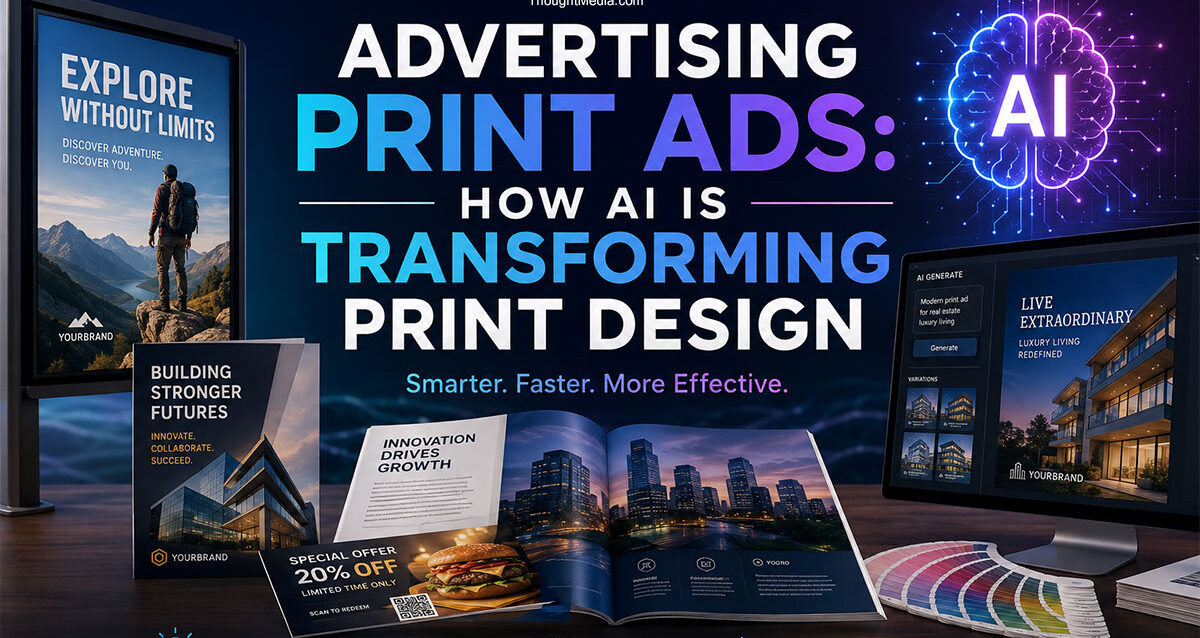
Advertising print ads remain an effective way for brands to reach customers through magazines, newspapers, direct mail, brochures, posters, billboards, flyers, packaging, and other physical media. What is changing is how those print advertisements are created: artificial intelligence is increasingly helping designers research audiences, generate concepts, develop imagery, create variations, personalize campaigns, resize creative, and connect traditional print advertising with digital marketing.
Print advertising is not disappearing.
It is evolving.
Professional graphic design still matters because successful print ads require:
✅ Strong visual hierarchy
✅ Brand consistency
✅ Typography
✅ Layout
✅ Photography
✅ Illustration
✅ Color management
✅ Print production knowledge
✅ Clear messaging
✅ Human creative judgment
But modern advertising teams now have an additional layer of technology available to them:
Artificial intelligence.
AI can help a creative team move from:
one concept
to:
dozens of visual directions
much faster.
It can help transform:
one campaign idea
into:
- Magazine advertisements
- direct-mail pieces
- posters
- social ads
- digital banners
- presentation graphics
- landing-page imagery
- localized creative
- personalized campaign variations
That does not mean professional graphic designers are becoming irrelevant.
The opposite may be true.
As AI produces more raw creative material, businesses increasingly need experienced designers and creative directors who can determine:
What is actually good?
What represents the brand?
What is appropriate for the audience?
What should be printed?
What should be rejected?
The future of print advertising is therefore not:
Human design vs AI design.
It is increasingly:
Human creative strategy + professional graphic design + artificial intelligence + data + modern advertising technology.
This guide explains how advertising print ads work, why print still matters, how AI graphic design is changing the creative process, where AI advertising fits into traditional campaigns, what businesses should automate, what should remain human-led, and how print and digital advertising can work together.
What Are Advertising Print Ads?
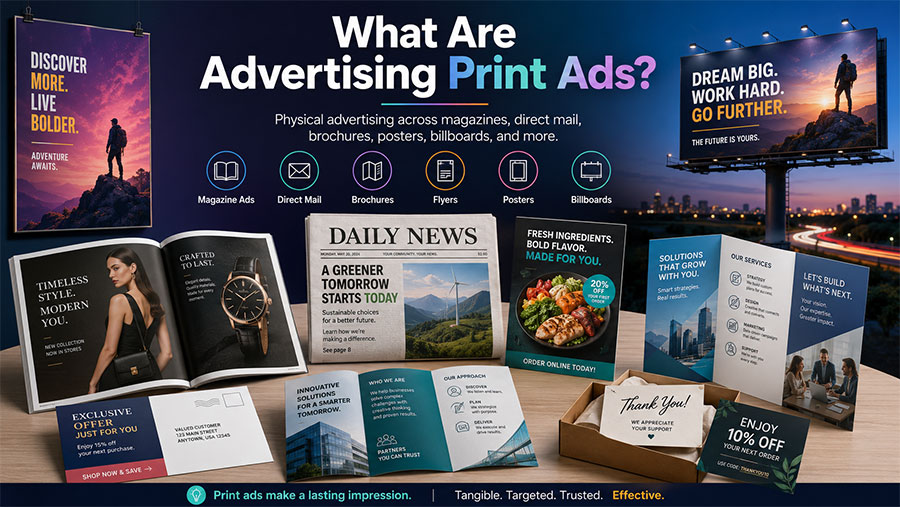
Advertising print ads are promotional messages designed specifically for physical printed media such as magazines, newspapers, direct mail, brochures, flyers, posters, catalogs, packaging, outdoor signage, and billboards.
Unlike digital advertising, print ads exist in a physical format.
A customer may encounter them:
- In a mailbox
- inside a magazine
- on a transit poster
- at a trade show
- in a store
- inside product packaging
- on a billboard
- inside a newspaper
- within a printed sales brochure
Print advertising, also known as print advert can be used for:
✅ Brand awareness
✅ Product launches
✅ Sales promotions
✅ Event marketing
✅ Retail campaigns
✅ Political or public information campaigns
✅ Direct response
✅ Local advertising
✅ B2B marketing
✅ Corporate communication
The medium may be traditional.
The strategy no longer has to be.
Modern print advertising can be informed by digital data, AI analytics, customer segmentation, QR codes, online retargeting, and AI-assisted creative development.
Is Print Advertising Still Effective?
Yes, when the format matches the audience and business objective.
Print has characteristics that digital advertising does not.
It Is Physical
Customers can:
- Hold it
- save it
- display it
- share it
It Can Create Local Visibility
Print remains useful for:
- Local businesses
- real estate
- retail
- events
- restaurants
- home services
- community campaigns
It Can Feel Premium
High-quality:
- Paper
- finishes
- embossing
- foil
- specialty printing
can create a physical brand experience that a banner ad cannot reproduce.
It Can Reach People Offline
Not every marketing interaction happens through a screen.
It Can Support Larger Campaigns
Print can drive people toward:
- Websites
- apps
- landing pages
- online stores
- social profiles
Thought Media’s print design services include physical marketing materials such as brochures, flyers, posters, catalogs, magazines, business materials, and large-format print creative.
What Types Of Print Ads Can Businesses Use?
Print advertising includes many formats.
| Print Advertising Format | Common Use |
|---|---|
| Magazine Ads | Brand awareness and targeted audiences |
| Newspaper Ads | Local and regional campaigns |
| Direct Mail | Offers, lead generation, customer acquisition |
| Flyers | Local promotions and events |
| Brochures | Products, services, sales support |
| Posters | Events, retail, public communication |
| Billboards | High-volume awareness |
| Catalogs | Products and ecommerce support |
| Packaging Inserts | Upsells, loyalty, cross-selling |
| Trade Show Graphics | B2B and event marketing |
| Point-of-Sale Displays | Retail conversion |
| Door Hangers | Local service marketing |
Each format has different design requirements.
A billboard should not be designed like a brochure.
A direct-mail postcard should not be designed like a magazine spread.
Good print design considers how the audience will experience the material.
What Makes A Good Print Advertisement?
A strong print ad typically communicates one primary idea quickly.
Important elements include:
Headline
The headline should attract attention.
Visual
Photography, illustration, typography, or product imagery should reinforce the message.
Value Proposition
The customer should understand why the offer matters.
Call To Action
What should happen next?
Examples:
Visit the website
Scan the QR code
Call today
Visit the store
Request a quote
Brand
The advertisement should clearly belong to the company.
Hierarchy
The eye should know where to look first.
Professional graphic design services can combine typography, branding, illustration, layout, imagery, packaging, print, and digital creative into a consistent visual system.
How Is AI Changing Advertising Print Ads?
Artificial intelligence is changing the workflow behind print advertising.
The traditional process might have looked like:
Brief → Concept → Designer → Revisions → Final Artwork → Print
A modern AI-assisted process may look more like:
Brief → Audience Data → AI Research → Concept Exploration → AI-Assisted Imagery → Designer Refinement → Variations → Human Approval → Print + Digital Adaptations
The difference is not that AI completely replaces the designer.
The difference is that AI can accelerate several stages.
Where Can AI Be Used In Print Advertising?
AI can support:
✅ Audience research
✅ Competitor analysis
✅ Concept ideation
✅ Headline exploration
✅ Image generation
✅ Background generation
✅ Image editing
✅ Mockups
✅ Layout ideas
✅ Campaign variations
✅ Localization
✅ Personalization
✅ Copy adaptation
✅ Resize workflows
✅ Creative testing
✅ Campaign analytics
The greatest benefit may be the ability to explore more creative options before committing to production.
What Is AI Graphic Design?
AI graphic design uses artificial intelligence to assist with creating, editing, generating, adapting, or organizing visual design assets.
AI graphic-design tools can help generate:
- Images
- textures
- backgrounds
- illustrations
- layout ideas
- typography treatments
- visual concepts
- campaign variations
Platforms such as Adobe Firefly now allow designers to generate and iterate visual concepts using prompts and adapt creative assets for applications that can include marketing and print.
This changes the economics of concept development.
Instead of producing only three visual directions, a creative team may explore:
20
50
or:
100 possibilities
before narrowing them down.
The final selection still benefits from human judgment.
Is AI Taking Over Graphic Design?
AI is rapidly becoming integrated into graphic-design workflows.
That is different from saying AI will eliminate graphic designers.
Consider photography.
Digital cameras did not eliminate professional photographers.
Photoshop did not eliminate designers.
Desktop publishing did not eliminate print design.
Those technologies changed:
How professionals work.
AI is doing something similar.
The designer’s role increasingly shifts toward:
✅ Creative direction
✅ Prompting
✅ Selection
✅ Refinement
✅ Brand consistency
✅ Typography
✅ Layout
✅ Composition
✅ Production
✅ Quality control
AI can produce visual possibilities.
A professional designer determines which possibility becomes a credible advertisement.
AI Graphic Design vs Traditional Graphic Design
| Area | Traditional Graphic Design | AI-Assisted Graphic Design |
|---|---|---|
| Concept Generation | Human-led | Human + AI |
| Image Creation | Photography / illustration | Photography / illustration / AI |
| Variations | Manual | Faster generation |
| Brand Judgment | Human | Human |
| Typography | Human | Human-led |
| Print Production | Human | Human |
| Creative Strategy | Human | Human-led |
| Personalization | Labor intensive | More scalable |
| Resizing | Manual / templated | Increasingly automated |
| Final Approval | Human | Human |
AI is strongest when used as part of a professional workflow.
How Can AI Generate Ideas For Print Ads?
A creative team can use AI to brainstorm:
- Campaign themes
- visual metaphors
- headlines
- calls to action
- imagery
- backgrounds
- color concepts
- compositions
Imagine an electric vehicle company launching a new product.
Traditional brainstorming might produce:
10 ideas.
AI-assisted brainstorming might generate:
100 conceptual directions.
The creative director can then identify the best five.
The benefit is not necessarily that AI creates the final idea.
The benefit is:
More exploration in less time.
Can AI Generate Images For Print Advertising?
Yes.
AI image-generation tools can create:
- Product environments
- conceptual photography
- surreal imagery
- illustrations
- abstract backgrounds
- textures
- campaign visuals
But there are important limitations.
AI may generate:
❌ Incorrect product details
❌ Strange hands
❌ Inconsistent logos
❌ distorted packaging
❌ inaccurate text
❌ unrealistic objects
That means generated imagery needs professional review.
Should AI Generate The Entire Print Ad?
Usually not without human refinement.
A finished print advertisement requires more than an image.
It may require:
- Brand standards
- exact logo placement
- legal copy
- pricing
- offer terms
- typography
- bleed
- trim
- print resolution
- color preparation
- proofing
AI can support creation.
Professional production still matters.
Can AI Create Multiple Versions Of The Same Print Advertisement?
Yes, and this is one of the most powerful applications.
Imagine a national home-services company.
Instead of one generic postcard, AI-assisted workflows could help create:
Version 1
Dallas
with regional imagery.
Version 2
New York
with different messaging.
Version 3
Miami
with different seasonal creative.
Version 4
Chicago
with another promotion.
The basic campaign remains consistent.
The creative becomes more relevant.
What Is Personalized Print Advertising?
Personalized print uses customer information to customize physical marketing.
A traditional direct-mail campaign might send everyone:
the same postcard.
A personalized campaign may vary:
- Name
- offer
- location
- imagery
- product
- message
AI can help determine which combination may be most relevant for different audience segments.
This creates a bridge between:
digital personalization
and:
physical advertising.
How Can AI Improve Direct Mail Advertising for Print?
AI can support direct-mail campaigns through:
✅ Audience segmentation
✅ Offer selection
✅ Copy variations
✅ Creative variations
✅ Geographic customization
✅ Customer scoring
✅ Campaign analysis
For example:
An automotive dealer could segment customers based on:
- Current vehicle
- lease expiration
- purchase history
- location
Different customers can receive different creative.
The printing itself remains physical.
The strategy behind it becomes data-driven.
What Is Programmatic Print?
Programmatic print applies principles similar to automated digital advertising to physical direct mail.
A trigger could occur when:
A website visitor views a product but does not purchase.
The customer later receives:
A personalized postcard.
This combines:
online behavior + automation + print.
The line between digital and physical advertising becomes less distinct.
How Can QR Codes Connect Print And Digital Advertising?
QR codes are one of the simplest ways to connect physical media with digital marketing.
A printed advertisement can send users directly to:
- Landing page
- ecommerce product
- booking system
- video
- application
- digital coupon
- social profile
This allows businesses to measure more of the print customer journey.
For example:
Magazine Ad → QR Code → Landing Page → Conversion
The print piece generates attention.
The digital environment continues the experience.
Can Print Ads Be Retargeted Digitally?
Print itself cannot place a digital retargeting pixel.
But print campaigns can direct people to digital environments where retargeting begins.
For example:
Postcard
↓
QR code
↓
Landing page
↓
Visitor enters digital advertising audience
↓
Display advertising
↓
Social advertising
This creates a coordinated campaign.
Thought Media’s display advertising services can support digital campaigns using visual advertising, audience targeting, retargeting, and analytics.
Print Advertising vs Digital Advertising
These channels should not necessarily be treated as competitors.
| Factor | Print Advertising | Digital Advertising |
|---|---|---|
| Physical Presence | ✅ | ✕ |
| Instant Click | ✕ | ✅ |
| Precise Targeting | Limited | ✅ |
| Tangible Experience | ✅ | ✕ |
| Rapid Testing | Limited | ✅ |
| Local Reach | ✅ | ✅ |
| Detailed Analytics | Limited | ✅ |
| Premium Physical Feel | ✅ | Limited |
| Dynamic Personalization | Limited | ✅ |
| Long Physical Life | ✅ | Limited |
The strongest campaigns can use both.
Print Advertising + Digital Advertising
Consider a product launch.
- Magazine
- direct mail
- billboard
- brochure
Digital
- Google Ads
- social ads
- display advertising
- video
- landing page
AI
- Audience analysis
- creative variations
- image generation
- personalization
- optimization
The campaign becomes:
Print + Digital + AI
rather than one isolated channel.
Thought Media’s digital marketing services combine advertising, data, automation, search, social media, content, and AI-supported strategies across multiple customer touchpoints.
How Can AI Connect Print And Social Media Advertising?
A single campaign concept can now generate many outputs.
For example:
Full-page magazine ad
Square image
Instagram Stories
Vertical creative
Feed advertisement
B2B variation
TikTok
Short-form video adaptation
AI can help generate:
- Alternate crops
- backgrounds
- copy
- campaign versions
Human designers can then refine the creative.
Can AI Turn A Print Ads Campaign Into Video?
Yes.
A static concept can potentially evolve into:
- Motion graphics
- social video
- animated ads
- product animation
This is another reason brands should think in terms of:
campaign systems
rather than individual pieces.
One strong creative platform can generate:
print + digital + animation + social + web.
What Is AI Advertising?
AI advertising uses artificial intelligence to assist with audience targeting, creative development, personalization, optimization, analytics, automation, and campaign decision-making.
AI may influence:
Audience
Who should see the campaign?
Message
What should they see?
Creative
Which visual should be used?
Timing
When should the ad appear?
Optimization
Which version performs better?
Historically, many of those capabilities were associated mainly with online advertising.
Increasingly, they can influence physical advertising as well.
Can AI Decide Which Print Ad To Send?
Potentially.
Imagine three print creatives:
A
B
C
Customer data may suggest:
Segment 1
Responds best to price-focused messaging.
Segment 2
Responds to premium branding.
Segment 3
Responds to convenience.
Instead of sending everyone Creative A:
AI-supported segmentation can help determine:
Who receives A, B, or C.
That makes print more sophisticated.
How Is AI Changing Advertising Agencies?
Advertising agencies increasingly need capabilities across:
- Strategy
- creative
- data
- AI
- automation
- digital advertising
- design
- analytics
A modern agency may use AI to accelerate:
✅ Creative research
✅ Concepting
✅ Copy
✅ visual generation
✅ variations
✅ audience insights
✅ reporting
Thought Media’s advertising industry solutions combine AI, automation, marketing, web design, animation, analytics, and digital technology for modern advertising organizations.
What Should AI Automate In Print Ad Design?
AI is particularly useful for repetitive production work.
Examples include:
Resizing
Adapt a design across different formats.
Background Removal
Automatically isolate products.
Image Expansion
Extend imagery for new proportions.
Versioning
Create multiple localized variants.
Copy Adaptation
Modify language for different audiences.
Concept Exploration
Generate multiple visual options.
Mockups
Show a design on:
- Billboard
- brochure
- package
- poster
Automation creates time for designers to focus on higher-value creative decisions.
What Should Remain Human-Led?
Some elements should remain strongly human-driven.
Brand Strategy
What does the company stand for?
Creative Direction
What should the campaign feel like?
Cultural Judgment
Could the advertisement be misunderstood?
Final Typography
Is the hierarchy correct?
Legal Review
Are claims accurate?
Print Production
Will the file actually print correctly?
Final Approval
Should the business put its name on this?
AI can accelerate creation.
Responsibility still belongs to people.
Why Human Print Advert Graphic Designers Still Matter
AI can create:
more.
Designers determine:
better.
A skilled designer understands:
- Spacing
- hierarchy
- balance
- typography
- brand identity
- production
- communication
An AI-generated image may look impressive but fail as an advertisement.
For example:
The product may be beautiful.
But the headline is unreadable.
The CTA is buried.
The logo is too small.
The customer does not understand the offer.
That is a design failure.
What Are The Risks Of AI In Print Advertising?
Businesses should consider several risks.
Brand Inconsistency
AI may generate visuals that do not match established branding.
Incorrect Products
AI can alter:
- Packaging
- dimensions
- components
Text Errors
Generated text may be inaccurate.
Intellectual Property
Businesses should review rights and tool terms.
Misrepresentation
AI-generated imagery may show something that does not exist.
Bias
AI may generate stereotypical or inappropriate imagery.
Compliance
Regulated advertising may require stricter review.
Human oversight reduces these risks.
Can AI Be Used For Billboard Design?
Yes.
AI can assist with:
- Concepts
- backgrounds
- imagery
- mockups
- variations
But billboard design has unique requirements.
People may see the advertisement for only a few seconds.
A strong billboard usually needs:
✅ Simple headline
✅ Large typography
✅ Strong image
✅ Clear branding
✅ Minimal clutter
AI should not encourage designers to add more information simply because more content can be generated.
Can AI Be Used For Magazine Advertising?
Yes.
Magazine advertising can benefit from AI-assisted:
- photography concepts
- image creation
- layouts
- visual variations
Magazine ads for print often have more time to communicate than billboards.
That allows:
- More copy
- detailed imagery
- product information
The design still needs to match the publication and target audience.
Can AI Be Used For Brochure Design?
Yes.
Brochures may contain:
- Product photography
- diagrams
- charts
- illustrations
- text
- calls to action
AI can assist with several components.
But multi-page documents still require strong information architecture.
The designer must determine:
What appears on page 1?
What appears on page 2?
How does the reader move through the piece?
Can AI Help With Packaging Advertising?
AI can accelerate:
- Concept exploration
- shelf mockups
- visual variations
- background creation
But packaging requires particularly careful production.
Packaging often includes:
- Legal information
- barcodes
- nutrition
- instructions
- trademarks
- precise dimensions
AI should not be trusted to generate critical packaging information without verification.
Can AI Improve Trade Show Graphics?
Yes.
Trade shows often require:
- Booth graphics
- signage
- brochures
- presentations
- screens
- advertisements
AI can help develop consistent campaign assets.
One visual direction might appear across:
Print banner
Booth wall
Brochure
Presentation
Digital screen
Social campaign
This strengthens brand consistency.
How Fast Can AI Create Print Ad Concepts?
Concept exploration can happen dramatically faster than traditional workflows.
A designer might use AI to rapidly test:
- Different environments
- styles
- audiences
- compositions
But speed should not be confused with completion.
The process still requires:
Select → Refine → Design → Review → Proof → Produce
AI can shorten the beginning.
It does not eliminate the end.
Does AI Make Print Advertising Cheaper?
Potentially.
AI can reduce production time for:
- Concepting
- variations
- image manipulation
- resizing
- repetitive tasks
However, the total advertising budget may still include:
- Strategy
- graphic design
- photography
- printing
- distribution
- media placement
- production
The goal should not simply be:
“Make ads cheaper.”
It should be:
“Produce better campaigns more efficiently.”
How Much Does Professional Print Advertising Cost?
Costs vary widely.
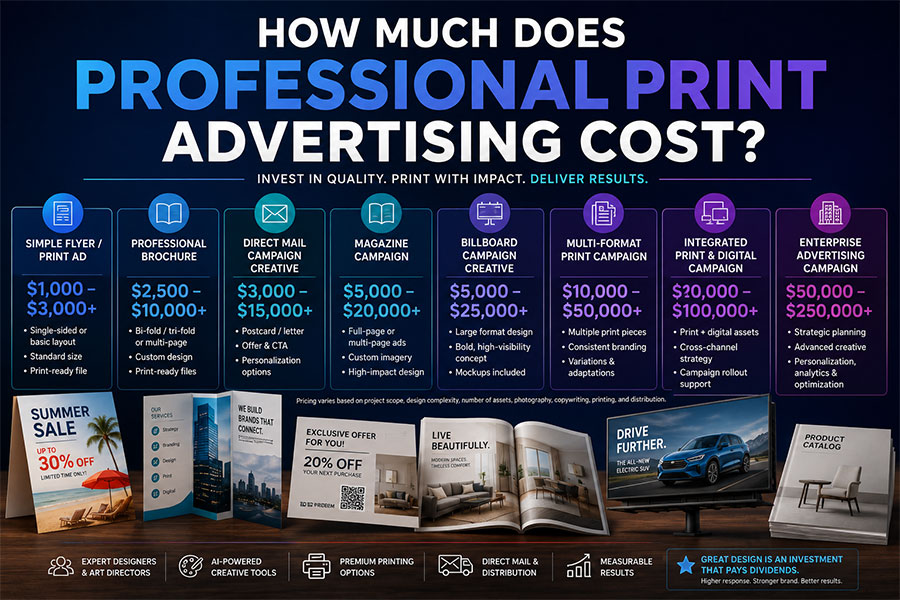
A planning framework may look like:
| Project | Approximate Creative Budget (USD) |
|---|---|
| Simple Flyer / Print Ad | $1,000–$3,000+ |
| Professional Brochure | $2,500–$10,000+ |
| Direct-Mail Campaign Creative | $3,000–$15,000+ |
| Magazine Campaign | $5,000–$20,000+ |
| Billboard Campaign Creative | $5,000–$25,000+ |
| Multi-Format Print Campaign | $10,000–$50,000+ |
| Integrated Print + Digital Campaign | $25,000–$100,000+ |
| Enterprise Advertising Campaign | $50,000–$250,000+ |
These are planning ranges rather than fixed prices.
Media placement and printing may be separate.
What Determines Print Advertising Cost?
Major factors include:
Number Of Assets
One poster vs 30 campaign pieces.
Concept Development
How many creative directions?
Photography
Is custom photography required?
AI Generation
Can some imagery be generated?
Illustration
Does the campaign require custom artwork?
Copywriting
How much message development is needed?
Personalization
How many variations?
Printing
Paper, finishes, size, and quantity affect cost.
Distribution
Direct mail requires postage and logistics.
How Can Businesses Measure Print Advertising?
Print measurement is harder than digital advertising.
But businesses can use:
✅ QR codes
✅ Unique landing pages
✅ Unique phone numbers
✅ Coupon codes
✅ Promotional codes
✅ Vanity URLs
✅ Customer surveys
Example:
Postcard A
uses:
/offer-a
Postcard B
uses:
/offer-b
The business can compare response.
How Can AI Help Measure Print Advert Campaigns?
AI can analyze:
- Responses
- customer segments
- geography
- conversions
- product purchases
The campaign can then inform future creative.
This creates a feedback loop:
Print → Response → Data → AI Analysis → Better Print
Traditional advertising becomes more measurable.
What Does An AI-Assisted Print Advertising Workflow Look Like?
A professional process might include ten stages.
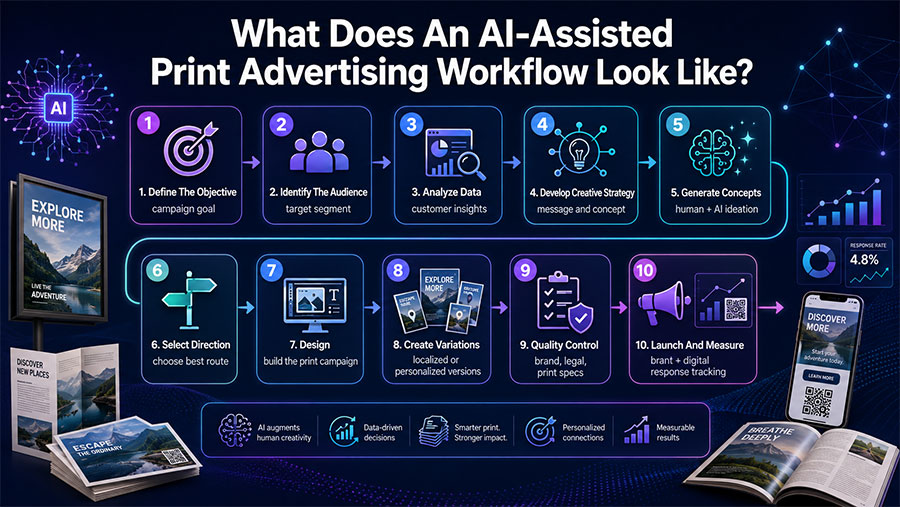
1. Define The Objective
What should the campaign accomplish?
2. Identify The Audience
Who should see it?
3. Analyze Data
What do we know about the audience?
4. Develop Creative Strategy
What should the campaign communicate?
5. Generate Concepts
Human and AI-assisted ideation.
6. Select Direction
Creative team chooses the strongest route.
7. Design
Professional graphic designers build the campaign.
8. Create Variations
AI can help adapt assets.
9. Quality Control
Review:
- Brand
- copy
- legal
- print specifications
10. Launch And Measure
Print and digital assets enter the market.
What Questions Should You Ask A Print Advertising Agency?
Ask:
Strategy
- Who is the audience?
- What is the campaign goal?
Creative
- Who develops concepts?
- Is AI used?
- How is AI reviewed?
Design
- Who handles typography and production?
- Are print-ready files included?
- Who handles printers?
Digital
- Can the campaign extend online?
Measurement
- How will response be tracked?
Rights
- Who owns the creative?
- Are AI-generated assets included?
Transparency matters.
What Are Common Print Advertising Mistakes?
Avoid:
❌ Too much copy
❌ Weak headline
❌ Tiny typography
❌ No call to action
❌ Poor imagery
❌ Inconsistent branding
❌ Ignoring print specifications
❌ AI-generated visual errors
❌ No measurement strategy
❌ Treating print as completely separate from digital
The medium may be physical.
The strategy should be integrated.
Should Small Businesses Still Use Print Ads?
Yes, when local or physical visibility matters.
Examples include:
- HVAC
- roofing
- restaurants
- dentists
- law firms
- real estate
- retail
- home renovation
- landscaping
A local business could combine:
Direct mail
Google Ads
Local SEO
Social advertising
Customers may encounter the company several times.
That repetition strengthens awareness.
Should Enterprise Companies Use Print Advertising?
Yes.
Enterprise print applications include:
✅ Conferences
✅ Product launches
✅ investor materials
✅ direct mail
✅ trade shows
✅ corporate publications
✅ high-value account marketing
For enterprise campaigns, AI can help support large-scale personalization and asset production.
How Will AI Change Print Advertising In The Future?
Print is likely to become:
More personalized.
More automated.
More connected to digital.
More data-driven.
AI may help determine:
- Who receives the ad
- which design they receive
- what offer appears
- when it is sent
- which digital campaign follows
The physical advertisement remains physical.
Everything around it becomes intelligent.
Will AI Replace Traditional Print Designers?
AI will change the profession.
It will automate parts of it.
But professional print design involves many tasks AI cannot responsibly own by itself.
Those include:
- Brand strategy
- communication
- hierarchy
- typography
- print production
- final judgment
The strongest designers will likely be those who know how to combine:
traditional design expertise
with:
AI tools.
Why Work With Thought Media™ For Print Advertising?
Thought Media™ combines professional graphic design, print design, digital marketing, advertising, animation, web development, and artificial intelligence.
That integrated capability allows print advertising to become part of a broader marketing system.
A campaign can include:
✅ Print advertisements
✅ Brochures
✅ Direct mail
✅ Billboards
✅ Digital display ads
✅ Social advertising
✅ Landing pages
✅ Animation
✅ AI-assisted creative
✅ Analytics
Thought Media™ has worked with businesses and organizations since 2009, providing design, advertising, technology, and digital services across multiple industries.
The goal is not to abandon traditional graphic design.
The goal is to enhance it.
Professional design provides the judgment.
AI accelerates the possibilities.
Digital marketing extends the campaign.
Data helps measure the result.
Final Thoughts: Advertising Print Ads And AI
Advertising print ads remain relevant, but the way they are created is changing rapidly.
Traditional graphic design remains essential for:
Branding.
Typography.
Layout.
Communication.
Production quality.
Artificial intelligence adds new capabilities:
Faster concepts.
More variations.
AI-generated visuals.
Personalization.
Audience insights.
Campaign automation.
Cross-channel adaptation.
The future is not likely to be:
Print vs digital.
Or:
Designer vs AI.
It is increasingly:
Print + digital + AI + professional creative direction.
Businesses that understand that combination can create physical advertising that feels more relevant, integrates with online customer journeys, and produces more value from every campaign concept.
Print may be one of the oldest forms of advertising.
Artificial intelligence is one of the newest technologies influencing it.
Together, they can create a very modern advertising system.
Frequently Asked Questions
What are advertising print ads?
Advertising print ads are promotional messages created for physical media such as magazines, newspapers, flyers, brochures, posters, direct mail, billboards, catalogs, packaging, and trade-show materials. They can support brand awareness, product promotion, lead generation, local marketing, and integrated advertising campaigns.
How is AI changing print advertising?
AI is helping advertising teams generate creative concepts, analyze audiences, create imagery, produce campaign variations, personalize direct mail, resize assets, adapt copy, and connect physical campaigns with digital marketing. Human designers remain important for creative direction, branding, typography, production, and final quality control.
Can AI create print advertisements?
AI can assist with imagery, concepts, backgrounds, variations, copy, and layout ideas, but professional print advertising still requires human review. Designers need to verify brand accuracy, typography, product details, legal copy, resolution, print specifications, and overall communication before an advertisement goes to production.
Is print advertising still effective for businesses?
Yes. Print advertising can still be effective for local marketing, direct mail, events, retail, product launches, brand campaigns, trade shows, and high-value B2B communication. Print can become even more useful when combined with QR codes, landing pages, retargeting, digital advertising, and measurable calls to action.
Will AI replace graphic designers in advertising?
AI is more likely to change graphic-design workflows than eliminate professional designers. AI can generate concepts and automate repetitive production tasks, while designers remain responsible for creative strategy, brand judgment, typography, composition, communication, print production, and final approval.