
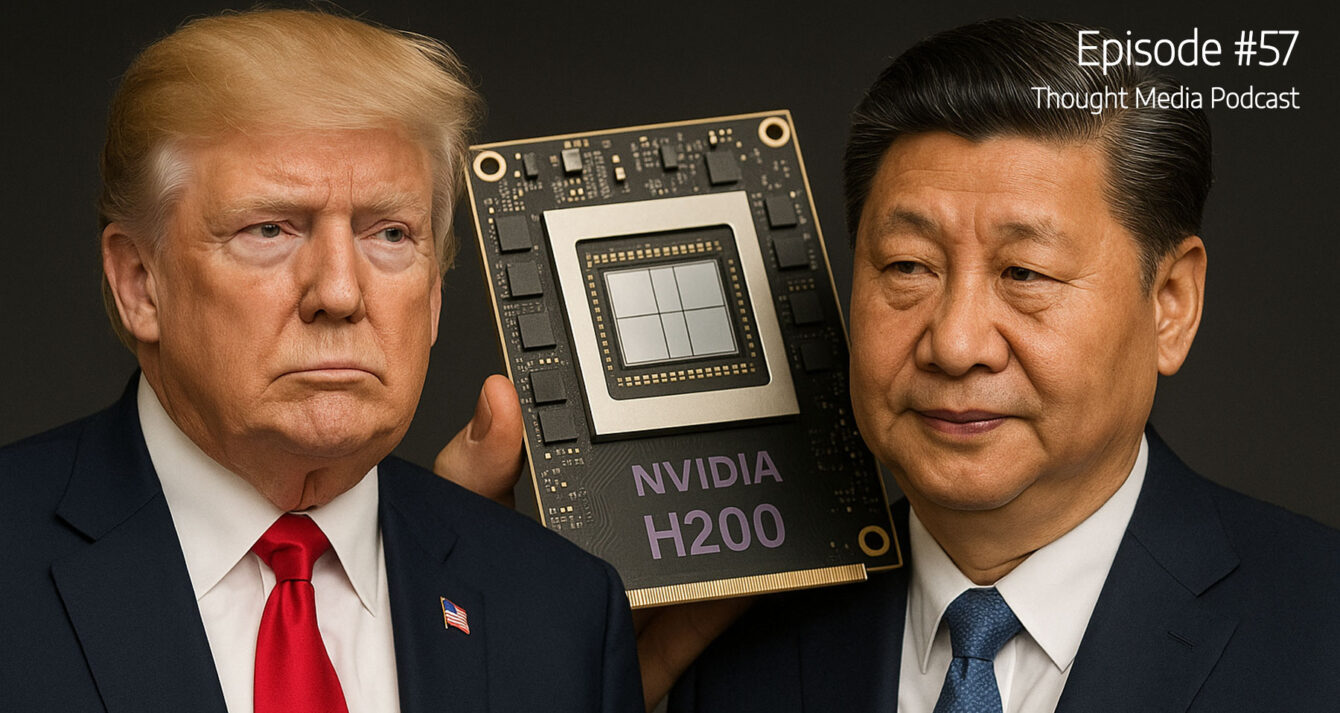


Episode 57 of the Thought Media Podcast examines a major geopolitical development: the United States has eased export restrictions on NVIDIA’s high-performance H200 AI chips, allowing limited, tightly regulated sales to China. This policy shift reverses more than a year of escalating chip sanctions and marks a new chapter in the U.S.–China technology rivalry.
Ava and Max begin by unpacking the background. For years, the U.S. blocked China from acquiring NVIDIA’s top-tier AI chips, arguing that access to such hardware could accelerate China’s military AI programs, surveillance infrastructure, and strategic capabilities. The H200 — NVIDIA’s successor to the H100, and one of the most powerful data-center GPUs in the world — had been completely off-limits.
But now, under a new export framework, NVIDIA can ship a carefully restricted version of the chip to China. These units are intentionally capped in performance, bandwidth, and interconnect speed to stay below U.S. national security thresholds. Companies purchasing them must register end users, allow monitoring, and comply with strict reporting rules. In return, NVIDIA regains access to a market that once accounted for up to 25% of its data-center revenue.
The episode highlights the political angle as well. Reports suggest the Trump administration pushed for a controlled export compromise, aiming to support U.S. semiconductor businesses while maintaining political leverage over China. Supporters argue the move stabilizes global markets. Critics say it hands China more compute power at a pivotal moment in the AI race.
Ava and Max break down the strategic interpretations. On one hand, the restricted H200 gives Chinese tech giants — including Tencent, Baidu, and Alibaba — renewed access to powerful GPUs for commercial AI development. Even downgraded versions are far beyond what most global companies can access. On the other hand, the U.S. retains the ability to cut off supply instantly and to closely track how the chips are used.
The hosts also explore China’s response. Beijing called the move “constructive” but reinforced its broader criticism of U.S. export controls. Meanwhile, Chinese companies continue accelerating domestic chip production, including Huawei’s Ascend series and several new emerging semiconductor players. Many experts believe China will use this temporary window to accelerate its independence from Western hardware.
The episode concludes with an assessment of the global AI landscape. Reopening NVIDIA exports will keep China competitive in training large-scale models and running next-gen AI systems. But it also intensifies the semiconductor race, as both nations push toward greater autonomy, innovation, and technological dominance.
Ava and Max frame the decision as a strategic recalibration — not a concession, but a controlled risk designed to preserve influence while navigating an increasingly complex global AI ecosystem.