

Agentic AI Development Services
Build AI Systems That Can Plan, Reason & Take Action
Agentic AI systems go beyond simple question-and-answer interactions by allowing artificial intelligence to work through multi-step tasks, use connected tools, access data, make decisions within defined boundaries, and coordinate actions toward a specific objective.
Thought Media™ provides Agentic AI development services for businesses, enterprises, and government organizations seeking more advanced automation across applications, data, workflows, and digital systems.
As part of our broader AI Agent Development services, we develop agentic systems around clearly defined objectives, approved tools, system integrations, permissions, monitoring, and human oversight.
Agentic developmentAgentic AI
What Is Agentic AI?
Agentic AI refers to AI systems designed to pursue objectives through multiple steps rather than responding to a single prompt.
Depending on the application, an agentic system may:
- Interpret a goal or request
- Break work into multiple steps
- Retrieve relevant information
- Use APIs, applications, and tools
- Analyze data and documents
- Make workflow decisions
- Coordinate specialized AI agents
- Take approved actions
- Monitor progress and results
- Adapt its approach when necessary
Agentic systems can range from a single AI agent using several tools to more advanced environments where multiple specialized agents coordinate different parts of a workflow.
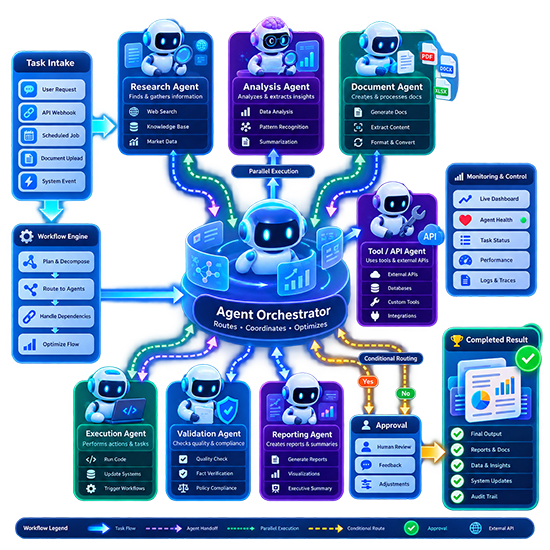
Multi-Agent Systems & Workflow Orchestration

For example, one agent may perform research, another may analyze information, another may generate documents, and another may validate the output before an approved action is performed.
Thought Media™ can develop agentic workflows using:
- Single-agent orchestration
- Multi-agent systems
- Sequential workflows
- Parallel task execution
- Agent-to-agent handoffs
- Tool and API orchestration
- Conditional workflow logic
- Human approval checkpoints
- Automated monitoring and reporting
Our Custom Enterprise AI Agents can integrate these capabilities with CRM, ERP, databases, cloud platforms, document systems, internal applications, and other business technologies.
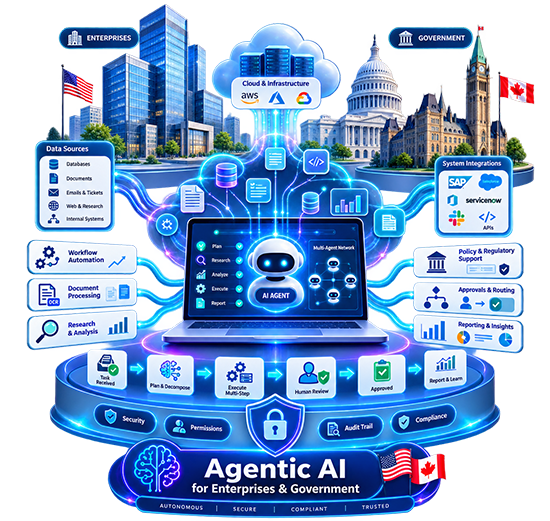
Agentic AI for Enterprises & Government

Potential applications include:
- Research and intelligence workflows
- Document processing and analysis
- Procurement and vendor evaluation
- Customer and employee service automation
- Reporting and business intelligence
- IT and operational workflows
- Compliance and policy support
- Case and request processing
- Knowledge management
- Administrative automation
Public-sector organizations can also explore our AI Agents for Public Sector services for agent workflows designed around government systems, public information, administrative processes, and responsible AI requirements.
Guardrails, Monitoring & Human Oversight
Greater autonomy requires stronger controls. Agentic systems should be designed with clear boundaries defining what agents can access, what tools they can use, what actions they can perform, and when human approval is required.
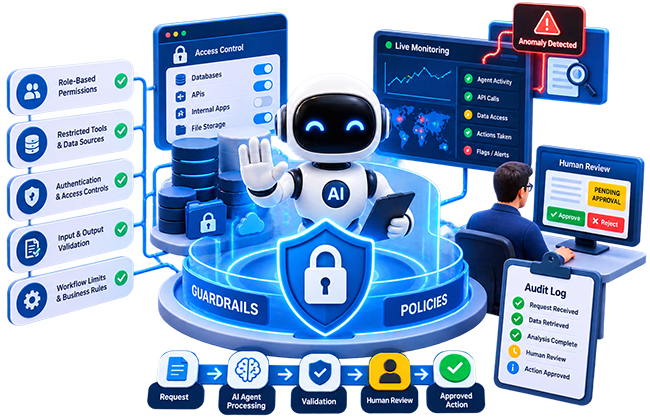
- Role-based permissions
- Restricted tools and data sources
- Authentication and access controls
- Input and output validation
- Human-in-the-loop approvals
- Workflow limits and business rules
- Audit logging
- Agent activity monitoring
- Testing and evaluations
- Error handling and escalation
OpenAI’s current guidance similarly emphasizes guardrails, human supervision, restricted data sources, approval requirements, and auditability when agents are allowed to take real-world actions.
Developing Production-Ready Agentic AI
Agentic AI development should begin with a clearly defined workflow rather than maximum autonomy.
Thought Media™ works with organizations to identify suitable processes, map required systems and data, determine the appropriate level of autonomy, develop tools and integrations, establish permissions, test agent behavior, and monitor performance after deployment.
Our broader Artificial Intelligence solutions and software development services allow agentic AI to be integrated into websites, applications, internal platforms, cloud infrastructure, and wider digital transformation initiatives.
Organizations interested in the technical architecture behind agentic systems can also review Anthropic’s guidance on building effective AI agents.
Revenue Growth
Generated over $50 million in additional revenue for our clients
Client Satisfaction
98% client satisfaction rate across all development projects.
Projects Executed
Successfully executed 1,000+ development and marketing projects.
frequently asked questionsAgentic Development
Agentic AI refers to AI systems designed to pursue defined objectives through multiple steps. These systems can reason through tasks, use connected tools, retrieve information, make workflow decisions, and perform permitted actions.
A standard AI assistant typically responds to individual requests. An agentic AI system can coordinate multiple steps, use tools and systems, maintain workflow state, and continue working toward an objective with a defined level of autonomy.
A multi-agent system uses multiple specialized AI agents that can collaborate or hand work between one another. Each agent may perform a different role such as research, analysis, validation, document generation, or workflow execution.
Yes, particularly when agents interact with sensitive data or perform higher-impact actions. Appropriate oversight can include restricted permissions, approval checkpoints, monitoring, validation, audit logs, and human review before specific actions are executed.
Let’s Build the Future of Enterprise
At Thought Media™, we collaborate with businesses and government organizations worldwide to create impactful digital strategies and brand experiences. If you’re ready to elevate your enterprise, let’s connect.


