

RFP writing services and templates are critical when an enterprise director or manager, government technology leader, procurement manager, department head, or project sponsor is told:
“We need to issue an RFP.”
the assignment can sound deceptively simple.
Define what you need.
Write the requirements.
Invite qualified vendors.
Compare proposals.
Choose the strongest provider.
In practice, the quality of the Request for Proposal can influence nearly every outcome that follows.
A poorly structured RFP can attract the wrong vendors, create incomparable proposals, obscure project risks, underestimate implementation costs, generate expensive change orders, create procurement delays, weaken security requirements, or leave the organization locked into technology it never intended to purchase.
A well-designed RFP does the opposite.
It turns organizational needs into a procurement framework vendors can understand, price, respond to, and ultimately deliver against.
That is why organizations increasingly look for:
- RFP writing services
- request for proposal writing
- procurement consulting
- strategic sourcing consulting
- RFP consultants
- technical writers
- scope of work development
- requirements gathering services
- solicitation drafting
- RFP management and advisory services
- procurement specialists
- contracting consultants
- RFP authors
- RFP architects
- project definition and sourcing advisors
The terminology varies.
The underlying need is usually the same:
We know what outcome we need, but we need help turning that outcome into a procurement document capable of producing strong, comparable, defensible proposals.
This guide explains how to do that.
It also provides access to six professional RFP templates plus six AI-ready versions covering web development, digital marketing, AI development, application development, graphic design, and managed hosting/cloud solutions.
What Are RFP Writing Services?
RFP writing services help organizations define requirements, structure a procurement, develop a Scope of Work, establish bidder instructions, create evaluation criteria, document technical requirements, and prepare a Request for Proposal that qualified vendors can respond to consistently.
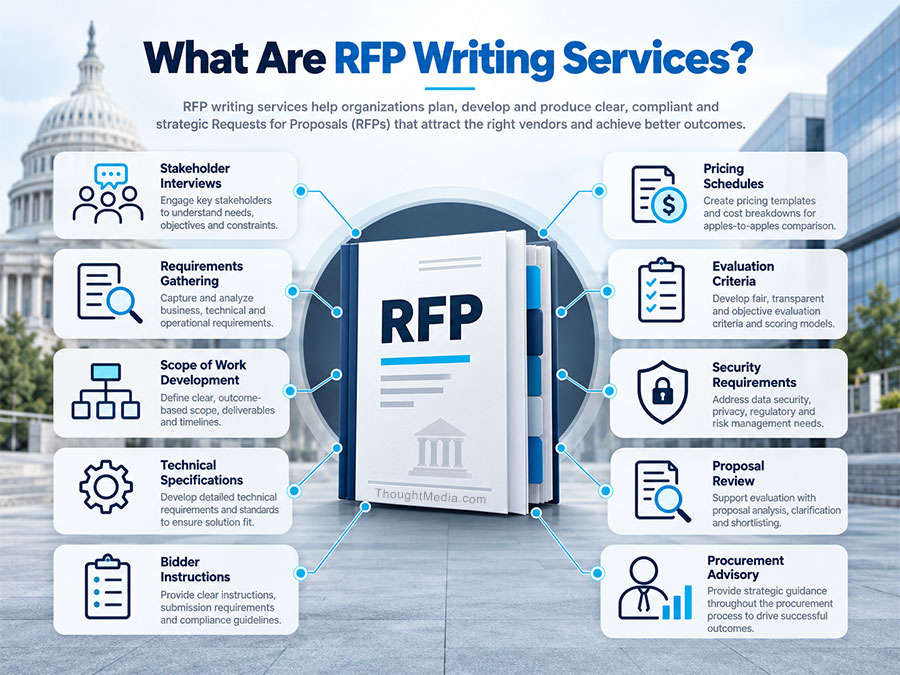
Depending on the engagement, an RFP consultant may assist with:
- Discovery workshops
- stakeholder interviews
- requirements gathering
- project definition
- Scope of Work development
- technical specifications
- functional requirements
- security requirements
- accessibility requirements
- bidder qualification standards
- proposal instructions
- pricing schedules
- evaluation methodology
- scoring matrices
- implementation requirements
- service levels
- warranties
- insurance requirements
- data ownership
- intellectual property
- contract assumptions
- vendor questions
- addenda
- proposal evaluation support
The strongest RFP writing services combine procurement discipline with subject-matter expertise.
Someone can be an excellent writer without understanding enterprise application architecture.
Someone can understand software engineering without knowing how to construct an objective procurement.
Complex technology procurements usually need both.
Why Is RFP Writing So Important?
A Request for Proposal becomes the common reference point connecting:
the organization
the procurement team
internal stakeholders
vendors
evaluators
and eventually:
the selected contractor.
If the RFP is unclear, every downstream participant begins interpreting the project differently.
That creates risk.
Consider a simple requirement:
“The vendor will build a modern enterprise website.”
What does modern mean?
Does the organization require:
- WordPress?
- React?
- Drupal?
- a headless CMS?
- cloud hosting?
- SSO?
- accessibility?
- CRM integration?
- multilingual content?
- API access?
- analytics?
- cybersecurity testing?
- content migration?
- SEO migration?
- disaster recovery?
- ongoing support?
If those expectations are not defined, each bidder can price a fundamentally different project.
The organization may believe it is comparing five proposals for the same requirement.
It may actually be comparing five different solutions.
What Can a Bad RFP Cost an Organization?
The financial cost of a weak RFP frequently appears after award, when changing course becomes expensive.
Scope Creep
If requirements are ambiguous, assumptions become change requests.
A $250,000 implementation can become significantly more expensive when essential functionality was never documented.
Incomparable Proposals
One vendor may include migration, testing, training, and support.
Another may quote only development.
The lower price appears attractive because the scope is incomplete.
Procurement Delays
Ambiguous requirements generate:
- bidder questions
- addenda
- extensions
- internal disagreements
- procurement restarts
A project that was supposed to begin in Q1 can move into Q2 or Q3.
Vendor Disputes
If the contract references an unclear Scope of Work, both parties may reasonably interpret obligations differently.
Failed Implementations
The worst outcome is not paying more.
It is spending the budget and still failing to achieve the operational objective.
Technology Lock-In
If ownership, portability, source code, APIs, hosting, data export, and licensing are not addressed, the organization can become unnecessarily dependent on the selected supplier.
Security Exposure
Cybersecurity cannot be an assumption.
Requirements around authentication, encryption, logging, vulnerability management, patching, incident response, data handling, access controls, and hosting should be intentionally evaluated.
Accessibility Risk
Public-facing platforms may have specific accessibility requirements that need to be incorporated into procurement, design, development, testing, and acceptance.
What Should a Professional RFP Include?
There is no single universal structure for every solicitation.
However, strong enterprise and public-sector RFPs generally address the following areas.
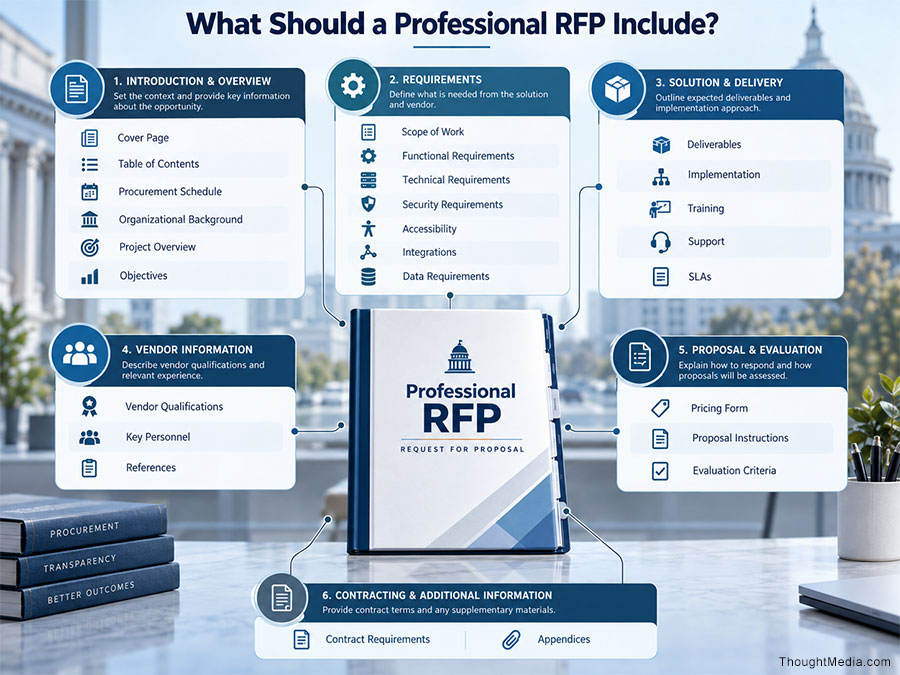
| RFP Section | Purpose |
|---|---|
| Cover Page | Identifies the solicitation and issuing organization |
| Table of Contents | Makes a large procurement easy to navigate |
| Procurement Schedule | Defines questions, submission, evaluation and award dates |
| Organizational Background | Gives bidders the context needed to understand the project |
| Project Overview | Defines the problem and desired outcome |
| Objectives | Explains what success should accomplish |
| Scope of Work | Defines the work the vendor is expected to perform |
| Functional Requirements | Defines what the solution must do |
| Technical Requirements | Defines architecture, infrastructure and technology expectations |
| Security Requirements | Establishes required cybersecurity controls |
| Accessibility | Defines applicable accessibility expectations |
| Integrations | Identifies systems the solution must connect with |
| Data Requirements | Addresses migration, ownership, storage and portability |
| Deliverables | Defines tangible outputs |
| Implementation | Defines planning, deployment and transition expectations |
| Training | Defines knowledge-transfer responsibilities |
| Support | Defines post-launch service expectations |
| SLAs | Defines measurable service commitments |
| Vendor Qualifications | Establishes bidder eligibility and experience |
| Key Personnel | Defines required expertise |
| References | Supports validation of prior performance |
| Pricing Form | Creates a comparable financial response |
| Proposal Instructions | Defines exactly how vendors must respond |
| Evaluation Criteria | Explains how proposals will be scored |
| Contract Requirements | Establishes insurance, warranties, IP and other terms |
| Appendices | Holds forms, diagrams, data and supporting documentation |
For federal negotiated acquisitions, FAR 15.203 provides a useful benchmark: competitive RFPs should communicate the requirement, anticipated terms, information required from offerors, and the evaluation factors and their relative importance.
What Is the Difference Between an RFP and a Scope of Work?
A Scope of Work, or SOW, defines the work.
An RFP defines the procurement.
A Scope of Work may specify:
- project responsibilities
- deliverables
- technical requirements
- implementation
- milestones
- acceptance criteria
The RFP surrounds that scope with the information needed to run a competitive process.
For example:
SOW:
Build and implement a new enterprise web platform.
RFP:
Explains what must be built, who may bid, how proposals should be structured, pricing requirements, evaluation criteria, schedule, insurance, contractual requirements, submission procedures, and how the selected vendor will be chosen.
The SOW is therefore often one of the most important components inside the RFP.
What Is Requirements Gathering?
Requirements gathering is the process of identifying what stakeholders, users, systems, and the organization actually need before the procurement document is finalized.
This may involve interviews with:
- executive sponsors
- IT
- procurement
- marketing
- communications
- cybersecurity
- legal
- operations
- finance
- end users
- accessibility stakeholders
A website project, for example, may look like a marketing initiative until discovery reveals dependencies involving:
IT + security + identity + CRM + analytics + accessibility + content + hosting.
Missing one stakeholder during discovery can mean missing entire categories of requirements.
The Most Important Rule: Define Outcomes Before Technology
One of the easiest ways to weaken an RFP is to specify technology before defining the problem.
For example:
“The organization requires a React website.”
Why?
Perhaps React is appropriate.
Perhaps it is not.
A stronger procurement begins with the desired outcome:
“The organization requires a scalable public-facing platform capable of supporting authenticated users, multilingual content, API integrations, high traffic, accessible interfaces, and future digital-service expansion.”
Vendors can then explain the architecture they recommend.
There are exceptions.
If an enterprise already standardizes on Microsoft Azure and .NET, requiring compatibility may be perfectly reasonable.
The principle is:
Specify technology when the requirement justifies it—not because somebody heard the framework name in a meeting.
How Detailed Should an RFP Be?
An RFP should contain enough detail for qualified bidders to understand and price the requirement without unnecessarily prescribing the solution.
Too little detail creates uncertainty.
Too much unnecessary prescription can prevent vendors from proposing better approaches.
The strongest RFPs distinguish between:
Mandatory Requirements
The vendor or solution must satisfy these.
Preferred Requirements
Desirable, but not necessarily disqualifying.
Functional Requirements
What the system must do.
Non-Functional Requirements
How it must perform.
Examples include:
- availability
- security
- accessibility
- scalability
- response time
- maintainability
Vendor-Recommended Approach
Areas where the organization wants bidders to propose methodology.
This creates a procurement that is structured but not artificially restrictive.
RFP Do’s and Don’ts
| Do | Don’t |
|---|---|
| Define the business problem | Start with a preferred vendor’s solution |
| Gather requirements from stakeholders | Let one department write the entire RFP in isolation |
| Identify mandatory requirements | Make every feature mandatory |
| Define measurable deliverables | Use vague phrases such as “best in class” without definition |
| Use a consistent pricing schedule | Let every bidder invent its own pricing format |
| Publish evaluation criteria | Hide how proposals will be scored |
| Define ownership and IP | Assume ownership automatically transfers |
| Address security early | Add cybersecurity after vendor selection |
| Define data portability | Allow unnecessary vendor lock-in |
| Preserve room for innovation | Over-prescribe every technical decision |
| Allow reasonable bidder questions | Treat clarifying questions as a nuisance |
| Establish acceptance criteria | Pay solely based on subjective completion |
| Evaluate total value | Select automatically on lowest price |
What Should the Evaluation Criteria Look Like?
The evaluation model should be determined before proposals arrive.
Otherwise evaluators may unconsciously change priorities after seeing particular vendors.
A technology RFP might use a 100-point model such as:
| Evaluation Category | Points |
|---|---|
| Understanding of Requirements | 10 |
| Technical Approach | 20 |
| Project Methodology | 10 |
| Relevant Experience | 10 |
| Proposed Team | 10 |
| Security / Risk Approach | 10 |
| Implementation & Support | 10 |
| Pricing / Total Cost | 15 |
| Value-Added Capabilities | 5 |
| Total | 100 |
Those weights should change depending on the procurement.
A graphic-design engagement might place greater emphasis on portfolio and creative approach.
Managed hosting may place greater emphasis on:
- security
- availability
- disaster recovery
- support
- SLAs
AI development may place greater emphasis on:
- data
- governance
- model evaluation
- security
- human oversight
- integration
- observability
The evaluation methodology must reflect what could actually cause the project to succeed or fail.
Lowest Price Is Not Always Best Value
One of the most expensive procurement mistakes is treating price as the only meaningful differentiator.
Suppose three proposals arrive:
| Vendor | Price |
|---|---|
| Vendor A | $280,000 |
| Vendor B | $410,000 |
| Vendor C | $525,000 |
Vendor A looks inexpensive.
But perhaps Vendor A excluded:
- content migration
- penetration testing
- accessibility remediation
- analytics implementation
- training
- post-launch support
Vendor B included all of them.
The meaningful comparison is therefore not:
$280K vs $410K.
It is:
What does each price actually purchase?
That is why standardized pricing schedules create enormous value.
What Should a Pricing Schedule Include?
Depending on the project, request separate pricing for:
- Discovery
- Strategy
- Design
- Development
- Integration
- Data migration
- Content migration
- Testing
- Accessibility
- Security
- Deployment
- Training
- Documentation
- Hosting
- Licensing
- Support
- Maintenance
- Optional services
- Hourly rates
- Travel
- Third-party costs
This helps evaluators identify both the initial investment and ongoing cost of ownership.
Should an RFP Include a Budget?
Sometimes.
Publishing a budget can help bidders propose a realistic solution.
It can also reduce proposals that are fundamentally outside the organization’s financial range.
For example:
“The organization anticipates an implementation budget of $500,000–$750,000.”
Vendors then compete on what can be delivered within that range.
Alternatively, organizations may avoid publishing the budget when they need the market to inform expected pricing.
The right choice depends on the procurement strategy.
What Are Mandatory Bidder Qualifications?
Mandatory qualifications can protect the organization from unqualified proposals.
But they should be used carefully.
Examples may include:
- minimum years of relevant experience
- required licenses
- required insurance
- specific certifications
- public-sector experience
- security clearances
- accessibility expertise
- relevant technology experience
Do not impose arbitrary requirements solely because they appear in another RFP.
Every mandatory condition reduces the bidder pool.
There should be a reason for each one.
What Insurance Requirements Should an RFP Consider?
Requirements vary by engagement and organization.
Common categories can include:
- Commercial General Liability
- Professional Liability / Errors & Omissions
- Cyber Liability
- Workers’ Compensation
- Automobile Liability where applicable
Coverage amounts should reflect the project’s risk.
A $25,000 design engagement does not necessarily require the same insurance as a multimillion-dollar cloud platform handling sensitive information.
Insurance requirements should be reviewed with the organization’s procurement, risk, and legal teams.
What Should an RFP Say About Intellectual Property?
Technology RFPs should explicitly address ownership.
Questions include:
- Who owns the final code?
- Who owns custom design assets?
- Who owns documentation?
- Who owns data?
- Can the vendor reuse custom components?
- Are third-party libraries included?
- What licenses apply?
- Can another vendor maintain the system later?
Without clear terms, an organization can pay for a platform it cannot easily transfer.
What Should an RFP Say About Data?
Data provisions should address:
Ownership
Who owns the organization’s information?
Access
Who can access it?
Location
Where will it be stored or processed?
Export
Can the organization obtain a complete usable copy?
Deletion
What happens when the contract ends?
Security
How is it protected?
Backups
How is it recovered?
Subprocessors
Which third parties may handle the data?
Data portability becomes especially important when avoiding vendor lock-in.
Cybersecurity Belongs Inside the RFP
Security should not be reduced to one sentence:
“The solution must be secure.”
That statement is practically meaningless.
A technology RFP may need to address:
- authentication
- MFA
- SSO
- encryption
- secrets management
- access controls
- secure development practices
- vulnerability scanning
- penetration testing
- logging
- monitoring
- patch management
- incident response
- breach notification
- backup security
- disaster recovery
- data retention
- third-party dependencies
The appropriate requirements depend on the risk profile.
AI Development RFPs Require Additional Governance
Artificial intelligence procurement introduces requirements conventional software RFPs may not address.
An AI RFP may need to define:
- permitted data
- training data restrictions
- model selection
- third-party model providers
- prompt/data retention
- model evaluation
- hallucination testing
- human review
- audit logs
- permissions
- AI-agent actions
- output monitoring
- security
- fallback behavior
- model replacement
- bias testing where appropriate
- performance benchmarks
Thought Media™ provides AI agent development for enterprises and public-sector organizations, giving our RFP advisory work practical grounding in how modern AI systems are actually designed and integrated.
Web Development RFPs Need More Than Design Requirements
A strong website-development procurement should consider:
- UX/UI
- CMS
- architecture
- mobile responsiveness
- accessibility
- SEO
- AEO
- performance
- content migration
- integrations
- analytics
- security
- hosting
- maintenance
Thought Media™ provides enterprise website development across modern technology stacks, giving our team practical insight into which requirements materially affect development scope and cost.
Application Development RFPs Need Architecture Detail
Application procurements may require:
- user roles
- authentication
- APIs
- workflows
- mobile requirements
- databases
- integrations
- offline functionality
- push notifications
- analytics
- testing
- deployment
- DevOps
- cloud environments
Our enterprise application development work involves these same considerations from the delivery side.
That experience matters when defining a procurement because requirements that appear small in a document can create substantial engineering implications.
Digital Marketing RFPs Should Define Outcomes, Not Activity
A weak marketing RFP may request:
“Social media, SEO and paid advertising.”
That is not enough.
A stronger RFP addresses:
- target audiences
- geography
- media budget
- Google Ads
- social advertising
- TikTok
- YouTube
- UGC
- organic social
- content
- SEO
- AEO
- landing pages
- conversion tracking
- attribution
- analytics
- reporting
- CRM integration
Thought Media™ provides integrated digital marketing services, so we understand how channel requirements influence staffing, creative volume, media strategy, analytics, and pricing.
Graphic Design RFPs Need Production Specifications
Graphic-design procurements should define more than “creative design.”
Consider:
- brand guidelines
- required asset types
- print vs digital
- accessibility
- revisions
- source files
- file formats
- licensing
- stock photography
- production requirements
- usage rights
- templates
- delivery schedule
Our graphic design services span digital and physical creative production, helping translate creative expectations into bidder-ready requirements.
Managed Hosting RFPs Should Focus on Risk
Managed hosting procurement should define measurable requirements around:
- uptime
- infrastructure
- cloud platform
- backups
- recovery
- monitoring
- patching
- cybersecurity
- performance
- technical support
- escalation
- data location
- capacity
- logging
- SLA response
Thought Media™ provides managed cloud services across major cloud environments, giving our RFP support work a practical understanding of infrastructure operations rather than treating hosting as a generic line item.
Six Free Professional RFP Templates
To help organizations begin the procurement process, Thought Media™ is making six professional RFP frameworks available at no cost.
Each template is designed as a starting point that can be customized around your organization’s actual needs.
1. Web Development RFP Template
Designed for:
- corporate websites
- enterprise websites
- government platforms
- public portals
- ecommerce
- website modernization
Includes sections covering architecture, CMS, UX/UI, accessibility, SEO, AEO, migration, integrations, security, analytics, hosting, support, and evaluation.
Download Web Development RFP Template (FREE)
2. Digital Marketing RFP Template
Designed for integrated campaigns involving:
- Google Ads
- paid media
- TikTok
- YouTube
- UGC
- content
- SEO
- AEO
- analytics
Includes campaign scope, media budget, creative, attribution, reporting, KPIs, channel responsibilities, and pricing schedules.
Download Digital Marketing RFP Template (FREE)
3. AI Development & Adoption RFP Template
Designed for:
- custom AI
- AI agents
- generative AI
- workflow automation
- enterprise AI adoption
- public-sector AI initiatives
Includes AI governance, security, data, model evaluation, integrations, human oversight, monitoring, testing, implementation, and support.
Download AI Development RFP Template (FREE)
4. Application Development RFP Template
Designed for:
- enterprise applications
- web applications
- mobile applications
- portals
- workflow systems
- internal business applications
Includes architecture, APIs, authentication, UX/UI, databases, integration, security, testing, DevOps, deployment, and maintenance.
Download Application Development RFP Template (FREE)
5. Graphic Design RFP Template
Designed for:
- branding
- campaigns
- digital design
- reports
- presentations
- corporate communications
Includes creative requirements, deliverables, revision processes, file formats, usage rights, production standards, and portfolio evaluation.

Download Graphic Design RFP Template (FREE)
6. Managed Hosting & Cloud RFP Template
Designed for:
- managed hosting
- AWS
- Azure
- Google Cloud
- enterprise infrastructure
- government workloads
Includes SLA requirements, uptime, backup, disaster recovery, security, monitoring, patching, support, data handling, and migration.
Download Managed Hosting RFP Template (FREE)
Six Additional AI-Ready RFP Templates
Each of the six templates is also available in an AI-ready version.
These versions contain embedded prompt instructions designed to help tools such as ChatGPT, Microsoft Copilot, Gemini, Claude, Perplexity, or an internal enterprise AI assistant customize the document.
Instead of showing:
[Insert project objectives]
the AI-ready version may contain an instruction such as:
AI INSTRUCTION: Review the organization background, stakeholder requirements and stated business problem. Draft 3–5 measurable project objectives. If insufficient information is available, ask the user targeted questions before completing this section. Do not invent organizational requirements.
Similar AI instructions can help:
- identify missing information
- expand requirements
- develop deliverables
- create scoring matrices
- structure pricing forms
- identify risks
- recommend mandatory vs preferred requirements
- develop security requirements
- draft implementation expectations
- create acceptance criteria
The objective is not to let AI invent an RFP.
It is to give the AI a professional structure within which to assist.
Access the Free RFP Template Library
Organizations can access all six standard RFP templates and their six AI-ready counterparts through the template-download form on this page.
12 professional RFP templates are included.
Complete the form with:
- Name
- Organization
- Business email
- Phone number
After submission, select the RFP template appropriate for your procurement.
These resources are intended to provide a strong professional starting point whether your team plans to:
edit the RFP internally
or:
use an AI assistant to customize it.
Why Use a Professional Template Instead of Starting From Scratch?
A professional framework eliminates the blank page.
More importantly, it reminds the procurement team to consider areas they may not yet know to ask about.
A director initiating their first AI procurement may not immediately think about:
model retention policies
or:
AI-agent action permissions.
A marketing manager procuring a website may not know to define:
301 redirect requirements.
A procurement analyst sourcing managed hosting may not know which:
recovery objectives
should be requested.
Templates bring those questions forward before a contract is awarded.
That is where much of their value comes from.
Why Work With an RFP Consultant?
Templates are valuable when an organization already understands most of its requirements.
A consultant becomes more valuable when the challenge is:
We do not yet know exactly what the RFP should require.
That is fundamentally different.
RFP consulting can help organizations:
- discover requirements
- interview stakeholders
- identify technical dependencies
- define the future state
- structure the Scope of Work
- identify procurement risks
- develop scoring
- build pricing forms
- define bidder qualifications
The consultant is helping architect the procurement itself.
Why Industry Experience Matters More Than Writing Ability
Technology procurement can be difficult because the RFP writer is defining work that another organization will eventually perform.
If the person drafting the requirements has never implemented that type of project, critical details can be missed.
A web-development procurement consultant should understand what happens when:
- content has to migrate
- URLs change
- authentication is integrated
- an API fails
- accessibility testing happens
- infrastructure scales
An AI RFP consultant should understand:
- models
- APIs
- agents
- data
- evaluation
- monitoring
- security
A hosting consultant should understand:
- infrastructure
- uptime
- backup
- recovery
- cloud architecture
That is why practical industry experience is so valuable.
Thought Media™ Brings Experience From Both Sides of the RFP
Thought Media™ has operated since 2009, through multiple generations of web development, applications, digital marketing, managed hosting, cloud infrastructure, cybersecurity, and artificial intelligence.
That gives our RFP support services an important perspective.
We have experience with:
preparing procurement requirements
and:
responding to RFPs and submitting proposals
as well as:
actually delivering the technology and services organizations procure.
Those experiences inform each other.
When you have built enterprise platforms, you understand which requirements affect architecture.
When you have managed hosting infrastructure, you understand which SLA questions matter.
When you have executed digital marketing campaigns, you understand what information an agency needs before it can responsibly price a campaign.
When you have responded to RFPs, you understand which procurement instructions create confusion for bidders.
That perspective is difficult to replicate with a generic writing service.
Generic Procurement Consultant vs Industry RFP Specialist
| Generic Procurement Support | Technology-Specialized RFP Support |
|---|---|
| Strong procurement process | Procurement + technical implementation understanding |
| Generalized templates | Service-specific requirements |
| Contract structure | Architecture implications |
| Vendor management | Vendor + delivery perspective |
| Administrative focus | Technical, operational and financial focus |
| Broad sourcing experience | Direct implementation experience |
The best outcome frequently combines procurement expertise with subject-matter expertise.
Why Not Just Write the RFP Internally?
Internal teams absolutely can prepare successful RFPs.
They often understand the organization better than anyone else.
The risk appears when the assigned person has never procured that particular technology.
An internal employee might be an outstanding director of communications.
That does not mean they should automatically know how to define:
- cloud disaster recovery
- API architecture
- authentication
- accessibility testing
- penetration testing
A specialist can supplement internal expertise rather than replace it.
Can AI Write an RFP?
Yes—but it needs structure.
AI is extremely useful for:
- organizing information
- drafting requirements
- rewriting sections
- identifying omissions
- developing questions
- creating tables
- creating preliminary scoring criteria
The danger is asking:
“Write me an RFP for a new website.”
An AI can generate something that looks highly professional while inventing requirements or omitting critical ones.
The better approach is:
professional RFP framework + organizational information + AI assistance + human review.
That is exactly why we provide separate AI-ready templates.
RFP Template vs Bespoke RFP Writing Services
A template may be appropriate when:
✅ The organization already understands the project.
✅ Requirements are relatively straightforward.
✅ Internal procurement expertise exists.
✅ The team has subject-matter expertise.
Bespoke RFP writing services become more valuable when:
✅ The project is high-value.
✅ Requirements are complex.
✅ Multiple departments are involved.
✅ Technical architecture is uncertain.
✅ The procurement is strategically important.
✅ Failure would create material financial or operational risk.
There is nothing wrong with using a template.
The question is whether the organization understands enough about the project to customize the template correctly.
What Does Bespoke RFP Support From Thought Media™ Include?
Depending on the procurement, Thought Media™ can assist with:
- Initial project definition
- stakeholder discovery
- requirements gathering
- technical requirements
- Scope of Work development
- RFP architecture
- bidder instructions
- deliverables
- mandatory requirements
- evaluation methodology
- scoring frameworks
- pricing forms
- technology considerations
- security requirements
- accessibility
- hosting and cloud requirements
- implementation requirements
- proposal-response structure
Engagements can range from reviewing an internally drafted procurement to developing a requirements-specific RFP from the ground up.
Who Should Consider RFP Writing Services?
Professional support may be particularly valuable for:
- Federal agencies
- state governments
- local governments
- special districts
- public authorities
- universities
- healthcare organizations
- utilities
- large enterprises
- associations
- nonprofits
- institutions
Thought Media™ already supports enterprise and federal government digital transformation requirements spanning web platforms, AI, marketing, and digital solutions.
What Should You Prepare Before Meeting an RFP Consultant?
Do not worry if the project is not fully defined.
That may be why you need assistance.
But gather what exists.
Useful starting material includes:
- Current website or system
- Business objectives
- Existing technical documentation
- Known stakeholders
- Budget information
- Required launch date
- Current contracts
- known integrations
- organizational policies
- security requirements
The consultant can help identify what is missing.
Final RFP Checklist
Before publishing a technology RFP, confirm:
Project
- Is the problem clearly explained?
- Are objectives measurable?
- Is the Scope of Work understandable?
Requirements
- Are mandatory requirements actually mandatory?
- Are technical requirements justified?
- Are integrations documented?
Risk
- Are security requirements defined?
- Is insurance addressed?
- Are data and privacy requirements clear?
- Is accessibility included?
Vendor
- Are required qualifications reasonable?
- Are reference requirements included?
- Are key personnel requirements defined?
Pricing
- Can proposals be compared?
- Are recurring costs separated?
- Are optional costs identified?
Evaluation
- Are evaluation criteria published?
- Are points or weights defined?
- Does the scoring reflect actual project risk?
Contract
- Is ownership clear?
- Are warranties addressed?
- Are support obligations defined?
- Are acceptance criteria measurable?
Procurement Process
- Are submission instructions clear?
- Is there a questions period?
- Are deadlines realistic?
- Is the evaluation process defensible?
If the answer to several of these is no, the procurement document probably needs more work before release.
Final Thoughts on RFP Writing Services
A Request for Proposal should not simply describe something the organization wants to buy.
It should create a structured path from:
organizational need
to:
competitive procurement
to:
successful implementation.
The quality of the RFP influences:
- who bids
- how they price
- what they propose
- how they are evaluated
- what gets contracted
- what ultimately gets delivered
For lower-risk procurements, a high-quality template may be exactly what the organization needs.
For complex enterprise and public-sector projects, professional request for proposal writing, requirements gathering, Scope of Work development, procurement consulting, and technical RFP advisory can reduce risk before expensive mistakes become embedded in the contract.
Thought Media™ provides both pathways.
Organizations can start with our 12 free professional RFP templates.
Or, when the procurement requires deeper strategic, technical, and implementation expertise, Thought Media™ can help build the RFP around the organization’s actual objectives.
The goal is not simply to publish an RFP.
The goal is to create a procurement process capable of producing the right project outcome.
Frequently Asked Questions
What are RFP writing services?
RFP writing services help organizations develop professional Requests for Proposal by defining requirements, creating the Scope of Work, organizing bidder instructions, establishing technical and contractual requirements, structuring pricing, and developing evaluation criteria. Specialized consultants may also provide requirements gathering, procurement advisory, and vendor-evaluation support.
How much does it cost to hire an RFP consultant?
RFP consulting costs vary based on complexity, procurement value, stakeholder involvement, technical requirements, and the amount of discovery required. A limited review or template customization may cost several thousand dollars, while complex enterprise or public-sector RFP development involving extensive requirements gathering and technical consulting can cost substantially more.
Can AI write a Request for Proposal?
AI can assist with drafting an RFP, organizing requirements, creating tables, identifying omissions, and developing preliminary scoring criteria. However, AI should work from a structured professional template and verified organizational information. Final requirements should be reviewed by appropriate procurement, technical, legal, security, and operational stakeholders.
What is the difference between an RFP consultant and a procurement consultant?
An RFP consultant typically focuses on defining requirements and preparing the solicitation itself. Procurement consultants may provide broader sourcing strategy, market analysis, vendor management, negotiations, and procurement-process support. Some providers offer both capabilities.
What should be included in a technology RFP?
A technology RFP should generally include organizational background, project objectives, Scope of Work, functional and technical requirements, security, accessibility, integrations, data requirements, deliverables, implementation, bidder qualifications, pricing, evaluation criteria, intellectual property, insurance, warranties, support, service levels, and proposal instructions.